
Many fitness enthusiasts believe they need to constantly switch exercises to build muscle. That’s a myth. Consistent overload on the same exercise with gradual increments produces steady muscle growth. Progressive overload is the scientifically proven principle that drives strength and size gains. This guide will show you exactly how to apply progressive overload to break plateaus and maximize your results in 2026.
Table of Contents
- What Is Progressive Overload? Definition And Core Concept
- How Progressive Overload Stimulates Muscle Adaptation
- Methods Of Applying Progressive Overload In Training
- Common Misconceptions And Clarifications About Progressive Overload
- Safe Implementation And Injury Prevention With Progressive Overload
- Putting Progressive Overload Into Practice: Strategies And Tips
- Explore Quality Equipment To Support Your Progressive Overload Journey
Key takeaways
| Point | Details |
|---|---|
| Progressive overload means gradually increasing training demands to drive adaptation | Muscle growth occurs through consistent, incremental increases, not frequent exercise changes |
| Multiple variables can be adjusted for overload | Weight, reps, tempo, and rest periods all create progressive stimulus |
| Safe progression involves manageable increases | Generally around 5 to 10 percent to avoid injury |
| Tracking progress and recovery is essential | Monitoring data helps identify plateaus and ensures sustained gains |
What is progressive overload? Definition and core concept
Progressive overload is the gradual, systematic increase in training stimulus that forces your body to adapt. Think of it as a staircase where each step represents a small but measurable increase in demand.
The increments can be tiny yet powerful. Adding five pounds to your bench press, squeezing out one extra rep, or reducing rest time by 10 seconds all count as progressive overload. These small changes accumulate into significant gains over weeks and months.
This principle applies universally across training goals:
- Strength training: Lifting heavier weights with proper form
- Hypertrophy: Increasing volume through reps, sets, or weight for muscle size
- Endurance: Extending workout duration or reducing rest intervals
Progressive overload serves as the foundation for breaking through plateaus. Without it, your body has no reason to grow stronger or bigger. Your muscles adapt to whatever stress you place on them, then stop adapting once they can handle that stress comfortably.
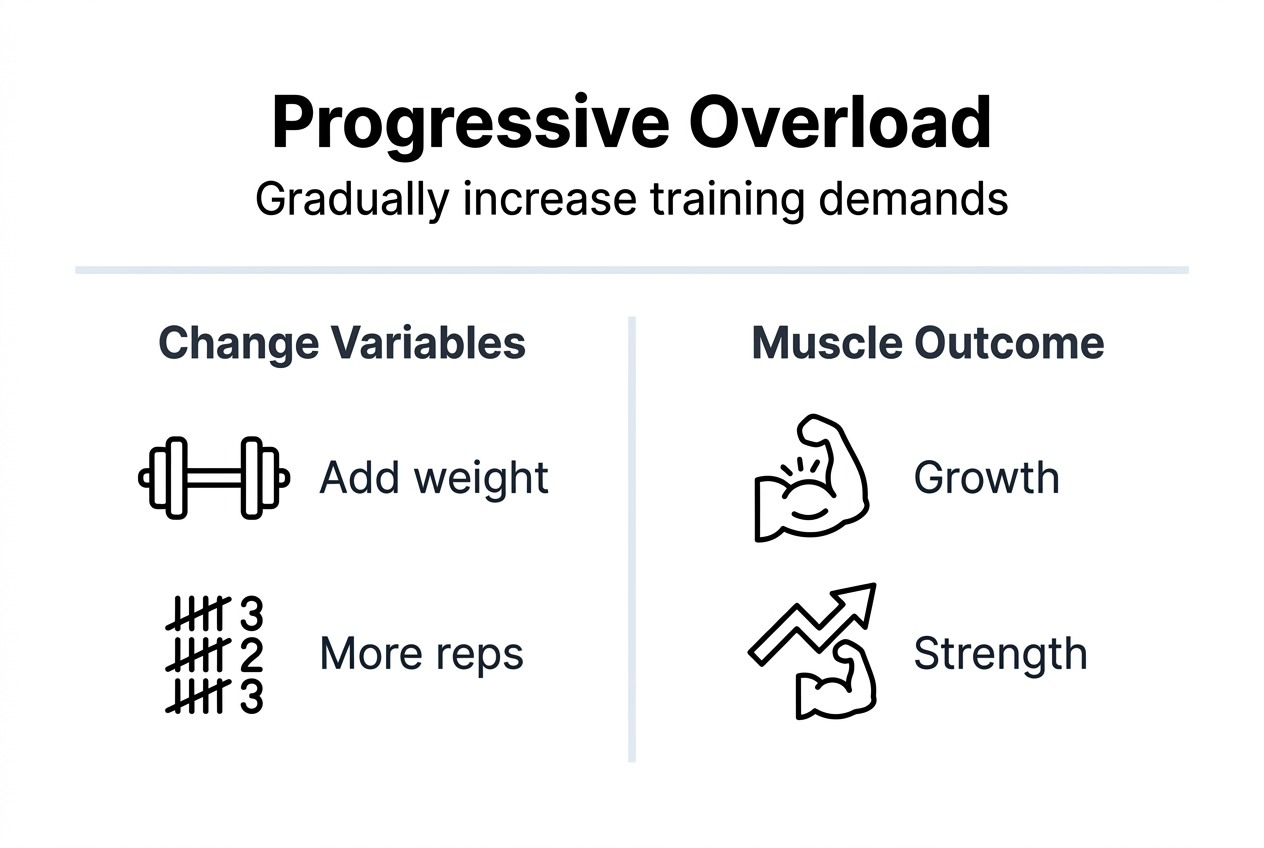
The key is making changes measurable and trackable. Vague goals like “train harder” don’t work. Concrete targets like “add 2.5 pounds next week” give you a clear path forward. This systematic approach transforms random workouts into a strategic progression that delivers consistent results.
How progressive overload stimulates muscle adaptation
When you stress your muscles beyond their current capacity, they respond at a cellular level. The process begins with microscopic tears in muscle fibers during training. Your body repairs these tears during recovery, building the fibers back stronger and thicker than before.
This repair process is why muscles adapt by repairing microscopic tears stronger. The neuromuscular system also becomes more efficient at recruiting muscle fibers. Over time, you can lift heavier weights not just because muscles are bigger, but because your nervous system learns to activate more muscle fibers simultaneously.
Connective tissues adapt alongside muscles. Tendons and ligaments strengthen to support increased loads, reducing injury risk as you progress. Bone density improves too, making your skeleton more resilient under heavy loading.
Key adaptation mechanisms include:
- Muscle protein synthesis: Increased production of contractile proteins that make muscles larger
- Motor unit recruitment: Better nerve signaling activates dormant muscle fibers
- Metabolic efficiency: Enhanced energy systems support longer, more intense training
- Structural reinforcement: Connective tissues thicken to handle greater forces
All these adaptations depend on one critical factor: progressively increasing demand. Static training where you lift the same weights for the same reps triggers initial adaptation, then stops. Your body only builds what it needs to handle current stress levels.
Understanding this biological process reveals why gradual overload matters. Jumping too quickly risks overwhelming recovery systems and causing injury. Progressing too slowly wastes time and potential gains. The sweet spot lies in manageable increments that challenge without crushing you.
Methods of applying progressive overload in training
You have multiple levers to pull when applying progressive overload. Each variable offers unique benefits and tradeoffs depending on your goals and circumstances.

Load increases represent the most direct path to strength gains. Adding weight to the bar is straightforward, measurable, and highly effective. Most lifters prioritize this variable because it clearly demonstrates progress. The downside? You eventually hit points where adding even five pounds feels impossible.
Volume adjustments through reps and sets expand your training capacity. If you bench press 185 pounds for 3 sets of 8 reps this week, aim for 3 sets of 9 reps next week. Volume increases support endurance and hypertrophy but lengthen workouts. Time becomes a limiting factor for busy schedules.
Tempo manipulation alters time under tension without changing weight. Slowing your descent during squats from 2 seconds to 4 seconds doubles muscular work per rep. This method shines when injury or equipment limits prevent load increases.
Rest period reduction intensifies workouts by limiting recovery between sets. Cutting rest from 90 seconds to 60 seconds forces muscles to work harder with less recovery. This approach improves conditioning alongside strength.
Exercise difficulty progression means advancing from easier to harder variations. Switching from machine chest press to barbell bench press, or from bilateral to unilateral exercises, creates new challenges without adding weight.
Here’s how these methods compare:
| Method | Strength Impact | Hypertrophy Impact | Time Required | Injury Risk |
|---|---|---|---|---|
| Load increases | Very high | High | Low | Medium |
| Volume increases | Medium | Very high | High | Low |
| Tempo changes | Low | High | Medium | Very low |
| Rest reduction | Low | Medium | Low | Low |
| Exercise difficulty | Medium | Medium | Low | Medium |
Pro Tip: Cycle through different overload variables across training blocks. Spend 4 to 6 weeks focused on load increases, then shift to volume work, then tempo manipulation. This strategy prevents plateaus while maintaining balanced development and gives overworked joints recovery time. Incorporate exercises that challenge forearm workout grip and growth to support heavier lifts.
Common misconceptions and clarifications about progressive overload
Misunderstandings about progressive overload lead many lifters astray. Let’s correct the most damaging myths.
Myth: You must constantly change exercises for growth. Reality? Muscle growth occurs with consistent overload, not exercise variation. Mastering basic movements like squats, deadlifts, and presses through progressive loading builds more muscle than randomly switching exercises weekly. Consistency allows you to track progress and ensure overload actually happens.
Myth: Every workout must be harder than the last. This belief leads to burnout and injury. Progressive overload is gradual, not rapid shocking. Some sessions should match previous performance to consolidate gains. Deload weeks where you reduce intensity by 40 to 50 percent are essential for long term progress.
Myth: Plateaus mean your program failed. Plateaus and stalled progress phases are normal parts of training. They signal your body has fully adapted to current stimulus and needs a new challenge. Instead of panicking, adjust one overload variable and continue.
Myth: Progressive overload only applies to beginners. Advanced lifters benefit just as much, though their rate of progress slows. A beginner might add five pounds weekly, while an advanced lifter adds five pounds monthly. Both are progressing appropriately for their level.
Key clarifications:
- Overload requires patience and consistency over months and years
- Rest days are part of the overload process, not obstacles to it
- Sustainable progress beats aggressive short term gains that end in injury
- Your body needs time to catch up to increased demands
Understanding these truths helps you set realistic expectations. Progress isn’t linear. You’ll experience rapid gains, frustrating plateaus, and occasional setbacks. That’s normal. What matters is the overall upward trend across months, not week to week fluctuations.
Safe implementation and injury prevention with progressive overload
Applying progressive overload safely requires strategic planning and self awareness. Reckless progression destroys progress faster than conservative approaches.
Start with sustainable increments. Recommended increases are approximately 10 percent or less in weight weekly. For a 200 pound squat, that’s 10 to 20 pounds monthly, not weekly. Smaller jumps like 2.5 to 5 pounds work better for upper body exercises where muscles are smaller.
Prioritize recovery as intensely as you prioritize training. Muscles grow during rest, not during workouts. Schedule at least one full rest day between training the same muscle groups. Sleep 7 to 9 hours nightly to support protein synthesis and nervous system recovery.
Listen to your body’s warning signals. Sharp pain, persistent soreness lasting beyond 72 hours, and decreased performance despite adequate rest all indicate you’re pushing too hard. Back off immediately when these signs appear.
Maintain impeccable form as loads increase. Poor technique under heavy weight causes injury. If adding weight compromises your movement pattern, you’ve progressed too quickly. Master the movement at lighter weights first.
Pro Tip: Invest in quality supportive gear as weights increase. Lifting straps prevent grip failure on heavy pulls. Weightlifting belts provide core stability during maximum effort lifts. Knee sleeves offer joint warmth and compression for heavy squats. These accessories let you focus on progressive overload instead of worrying about weak links. Proper equipment supports implementation of injury prevention strategies and helps you achieve strength gains gym accessories enable.
Incorporate deload weeks every 4 to 6 weeks of progressive training. Reduce volume by 40 to 50 percent while maintaining intensity. This allows accumulated fatigue to dissipate while maintaining neural adaptations.
Putting progressive overload into practice: strategies and tips
Transforming theory into results requires systematic implementation. Follow these steps to make progressive overload work in your training.
-
Establish baseline metrics by recording current performance for each exercise. Log weights, reps, sets, rest periods, and tempo for all movements in your program.
-
Choose your primary overload variable based on your goal. Prioritize load for strength, volume for hypertrophy, or rest reduction for conditioning.
-
Plan specific increments before each workout. Decide whether you’ll add weight, reps, or modify another variable. Vague intentions fail.
-
Execute the planned progression during your session. If you planned 3 sets of 10 reps instead of last week’s 3 sets of 8, complete all 30 reps even if the final set is challenging.
-
Record actual performance immediately after training. Note whether you hit your target, fell short, or exceeded it.
-
Analyze patterns weekly to identify stalls and successes. If you failed to progress on an exercise for two consecutive weeks, change your approach.
When weight increases stall, switch to alternative overload methods:
- Increase reps by 1 to 2 per set while maintaining current weight
- Add an extra set to increase total volume
- Slow down tempo on the eccentric phase
- Reduce rest periods by 10 to 15 seconds
- Progress to a more challenging exercise variation
Balance multiple variables for well rounded development. Don’t neglect exercises that support main lifts. Improving grip strength prevents deadlift plateaus. Blood flow restriction training adds overload without joint stress.
Use training logs or apps to maintain consistency. Written records remove guesswork and ensure you’re actually progressing. Many lifters think they’re applying overload but discover through logs they’ve used the same weights for months.
Set realistic milestone goals tied to specific timeframes. “Add 20 pounds to my squat in 12 weeks” gives you a target and timeline. Break big goals into smaller weekly targets to stay motivated.
Apply these hacks and tips for efficient workouts to maximize training time. Incorporate workout accessories for recovery between sessions. Even strength training home routines benefit from progressive overload when properly structured.
Explore quality equipment to support your progressive overload journey
Applying progressive overload safely and effectively requires the right tools. As weights increase and training intensity climbs, quality equipment becomes essential rather than optional.

Armageddon Sports offers specialized lifting equipment designed to support your strength progression. Fitness gloves protect your hands and improve grip during heavy lifts, preventing calluses and grip failure that limit performance. Weightlifting belts provide crucial core support during maximum effort squats and deadlifts, letting you safely handle the heavier loads progressive overload demands. These accessories aren’t crutches but strategic tools that address weak points, allowing your major muscle groups to push harder without compromise. Equip yourself properly to turn progressive overload principles into tangible strength gains.
Frequently asked questions
What does progressive overload mean in simple terms?
Progressive overload means gradually making your workouts harder over time by increasing weight, reps, sets, or exercise difficulty. Your muscles adapt to current stress levels, so you must continuously challenge them with slightly greater demands to keep growing stronger.
How often should I increase weights or reps?
Increase training variables when you can complete all planned sets and reps with good form. For beginners, this often means weekly progressions. Intermediate and advanced lifters may progress every 2 to 4 weeks as gains slow naturally with experience.
Can I apply progressive overload without gym equipment?
Yes, bodyweight training allows progressive overload through increased reps, slower tempo, reduced rest, or harder exercise variations. Progress from regular pushups to decline pushups to one arm pushups. Add pauses, pulses, or isometric holds to increase difficulty without equipment.
Is it normal to experience plateaus in strength training?
Plateaus are completely normal and inevitable in any long term training program. They indicate full adaptation to current stimulus. When progress stalls for 2 to 3 weeks, modify your overload variable, take a deload week, or adjust exercise selection to restart progress.
How do I avoid injury while increasing training intensity?
Limit weight increases to 5 to 10 percent when progressing. Maintain perfect form even as loads increase. Prioritize adequate sleep and nutrition for recovery. Include deload weeks every 4 to 6 weeks. Stop immediately if you experience sharp pain or unusual discomfort during lifts.
Recommended
- How to Improve Grip Strength Naturally for Stronger Lifts – Armageddon Sports
- Forearm Workout Guide for Maximum Grip and Muscle Growth – Armageddon Sports
- Maximize strength gains with the right gym accessories – Armageddon Sports
- What Is Powerlifting and How It Transforms Strength – Armageddon Sports