
Struggling to hold onto the bar during max deadlifts or finding your forearms giving out before your back does is a challenge that frustrates even the most dedicated lifters. For anyone serious about maximizing strength and efficiency in every workout, grip training is the crucial link between raw power and real progress. By focusing on targeted grip strength improvement, you lay the foundation for safer lifts, better muscle engagement, and greater dominance in both the gym and competition.
Table of Contents
- Step 1: Select Appropriate Grip-Enhancing Equipment
- Step 2: Incorporate Targeted Grip Exercises Into Routines
- Step 3: Integrate Progressive Overload For Continued Gains
- Step 4: Apply Grip Training To Daily And Gym Activities
- Step 5: Evaluate Grip Strength Progress For Optimal Results
Quick Summary
| Essential Insight | Clarification |
|---|---|
| 1. Select Equipment for Your Goals | Choose grip-enhancing tools based on your specific training objectives and current grip strength. Each tool targets different aspects of grip development. |
| 2. Incorporate Grip Exercises Regularly | Aim to train grip strength 2 to 3 times per week using varied exercises, enhancing overall grip endurance and performance. |
| 3. Apply Progressive Overload | Gradually increase resistance in your grip exercises to prevent plateaus and ensure ongoing strength gains in your training. |
| 4. Integrate Grip Strength in Daily Life | Use your improved grip strength in routine activities and compound lifts to translate training gains into real-world applications. |
| 5. Measure Your Progress Systematically | Regularly track grip strength using a dynamometer and performance in lifts to assess training effectiveness and adjust as needed. |
Step 1: Select appropriate grip-enhancing equipment
Choosing the right grip-enhancing tools depends on your training goals and current grip strength level. Different equipment targets specific grip types and muscle groups, so understanding what each tool does helps you build a more effective training program. Whether you’re training for raw finger strength, wrist stability, or overall grip endurance, the market offers multiple options designed to challenge your hands and forearms progressively.
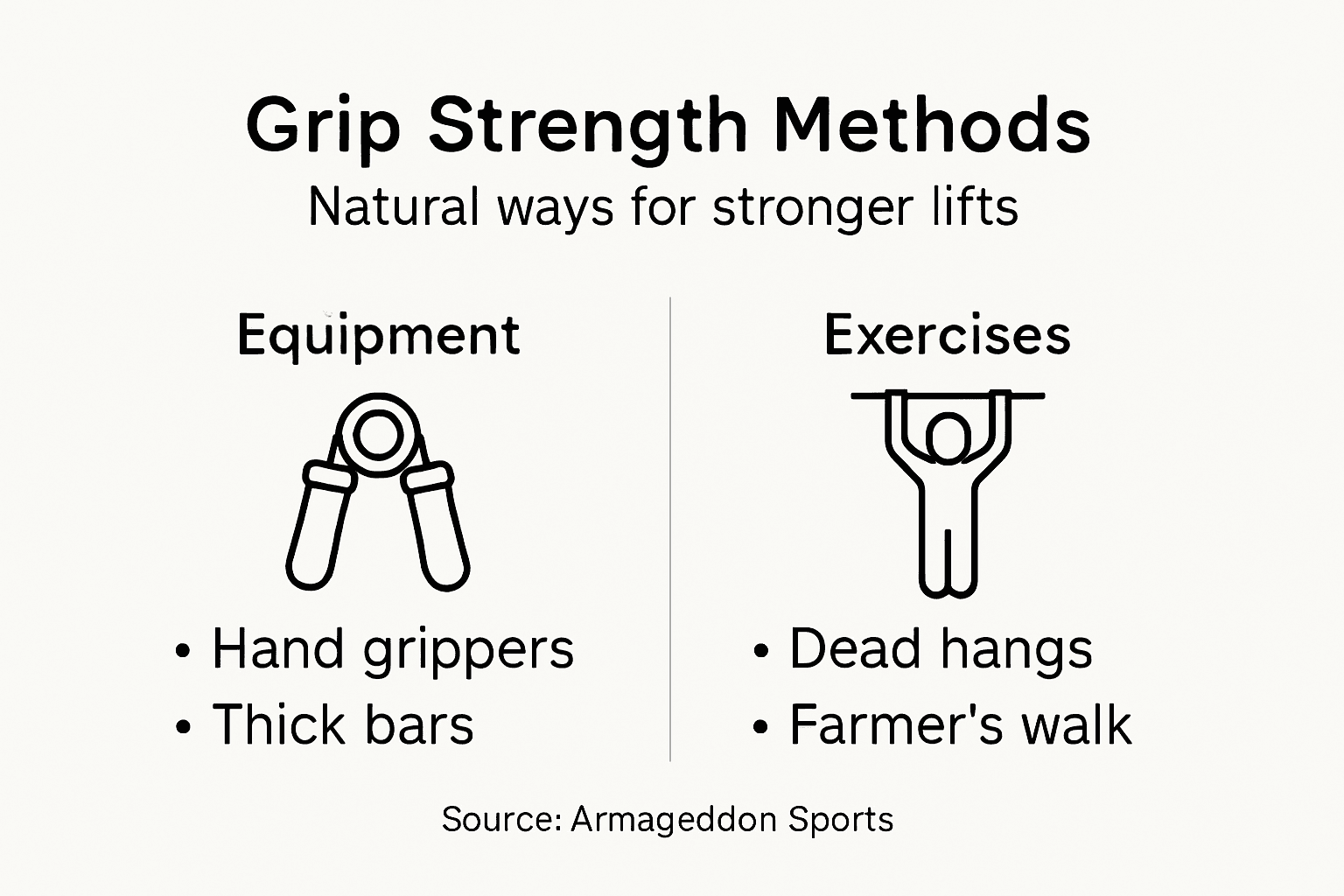
Start by identifying which aspect of grip strength you want to improve. Are you looking to increase your pulling power for deadlifts and rows, or do you need stronger finger strength for holding heavy loads? Hand grippers, pull-up bars, kettlebells, plate pinch grips, thick grip attachments, and grip rings each serve different purposes and train your hands differently. Adjustable grippers work well if you want to track progressive resistance gains over time, while thick grip attachments transform your existing barbells and dumbbells into forearm killers. If your goal involves specific finger strength for climbing or sport-specific grip demands, finger trainers and reverse grip devices offer targeted stimulus. For general lifting applications, selecting quality grippers with measurable resistance ensures you can progressively overload your grip just like any other muscle group. When shopping for equipment, look for adjustable options that grow with your strength gains rather than fixed resistance tools that plateau quickly.
Consider integrating lifting straps into your grip training strategy, as they complement direct grip work by allowing heavier compound movements while your grip adapts to stronger holds. This balanced approach prevents grip from becoming your limiting factor while you simultaneously build genuine strength improvements through dedicated grip equipment.
Here’s a comparison of common grip-enhancing tools and their primary training benefits:
| Equipment Type | Targeted Grip Aspect | Typical Application |
|---|---|---|
| Hand Gripper | Crush grip strength | Isolated hand/finger training |
| Thick Grip Adapter | Forearm, crush, wrist | Converts bars/dumbbells |
| Plate Pinch Grip | Pinch grip & fingers | Pinching plates for time |
| Pull-up Bar | Support & endurance | Dead hangs, pull-ups |
| Lifting Straps | Support/complement | Overcomes grip fatigue |
Pro tip: Start with one versatile tool like an adjustable gripper or thick bar adapter rather than collecting multiple devices, then add specialized equipment only after you’ve mastered proper tension and can consistently progress in resistance.
Step 2: Incorporate targeted grip exercises into routines
Now that you have your equipment selected, it’s time to build a structured grip training program that fits seamlessly into your existing lifting routine. The key to rapid grip strength gains is consistency combined with progressive challenge. Unlike general strength training where you might lift three days a week, grip training responds incredibly well to more frequent stimulus, ideally performed 2 to 3 times weekly with varied exercises that target different grip types.
Start by introducing foundational exercises that build balanced hand and forearm strength. Dead hangs, farmer’s walks, towel pull-ups, and plate pinches form the backbone of effective grip training because they target your support grip, crush grip, and pinch grip simultaneously. Dead hangs are deceptively simple but brutally effective. Just grab a pull-up bar and hang, letting your bodyweight provide resistance while your forearms adapt to the load. Farmer’s walks involve grabbing heavy dumbbells or kettlebells and walking, forcing your grip to sustain tension through dynamic movement. Towel pull-ups transform standard pull-ups into a forearm killer by wrapping towels around the bar, forcing your fingers and hands to work exponentially harder. These exercises should be rotated throughout your week rather than performing the same movement every session. Seven essential grip exercises including dead hangs, finger pull-ups, pinch grips, farmer’s walks, towel pull-ups, wrist rollers, and hangboard routines provide enough variety to prevent your body from adapting while systematically building strength across all grip modalities.
Progression matters as much as exercise selection. Start with weights or hold durations you can comfortably manage, then gradually increase resistance or time under tension each week. When incorporating these exercises into your existing routine, place them at the end of your workouts rather than at the beginning, since your grip stabilizes compound lifts and you don’t want to fatigue it before heavy deadlifts or rows. As your grip improves over several weeks, you’ll notice that heavier lifts feel more secure and your overall pulling strength increases dramatically.
Pro tip: Alternate between two or three different grip exercises each session rather than repeating the same movement, and add one new variation every four weeks to continuously challenge your hands and prevent strength plateaus.
Step 3: Integrate progressive overload for continued gains
Your grip won’t improve indefinitely by doing the same thing week after week. To keep seeing strength gains and avoid frustrating plateaus, you need to systematically increase the demands placed on your hands and forearms. This is where progressive overload comes in, and it’s the single most important principle separating people who make consistent progress from those who stall after a few months.
Progressive overload means gradually increasing stress on muscles through manipulating training variables like weight, reps, sets, tempo, and rest periods. For grip training specifically, you have multiple levers to pull. The most straightforward approach is adding weight. If you’re doing farmer’s walks with 50 pound dumbbells, work up to 55 pounds the following week, then 60 pounds the week after. With dead hangs, add 5 to 10 pounds using a weight belt once you can comfortably hold your bodyweight for 45 to 60 seconds. You can also increase time under tension without adding weight. If you held a dead hang for 30 seconds last week, aim for 35 seconds this week. For exercises like plate pinches, increase the number of plates you’re pinching, or graduate from smooth plates to rough textured ones that demand greater grip force. Volume matters too. If you performed three sets of farmer’s walks, add a fourth set the following week. The key is making small, manageable increases rather than jumping dramatically, which leads to injury or burnout.
Track your progress meticulously. Write down the exercises, weights used, durations, and how many reps or sets you completed each session. This simple habit reveals exactly where you improved and helps you identify what progression strategy works best for your body. Some people respond better to adding weight, while others see faster gains from increasing time under tension or volume. Experiment over several weeks to discover your personal progression sweet spot, then lean into that strategy while rotating the other variables to keep your grip engaged and adapting.
This summary shows effective ways to progressively overload your grip training for continuous improvements:
| Overload Method | How to Implement | Adaptation Outcome |
|---|---|---|
| Add Weight | Increase load for each exercise | Greater maximum strength |
| Increase Duration | Hold longer for static moves | Improved endurance |
| More Sets/Reps | Add sets or reps weekly | Enhanced muscle stamina |
| Modify Surface | Use rough/unstable grips | Stronger stabilizing grip |
Pro tip: Increase your grip training variables by only 5 to 10 percent weekly rather than attempting larger jumps, as this gradual approach allows your connective tissues to adapt alongside muscle growth and drastically reduces injury risk.
Step 4: Apply grip training to daily and gym activities
Grip strength gains don’t exist in a vacuum. The real power comes when you intentionally apply your improving grip to every lifting movement and daily task you encounter. This bridges the gap between isolated grip exercises and real-world strength, making your training transfer directly to heavier deadlifts, stronger rows, and better overall performance. By treating grip development as part of your complete training ecosystem rather than a separate pursuit, you’ll see dramatic improvements in how much weight you can handle and control.

Start by being intentional during your compound lifts. On deadlifts, stop using lifting straps for lighter sets and force yourself to grip the bar without assistance. This trains your grip under actual heavy load while your entire body is engaged. The same applies to rows and pull-ups. Yes, your grip might fatigue before your back muscles do, but that’s the point. You’re training grip strength in a functional context where it matters most. When you do eventually use straps on maximal attempts, your bare-hand grip will be significantly stronger than before. During your regular gym sessions, incorporate efficient workout hacks that maximize time under tension while maintaining grip engagement throughout every set. Squeeze the bar harder on every rep. Make every rep intentional. This simple mindset shift transforms ordinary training into grip-specific stimulus.
Beyond the gym, grip training becomes part of your daily existence. When carrying groceries, deliberately grip the bags tighter rather than letting them hang passively. When opening jars or doors, focus on gripping with intention and power. When shaking hands, engage your grip fully. These small moments accumulate and reinforce the neural patterns you’re building through dedicated grip training. You’re essentially adding dozens of micro-sessions throughout your week without taking extra time. The gym provides structured progression and heavy stimulus, while daily life provides constant reinforcement and adapted grip usage. Combined, they create unstoppable grip strength development that translates to every lift you perform and every physical task you encounter.
Pro tip: Track which compound lifts feel most limited by grip strength, then add 5 to 10 minutes of grip-specific work after those exact exercises while your forearms are already fatigued and primed for adaptation.
Step 5: Evaluate grip strength progress for optimal results
Without measurement, you’re flying blind. You might feel stronger, but feelings can deceive you. Real progress requires objective data that shows exactly how much your grip strength has improved and whether your training approach is working. Evaluating your progress systematically allows you to identify what’s working, adjust what isn’t, and keep your training on track toward your goals.
The most straightforward method is using a grip dynamometer, a simple device that measures your maximum grip force in kilograms or pounds. These range from affordable handheld versions available online to professional-grade equipment found in gyms and clinics. Hand grip strength assessment using dynamometers measures muscle force and tracks functional performance changes over time, giving you objective data you can compare week to week and month to month. Test yourself every four weeks under consistent conditions to ensure accuracy. Use the same hand position, same time of day, and the same testing protocol each time. Perform three maximum efforts with each hand and record the best result. This consistency matters because even small variables like hand position or arm angle can shift your numbers, making comparisons unreliable. Over eight to twelve weeks, you should see noticeable improvements in your dynamometer scores. If you’re not improving, your training stimulus isn’t sufficient, and you need to increase intensity or volume. If you’re improving consistently, keep doing what you’re doing but expect the rate of improvement to slow as you get stronger.
Beyond the dynamometer, track performance improvements in your actual lifts. How much heavier can you deadlift without straps? How many more pull-ups can you complete? How long can you hold a dead hang? Regular grip strength measurement helps evaluate treatment efficacy and track recovery in functional contexts that matter to you. These real-world metrics often motivate more than raw dynamometer numbers because you’re directly experiencing stronger, more capable hands. Record these numbers monthly and watch the progression unfold. You’ll notice your grip no longer limits your lifts, your pull-ups feel easier, and carrying heavy objects becomes less taxing on your forearms.
Pro tip: Test your grip strength in the morning after a full night of sleep and at least two hours after eating, as fatigue and food digestion both temporarily reduce grip force and skew your measurements.
Unlock Your Strongest Grip with the Right Gear from Armageddon Sports
Improving your grip strength naturally takes dedication and the right tools. Whether you are battling grip fatigue during heavy deadlifts or aiming to boost your crush grip and endurance, having quality equipment can make all the difference. The article highlights how progressive overload and consistent targeted exercises build stronger hands and forearms for better performance. Now you can complement your training with premium lifting equipment designed to support and enhance your grip. From durable straps to wrist wraps and thick grip adapters, these essentials help you push past plateaus safely and effectively.

Don’t let grip strength hold you back from conquering heavier lifts and mastering your workouts. Explore our collection of fitness and workout gloves for added support and protection during intense sessions. Act now to take advantage of special offers and get fast shipping on gear that complements your natural grip training journey. Visit Armageddon Sports today to upgrade your grip game and experience stronger lifts like never before.
Frequently Asked Questions
How can I improve my grip strength naturally for heavier lifts?
To improve grip strength naturally, incorporate targeted grip exercises like dead hangs, farmer’s walks, and towel pull-ups into your routine. Aim to perform these exercises 2 to 3 times a week, gradually increasing the weight or duration to challenge your grip over time.
What types of equipment can I use to enhance my grip strength?
Consider using hand grippers, thick grip attachments, and pull-up bars to boost your grip strength. Start with one versatile tool and progressively add specialized equipment as you develop your grip.
How often should I train my grip for optimal results?
For optimal grip strength gains, train your grip 2 to 3 times weekly with varied exercises targeting different grip types. Consistent training will yield noticeable improvements in your overall lifting performance within 4 to 6 weeks.
What is progressive overload, and how can I apply it to grip training?
Progressive overload involves gradually increasing the demand on your muscles to continue making gains. To apply this to grip training, incrementally add weight, increase hold durations, or add more sets to your grip exercises every week.
How can I ensure my grip training translates to better lifting performance?
To ensure your grip strength translates to better lifting performance, practice gripping techniques during compound lifts without using lifting straps. Focus on maximizing your grip engagement during exercises like deadlifts and rows to reinforce your grip strength in real-world situations.
How can I measure my grip strength progress effectively?
You can measure grip strength progress using a grip dynamometer to track your maximum grip force. Test your grip every four weeks under consistent conditions to compare results and identify areas for improvement.
Recommended
- How to Use Lifting Straps for Maximum Grip Strength – Armageddon Sports
- How to Actually Use Weight Lifting Straps for Deadlift – Are Wrist Hoo – Armageddon Sports
- Thick & Fat Grips Bar Training Adapters Alternative Workout Forearms Strength Builder for Weights Barbell Dumbells Sillicone Rubber – Armageddon Sports
- Weight Lifting Grip Wrist Straps Pull Up Gym Pads Workout Wraps – Armageddon Sports


