
Many gym users wrongly believe all accessories automatically boost strength. A survey found 62% overestimate benefits without professional guidance. The truth is accessories like belts, straps, and gloves enhance performance only when matched to your goals and used correctly. This guide clarifies how to select and use gym accessories to truly improve training and recovery.
Table of Contents
- Introduction To Gym Accessories And Their Functional Roles
- How Gym Accessories Improve Performance And Safety
- Grip-Enhancing Accessories: Straps Vs. Gloves
- Gym Accessories For Recovery Enhancement
- Common Misconceptions And Proper Usage Guidelines
- Practical Framework For Selecting Gym Accessories
- Explore Quality Gym Accessories To Enhance Your Training
- FAQ
Key takeaways
| Point | Details |
|---|---|
| Accessories enhance performance when used correctly | Proper selection and usage improve safety, strength, and recovery outcomes. |
| Grip aids serve distinct functions | Straps boost grip endurance while gloves protect skin with moderate wrist support. |
| Correct fit prevents injury | Improper fitting increases injury risk and reduces accessory effectiveness. |
| Match accessories to training goals | Align accessory choice with specific strength, recovery, or stability objectives. |
Introduction to gym accessories and their functional roles
Gym accessories are specialized tools designed to support strength training, improve grip, stabilize joints, and accelerate recovery. These products fall into several categories: support gear like weightlifting belts, grip aids including straps and gloves, stability tools such as resistance bands, and recovery devices like muscle stimulators. Understanding these categories helps you match accessories to your specific needs.
Fitness accessories operate across three functional domains: biomechanical support, grip enhancement, and recovery optimization. Biomechanical accessories like belts and wrist wraps stabilize joints and increase core pressure during heavy lifts. Grip aids reduce hand fatigue and improve control. Recovery tools promote circulation and reduce soreness after intense sessions.
Each accessory serves a distinct purpose:
- Lifting belts increase intra-abdominal pressure for spinal protection
- Wrist wraps stabilize joints under heavy loads
- Straps extend grip endurance during pulling movements
- Gloves protect skin and provide moderate wrist support
- Resistance bands activate muscles during warm-ups
- Muscle stimulators enhance post-workout circulation
Selecting the right accessory starts with identifying your primary training challenge. Are you limited by grip strength on deadlifts? Do heavy squats stress your lower back? Does recovery take too long between sessions? Answering these questions guides you toward accessories that genuinely solve your specific problems.
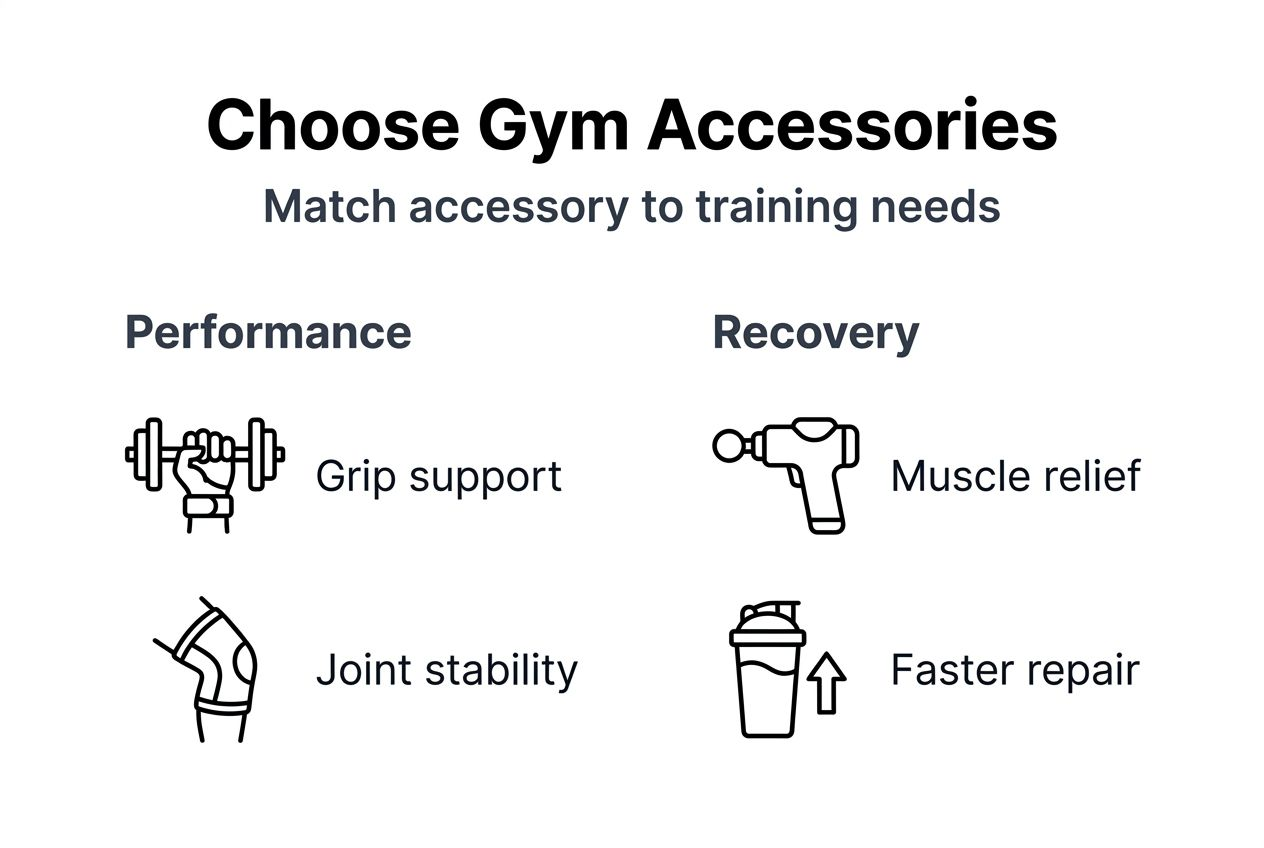
The top workout accessories for training efficiency and recovery combine multiple benefits. A quality lifting belt provides both spinal support and confidence under maximal loads. Understanding how accessories interact with your body’s biomechanics ensures you select tools that complement rather than replace natural strength development. The top fitness accessories for gyms comparison reveals how different products stack up for various training goals.
How gym accessories improve performance and safety
Lifting belts work by creating a rigid wall against which your core muscles can push. This increases intra-abdominal pressure, which stabilizes your spine during heavy compound lifts. Research shows lifting belts reduce spinal load significantly during maximal efforts. The increased pressure acts like an internal brace, distributing force more evenly across your torso.
Wrist wraps function differently. They provide external joint stabilization when handling heavy weights overhead or during pressing movements. Studies confirm wrist wraps reduce wrist pain and injury by preventing excessive joint extension under load. The wrap creates a supportive sleeve that limits dangerous ranges of motion while maintaining functional mobility.
Grip aids address a different limitation. Your grip often fails before target muscles reach fatigue during pulling exercises. Straps transfer load from your fingers to your wrists, allowing you to complete more reps and fully exhaust back and leg muscles. This targeted support prevents grip weakness from limiting overall muscle development.
Key performance and safety benefits include:
- Enhanced core stability during squats and deadlifts
- Reduced risk of wrist hyperextension injuries
- Extended set duration when grip would normally fail
- Improved confidence handling near-maximal loads
- Better force transfer through stabilized joints
Pro Tip: Fit your belt snugly but not painfully tight, positioned over your navel. Wrist wraps should cover the joint completely without cutting off circulation. Test accessories with submaximal weights first to ensure proper positioning before attempting heavy lifts.
Accessories support natural muscle function rather than replacing it. A belt doesn’t make your core stronger; it provides a surface against which your core can generate more force. Similarly, wrist wraps don’t lift the weight but prevent injury that would otherwise halt your progress. The benefits of weightlifting belts for athletes extend beyond just adding pounds to your max.
Grip-enhancing accessories: straps vs. gloves
Wrist straps and weightlifting gloves serve overlapping but distinct purposes. Straps excel at extending grip endurance, while gloves prioritize hand protection and comfort. Understanding these differences helps you choose the right tool for specific exercises and training phases.
| Feature | Wrist Straps | Weightlifting Gloves |
|---|---|---|
| Grip enhancement | Significantly extends grip endurance | Minimal grip strength improvement |
| Wrist support | Moderate to high depending on wrap style | Light to moderate support |
| Hand protection | None | Prevents calluses and blisters |
| Best for | Heavy pulling movements like deadlifts | General training and moderate loads |
| Limitations | May create grip dependency if overused | Can reduce tactile feedback |
Wrist straps wrap around the bar, creating a mechanical advantage that reduces finger strain. This allows you to train back and leg muscles to complete failure without grip limiting your performance. However, overusing straps can prevent natural grip strength development. Your forearms need direct stress to grow stronger.
Weightlifting gloves provide a padded barrier between your hands and the bar. Research indicates gloves offer moderate wrist support but don’t significantly boost grip strength compared to straps. Their primary value lies in comfort and skin protection during high-volume training sessions.
Consider these usage guidelines:
- Use straps only on final heavy sets when grip fails first
- Train grip directly with exercises like farmer’s carries
- Choose fitness gloves for comfort during moderate-intensity work
- Alternate between bare hands and accessories to maintain grip strength
- Reserve straps for exercises where grip clearly limits target muscle fatigue
Pro Tip: Perform your first two working sets without straps to maintain natural grip strength. Add straps only when grip failure would prevent you from adequately stimulating target muscles. This balanced approach develops both grip endurance and overall pulling strength.
The choice between straps and gloves often depends on your training phase. During strength-focused blocks with heavy weights, straps prove more valuable. During higher-rep hypertrophy phases, gloves offer sufficient support while keeping hands comfortable through extended sets.
Gym accessories for recovery enhancement
Recovery accessories accelerate the repair process between training sessions. Electrical muscle stimulators use low-frequency currents to induce muscle contractions, which increases blood flow to worked tissues. Research shows muscle stimulators reduce DOMS by up to 30% by promoting faster waste product removal and nutrient delivery.
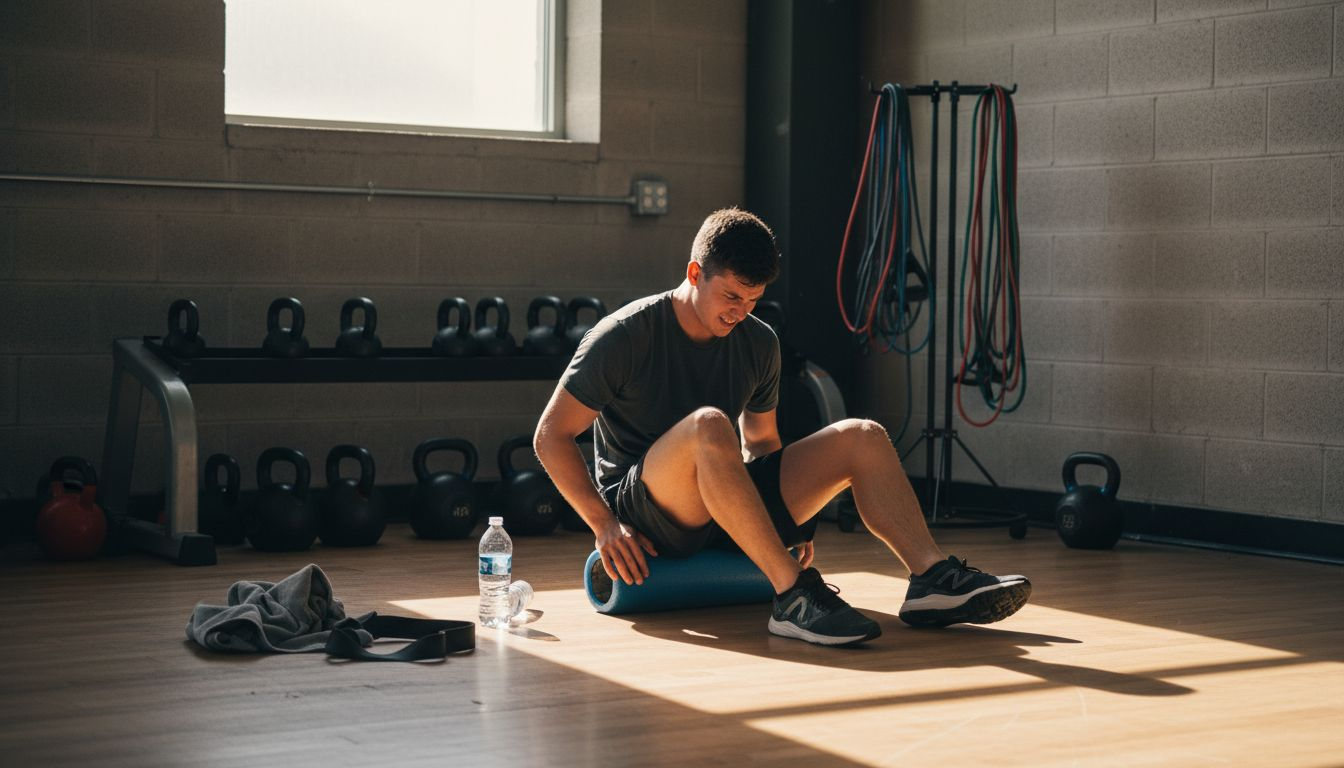
Foam rollers apply targeted pressure to muscle tissue, releasing tension and improving circulation. Rolling before workouts prepares muscles for activity, while post-workout rolling speeds recovery by reducing adhesions and promoting fluid movement through tissues. The mechanical pressure mimics massage therapy benefits at a fraction of the cost.
Resistance bands serve dual purposes. During warm-ups, they activate muscles through full ranges of motion, preparing joints and connective tissues for heavier loads. Studies demonstrate resistance bands reduce injury risk more effectively than static stretching by improving muscle activation patterns. Bands also provide accommodating resistance during rehabilitation exercises.
Key recovery benefits include:
- Increased circulation delivering nutrients to damaged muscle fibers
- Reduced muscle soreness allowing more frequent training
- Enhanced tissue flexibility preventing injury
- Improved muscle activation patterns during warm-ups
- Accelerated removal of metabolic waste products
Integrating recovery accessories into your routine requires consistency. Use muscle stimulators for 15 to 20 minutes on major muscle groups immediately post-workout. Foam roll for 5 to 10 minutes targeting areas with tightness or soreness. Perform band warm-ups for 5 minutes before lifting to activate stabilizers and prime movement patterns.
The muscle stimulator recovery benefits extend beyond soreness reduction. Regular use can improve muscle endurance and maintain strength during recovery periods. These tools don’t replace proper sleep and nutrition but complement those foundational recovery elements. Faster recovery means more productive training sessions and better long-term progress.
Common misconceptions and proper usage guidelines
Many gym users hold incorrect beliefs about accessory capabilities. The most common myth is that accessories instantly boost strength. In reality, they optimize force production by addressing specific limiting factors. A belt won’t add 50 pounds to your squat overnight, but it might allow you to lift with better technique and confidence.
Another misconception claims wrist straps significantly increase raw grip strength. Straps bypass grip limitations temporarily but don’t train grip muscles. If anything, overreliance on straps can weaken grip over time. The survey showing 62% overestimate benefits highlights how widespread these misunderstandings are.
Some lifters worry that belts weaken core muscles by providing external support. This concern lacks scientific backing. Belts actually increase core muscle activation by giving those muscles a stable surface to push against. The key is using belts strategically rather than for every single set.
Common risks of improper use:
- Wearing belts too loose reduces effectiveness and creates false security
- Over-tightening wrist wraps cuts circulation and causes numbness
- Using straps on every set prevents grip strength development
- Continuing to lift through accessory-induced pain signals equipment fit issues
- Relying solely on accessories without addressing technique flaws
Research confirms improper accessory use increases injury risk by 15% through altered biomechanics and false confidence. A poorly fitted belt might encourage you to attempt weights your actual core strength can’t safely support. Wraps applied incorrectly can restrict blood flow or create pressure points that damage tissues.
Proper usage starts with correct fitting. Belts should sit firmly over your navel, tight enough to feel substantial pressure when you brace but not so tight you can’t breathe normally. Wrist wraps should cover the joint completely, secured firmly but allowing normal blood flow. Test all accessories with light weights first.
Balance accessory use with natural muscle development. The home gym equipment importance discussion emphasizes building fundamental strength before relying heavily on support gear. Use accessories as tools to overcome specific limitations, not as substitutes for proper training progression.
Practical framework for selecting gym accessories
Choosing effective accessories requires a systematic approach. Follow this step-by-step process to make informed decisions that align with your training needs:
- Assess your primary training goal: strength, hypertrophy, endurance, or rehabilitation
- Identify your main limiting factor: grip failure, joint instability, recovery speed, or technique breakdown under load
- Match accessory types to your specific limitation using the categories discussed earlier
- Research proper fitting and usage techniques before purchasing
- Start with one accessory, master its use, then add others if needed
- Regularly evaluate whether the accessory improves your targeted metric
- Adjust usage frequency based on training phase and individual response
Selection criteria should emphasize function over appearance. A flashy belt that doesn’t fit properly provides zero benefit. Prioritize these factors when evaluating products:
- Goal alignment: Does this accessory address your specific limiting factor?
- Fit and comfort: Can you wear it for extended periods without pain or restriction?
- Durability: Will it withstand regular use under heavy loads?
- Science-backed benefits: Does research support its claimed effects?
- Ease of use: Can you apply and adjust it quickly between sets?
Frequency and duration vary by accessory type and individual needs. Belts typically appear only during heavy compound lift sets. Wrist wraps might be used throughout pressing workouts if joint stress is a concern. Recovery tools like stimulators work best when used consistently after every training session.
Avoid overreliance by setting clear usage rules. For example, only use straps when grip fails before target muscles reach fatigue. Remove your belt between sets to prevent dependency. Periodically test your performance without accessories to gauge natural strength progression. The top workout accessories for training efficiency and recovery work best when integrated thoughtfully rather than used indiscriminately.
Your accessory needs will evolve as you progress. Beginners rarely need belts since lighter weights don’t stress the spine enough to require external support. Intermediate lifters benefit most from targeted accessory use during heavy training blocks. Advanced athletes often cycle accessories based on competition preparation phases.
Explore quality gym accessories to enhance your training
Ready to apply these insights? Armageddon Sports offers a curated selection of fitness accessories designed to support your strength training and recovery goals. Our weightlifting belts provide reliable spinal support during maximal lifts, while our fitness gloves keep your hands protected through high-volume training sessions.
Each product category addresses specific training challenges discussed throughout this guide. Browse our collections to find accessories that match your current needs and training phase. Quality gear makes the difference between struggling with limitations and breaking through to new performance levels.
FAQ
How do I choose the right gym accessory for my specific training goals?
Start by identifying your primary training limitation. If grip fails during back exercises, prioritize wrist straps. If heavy squats stress your lower back, a quality lifting belt provides the support you need. Match accessory function to your specific challenge, ensuring proper fit and learning correct usage before relying on it during heavy training. The top workout accessories for training efficiency and recovery guide offers detailed selection criteria for different goals.
Can using gym accessories replace natural strength development?
Accessories support but never replace natural muscle function. They optimize force production by addressing specific limiting factors, not by doing the work for your muscles. Overreliance prevents balanced development and can create dependency that weakens natural capabilities. Use accessories strategically as supplements within a comprehensive training program that prioritizes progressive overload and proper technique development.
What are the risks of using gym accessories improperly?
Improper fitting alters natural biomechanics, potentially increasing injury risk. Research shows incorrect use raises injury risk by 15% through false confidence and poor positioning. Belts worn too loose provide no support, while over-tightened wraps restrict circulation. Misuse creates more harm than benefit by encouraging poor technique or loads beyond your actual capacity. Always follow manufacturer guidelines and seek professional instruction when first using new accessories.
How do grip straps and gloves differ in supporting workouts?
Straps significantly extend grip endurance by mechanically transferring load from fingers to wrists, but may cause grip dependency if overused. Gloves primarily protect skin and provide moderate wrist support without substantially improving grip strength. Choose straps for heavy pulling movements where grip clearly limits performance. Select gloves for general training comfort and hand protection during moderate-intensity work. Many lifters use both depending on the specific workout and exercise selection.
Recommended
- How to Improve Grip Strength Naturally for Stronger Lifts – Armageddon Sports
- Top workout accessories for training efficiency and recovery – Armageddon Sports
- How to Use Lifting Straps for Maximum Grip Strength – Armageddon Sports
- Forearm Workout Guide for Maximum Grip and Muscle Growth – Armageddon Sports