
Every serious lifter eventually hears conflicting advice about building mass, yet the truth behind muscle growth often gets lost in gym folklore. Understanding muscle hypertrophy matters because it separates long-term success from frustrating plateaus and wasted effort. This guide cuts through the noise to clarify what hypertrophy really is, debunk widespread myths, and highlight the most effective training principles and equipment for both strength and size gains.
Table of Contents
- Defining Hypertrophy And Common Misconceptions
- Types Of Hypertrophy: Sarcoplasmic Vs. Myofibrillar
- How Muscle Hypertrophy Actually Occurs
- Hypertrophy Training Methods And Equipment
- Risks, Mistakes, And Recovery Essentials
Key Takeaways
| Point | Details |
|---|---|
| Understanding Hypertrophy | Muscle hypertrophy increases existing muscle cell size, not the number of muscle fibers. |
| Drivers of Muscle Growth | Mechanical tension and metabolic stress are the primary factors influencing hypertrophy, not hormone spikes. |
| Training Variety | Employ both myofibrillar and sarcoplasmic hypertrophy through varied rep ranges for comprehensive muscle development. |
| Importance of Recovery | Adequate protein intake, sleep, and rest days are essential for muscle repair and growth. |
Defining Hypertrophy and Common Misconceptions
Muscle hypertrophy is the process of increasing the size of your muscle cells, not creating new ones. This distinction matters because many lifters confuse hypertrophy with hyperplasia, which is the creation of new muscle fibers. When you train with weights, your existing muscle cells respond by getting larger through increased cellular size rather than multiplying. Your muscle fibers are mostly established by the time you finish puberty, so the real game for muscle growth happens within those existing cells. Think of it like inflating a balloon instead of creating new balloons. The balloon (your muscle cell) gets bigger, but you’re not making additional balloons in the process.
One of the biggest misconceptions in the gym revolves around what actually triggers hypertrophy. Many lifters believe that massive hormone spikes from their training sessions drive muscle growth, or that specific rep ranges magically activate growth hormones that create muscle. The reality is more straightforward. Research shows that mechanical tension and metabolic stress are the primary drivers of hypertrophy, not systemic hormone fluctuations. Your muscles grow because you’ve placed genuine mechanical load on them and created an environment where they need to adapt. The metabolic byproducts from training, the actual tension placed on muscle fibers, and the damage you create during sets matter far more than chasing testosterone spikes or worrying about workout timing relative to meal windows.
Another common myth is that you need to train a specific way to trigger hypertrophy. You’ll hear endless debates about rep ranges, tempos, and rest periods. The truth? Your muscles don’t understand rep ranges. They understand load and volume. Whether you perform 6 reps or 15 reps, if you’re creating meaningful mechanical tension and pushing toward failure, you’re stimulating growth. A bodybuilder performing 12 reps per set and a strength athlete performing 5 reps per set can both build substantial muscle mass because both are applying real tension to the tissue. The mechanism is the same. The execution differs based on your preferences and goals.
You might also hear that you can build muscle purely through training light weights with high reps, or conversely, that you must lift heavy to grow. This oversimplifies the process. Your muscles adapt to the demands placed on them. If those demands create sufficient mechanical tension, metabolic stress, and muscle damage, growth follows. This happens across a spectrum of loads and rep ranges, which is why multiple training approaches work for muscle building.
Pro tip: Stop obsessing over the “perfect” rep range and instead focus on creating consistent mechanical tension through a full range of motion while maintaining progressive overload. If each week you’re either lifting slightly heavier weights or performing more total volume than the previous week, your muscles will grow regardless of whether you’re in the 5-rep or 15-rep range.
Types of Hypertrophy: Sarcoplasmic vs. Myofibrillar
Muscle growth doesn’t happen in just one way. Your muscles can expand through two distinct mechanisms, each producing different results based on how you train. Myofibrillar hypertrophy increases the size and number of the actual contractile proteins (actin and filaments) within your muscle fibers. This type of growth makes your muscles denser, stronger, and more capable of generating force. Sarcoplasmic hypertrophy, on the other hand, increases the volume of the fluid and energy storage components surrounding those contractile proteins. This approach prioritizes muscle size and endurance capacity without necessarily making you significantly stronger. Understanding the difference is crucial because myofibrillar versus sarcoplasmic hypertrophy respond to completely different training stimuli.

Myofibrillar hypertrophy is the strength player’s best friend. You build this type primarily through heavy, low-rep training where you’re lifting weight close to your maximum effort. Think sets of 3 to 6 reps with substantial load. When you place enormous tension on your muscle fibers, they adapt by increasing the density and number of contractile elements. A powerlifter or strength athlete pursuing this approach gets visibly harder and more muscular without necessarily gaining as much overall size as a bodybuilder. The muscle looks compact and defined. Sarcoplasmic hypertrophy works opposite. It thrives on higher-rep moderate-intensity training, typically in the 8 to 15 rep range. This approach floods the muscle with metabolic stress and accumulates fatigue without requiring absolute maximum weights. The sarcoplasm expands to store more glycogen and fluid, giving muscles a fuller, more pumped appearance. Bodybuilders targeting aesthetics lean heavily into sarcoplasmic hypertrophy because it delivers visible size.
The smart approach isn’t choosing one over the other. Both types contribute to complete muscle development. A balanced program includes lower-rep strength work to build dense, functional muscle alongside moderate-rep volume work to maximize size. You might perform heavy compound lifts for 5 reps on day one, then hit the same muscle groups with higher-rep isolation work on day three. This dual approach builds muscles that are both strong and large. Your training equipment matters here too. Using proper weightlifting belts, straps, and grips ensures you can safely handle heavy loads for myofibrillar work while maintaining form during high-rep pump sessions. The combination creates lasting muscle development that looks impressive and performs equally well.
Many lifters chase only one type and wonder why their progress plateaus. A purely heavy strength routine builds tremendous strength but misses opportunities for size. Pure hypertrophy training maximizes the pump but leaves strength potential on the table. Your muscles respond most dramatically when exposed to varied stimulus across the hypertrophy spectrum.
Here’s a quick comparison of sarcoplasmic and myofibrillar hypertrophy for different training drivers and results:
| Type of Hypertrophy | Main Training Driver | Visual Result | Strength Impact |
|---|---|---|---|
| Myofibrillar | Heavy, low-rep lifting | Dense, defined look | Major strength gains |
| Sarcoplasmic | Moderate, high-rep volume | Fuller, pumped look | Moderate strength boost |
Pro tip: Structure your weekly training so that 40 percent targets heavy strength work (3 to 6 reps) and 60 percent targets moderate-rep hypertrophy (8 to 12 reps) to optimize both myofibrillar and sarcoplasmic growth simultaneously.
How Muscle Hypertrophy Actually Occurs
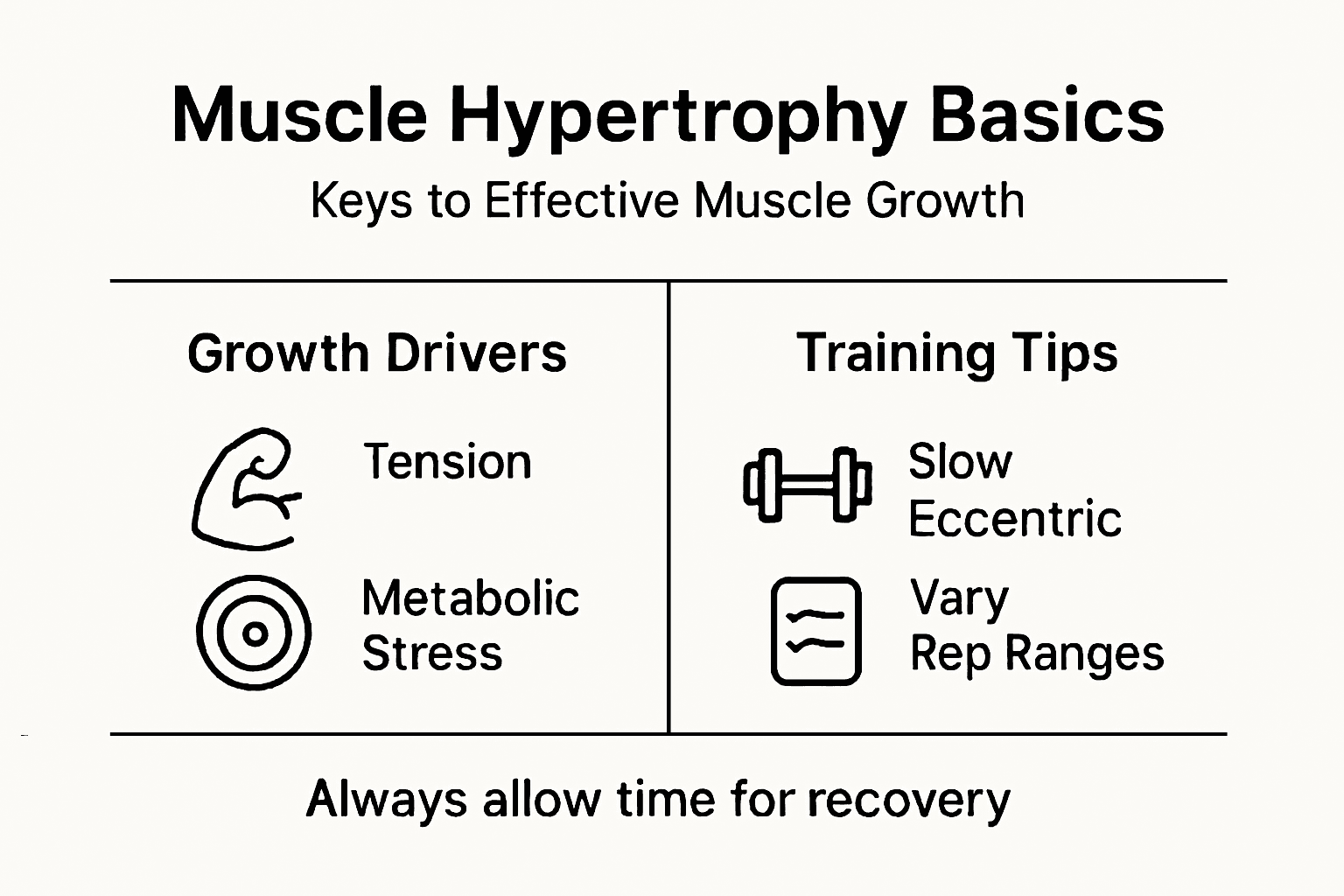
Muscle growth follows a predictable biological sequence, but understanding each step transforms how you approach training. When you perform resistance exercise, three primary triggers activate the hypertrophy response: mechanical tension, muscle damage, and metabolic stress. Mechanical tension occurs when you load your muscles with weight, forcing them to work hard. Muscle damage happens through the microscopic tears created during intense contractions, particularly on the eccentric (lowering) phase. Metabolic stress builds up from the accumulation of metabolic byproducts like lactate and hydrogen ions, creating that intense burn sensation. All three work together to disrupt the balance between muscle protein synthesis and breakdown, tipping the scales toward growth. Mechanical tension combined with metabolic stress activates the cellular machinery responsible for building new muscle tissue.
Once these triggers activate, your body launches a cascade of signaling pathways. mTOR, IGF, and MAPK are key players in this process. These cellular messengers essentially tell your muscle fibers that conditions demand growth. Your body increases protein synthesis, meaning it ramps up the process of constructing new muscle proteins faster than it breaks them down. But here’s where satellite cells become crucial. These are dormant muscle cells that exist in reserve. When activated by training stimulus, satellite cells donate nuclei to muscle fibers, allowing those fibers to expand and accommodate new protein. Without satellite cell activation, your muscle fibers cannot grow beyond a certain point. This is why consistent training stimulus matters. You’re not just creating stress. You’re recruiting these cellular repair workers to rebuild your muscles larger than before.
The timeline matters significantly. Immediately after your workout, your muscles remain in a heightened state of protein synthesis for 24 to 48 hours. This is when the actual construction happens. Your muscles have received the signal to grow, and now they’re doing the work. What you do during this window directly influences the outcome. Adequate protein intake provides the amino acid building blocks. Sufficient calories ensure your body has energy to build rather than break down tissue. Sleep allows uninterrupted protein synthesis and hormone optimization. Without these factors, your training stimulus goes to waste.
Training variables dramatically influence these mechanisms. Higher volume (total reps performed) increases metabolic stress and muscle damage. Eccentric loading especially triggers damage and subsequent growth. Blood flow restriction techniques enhance metabolic stress without requiring maximum weights. Contraction speed affects the mechanical tension profile. The sophisticated approach recognizes these mechanisms and adjusts training accordingly rather than mindlessly following generic programs.
Pro tip: Prioritize eccentric movements and extend your time under tension during sets by slowing the lowering phase to 3 to 4 seconds, maximizing mechanical tension and muscle damage while using moderate weight that allows proper form.
Hypertrophy Training Methods and Equipment
Building an effective hypertrophy program requires understanding both the training methods that work and the equipment that supports them. Evidence-based hypertrophy training emphasizes moderate to high volume combined with appropriate intensity levels and consistent progression. This means performing enough total reps per muscle group weekly while gradually increasing either the weight lifted or the total volume performed. The specific rep range matters less than ensuring each set creates meaningful mechanical tension and metabolic stress. Whether you use free weights, machines, or a combination depends on your goals and preferences. Both approaches work effectively when programmed correctly. The key is selecting equipment that allows you to progressively overload while maintaining proper form.
Advanced training techniques separate ordinary programs from those that truly maximize growth. Supersets pair two exercises back to back without rest, accumulating fatigue and metabolic stress. Drop sets involve reaching failure, then reducing weight and continuing for additional reps. Cluster sets break a heavy load into multiple smaller sets with brief rest periods. Accentuated eccentric loading emphasizes the lowering phase where you control weight with extra tension. Blood flow restriction training uses light weights with partial occlusion of blood flow, creating massive metabolic stress without joint stress. Advanced resistance training techniques like supersets and eccentric loading optimize hypertrophy by maximizing both mechanical tension and metabolic stress simultaneously. These methods also improve training efficiency, allowing you to achieve results in less time while helping break through plateaus that stall progress.
The equipment you choose directly impacts your ability to execute these methods. Quality weightlifting belts stabilize your core during heavy compound lifts, allowing you to handle maximum loads safely. Lifting straps enable heavier pulling movements by reducing grip fatigue, keeping your back and lats as the limiting factor rather than your forearms. Gloves protect your hands during high-volume training and improve grip security. Adjustable dumbbells provide versatility for drop sets and cluster sets without requiring multiple equipment changes. When designing training for strength and hypertrophy at home, prioritize equipment that enables progressive overload across your primary lifts. Barbells, adjustable dumbbells, and pull-up bars form the foundation. Accessories like belts, straps, and proper footwear transform your ability to train intensely and safely.
Programming structure matters as much as individual exercises. A typical effective approach dedicates 40 percent of volume to heavy compound movements (3 to 6 reps) and 60 percent to moderate-rep isolation work (8 to 15 reps). This combines the strength benefits of heavy loading with the metabolic stress of higher-rep work. Include one compound movement per muscle group weekly that prioritizes load, then follow with isolation movements that emphasize the pump and mechanical tension through better ranges of motion. Rotate between different exercise variations every 4 to 8 weeks to prevent adaptation and maintain progress. Track your workouts obsessively. Progressive overload means nothing if you cannot demonstrate that you performed more volume, weight, or intensity than last week.
Pro tip: Implement drop sets on your final 1 to 2 working sets of each exercise by reaching failure at your target rep range, then immediately reducing weight by 20 to 30 percent and continuing for additional reps to maximize metabolic stress and training efficiency.
Risks, Mistakes, and Recovery Essentials
Pursuing aggressive hypertrophy comes with real risks if you ignore the fundamentals of safe training. The most common mistake lifters make is confusing intensity with recklessness. Training hard does not mean training stupidly. Overtraining occurs when training volume and intensity exceed your recovery capacity, leading to plateaus, decreased performance, injury, and burnout. Many lifters believe more volume always equals more growth, so they add sets weekly without considering whether their body can recover. This backfires. Your muscles grow during rest, not during the workout. If you never allow adequate recovery between sessions, you prevent the adaptation process from completing. Improper technique ranks equally dangerous. Ego lifting with weight you cannot control sacrifices form for numbers on the bar. This shifts tension away from target muscles and places excessive stress on joints and connective tissue. Common risks in hypertrophy training include overtraining, improper technique, and insufficient recovery, all of which can accumulate into serious injury. Training to failure should be managed carefully, favoring technical failure (where form breaks down) over absolute failure (where you cannot move the weight one more rep), which reduces injury risk significantly.
Muscle imbalances represent another underestimated problem. If you favor certain movements or neglect specific muscle groups, structural imbalances develop. Your anterior chain becomes overdeveloped while your posterior chain lags. Shoulders roll forward. Lower back pain emerges. These imbalances compound over months of training, creating dysfunction that limits your progress and increases injury risk. The solution is honest assessment. Which movements do you avoid because they feel weak or uncomfortable? Those are exactly the movements you need to prioritize. Include pulling movements to balance pressing. Train legs with the same intensity you train chest. Address weaknesses rather than magnifying strengths.
Recovery is not optional. It is the foundation of hypertrophy. Protein intake provides the amino acids your body uses to build muscle. Aim for 0.7 to 1 gram per pound of body weight daily. Sleep allows uninterrupted anabolic hormone production and protein synthesis. Target 7 to 9 hours nightly because sleep deprivation directly impairs muscle growth and increases injury risk. Rest days are mandatory, not signs of weakness. Muscles need time between sessions to recover and adapt. Typically, one full rest day weekly and training different muscle groups on different days prevents overuse. Caloric balance ensures your body has energy to build tissue rather than breaking it down for fuel. You cannot build muscle in a severe caloric deficit. Proper nutrition, sleep, and rest days are critical recovery components that support muscle repair and growth while minimizing injury risk and setbacks.
Monitor your body carefully. Pain that feels mechanical (a sharp twinge in a joint during a specific movement) differs from soreness (general muscle fatigue and tenderness). Mechanical pain signals that something is wrong. Stop that exercise. Sharp pain in joints should never be ignored. Fatigue that does not improve with a rest day suggests overtraining. Persistent soreness beyond 72 hours indicates you may have exceeded your recovery capacity. Listen to these signals before they force you to stop training entirely.
For reference, here are key recovery essentials for successful hypertrophy and their direct effects:
| Recovery Essential | Main Benefit | Impact on Muscle Growth |
|---|---|---|
| Protein Intake | Supplies amino acids | Required for tissue repair |
| Sleep | Boosts hormone production | Maximizes protein synthesis |
| Rest Days | Allows muscle adaptation | Prevents injury and overtraining |
| Caloric Balance | Provides energy for growth | Prevents muscle breakdown |
Pro tip: Implement a deload week every 4 to 6 weeks where you reduce volume by 50 percent and intensity by 20 to 30 percent, allowing your nervous system and connective tissue to fully recover while maintaining training habits and preventing overuse injuries.
Unlock Your Muscle Growth Potential with the Right Gear
Understanding muscle hypertrophy means recognizing the importance of mechanical tension, metabolic stress, and consistent progressive overload. Yet too often lifters struggle with plateaus, injuries, or ineffective training because they lack the essential equipment that supports safe heavy lifting and high-rep muscle fatigue. Whether you are pursuing myofibrillar hypertrophy through heavy low-rep sets or sarcoplasmic hypertrophy with moderate higher reps, the right tools can dramatically improve your workout quality and recovery.

Armageddon Sports specializes in premium weightlifting belts, straps, gloves, and fitness accessories designed to maximize your hypertrophy training efficiency and protect you from injury. Equip yourself to safely push heavier loads, maintain perfect form during intensive pump sets, and accelerate muscle repair with the proper support gear. Explore our full selection today at Armageddon Sports and take advantage of unbeatable deals on products crafted for hypertrophy success. Don’t wait until injury or frustration stops your progress. Start optimizing your training now by visiting weightlifting gear and accessories that champions use every session.
Frequently Asked Questions
What is muscle hypertrophy?
Muscle hypertrophy is the process of increasing the size of existing muscle cells, not the creation of new muscle fibers. This occurs primarily through increased cellular size as a response to weight training.
What triggers muscle hypertrophy during training?
Muscle hypertrophy is primarily triggered by mechanical tension, muscle damage, and metabolic stress during resistance training. These factors create an environment where muscles need to adapt and grow.
What are the two types of hypertrophy?
The two types of hypertrophy are myofibrillar and sarcoplasmic. Myofibrillar hypertrophy focuses on increasing the density and strength of muscle fibers, while sarcoplasmic hypertrophy increases the fluid and energy storage around those fibers, prioritizing size and endurance.
How can I effectively train for hypertrophy?
To effectively train for hypertrophy, combine lower-rep strength work (3 to 6 reps) with moderate-rep volume work (8 to 15 reps). Ensure progressive overload by gradually increasing weights or total volume and incorporate advanced techniques like supersets and drop sets for added stress.
Recommended
- Strength Training: Transforming Fitness at Home – Armageddon Sports
- Thick & Fat Grips Bar Training Adapters Alternative Workout Forearms Strength Builder for Weights Barbell Dumbells Sillicone Rubber – Armageddon Sports
- What Is Home Gym Equipment and Why It Matters – Armageddon Sports
- BFR Bands Blood Flow Restriction Bands Cuffs Occlusion Straps for Arms Biceps Legs Wraps Kaatsu Full Set of 4 – Armageddon Sports


