
Most athletes and gym-goers think core training means grinding through sets of crunches until their abs burn. That belief is not just outdated, it is actively limiting your performance. The core is a complex, three-dimensional system of muscles that stabilizes your spine, transfers force between your upper and lower body, and powers every athletic movement you make. Whether you squat heavy, sprint on a track, or swing a racket, your core is the engine behind it all. This guide breaks down the anatomy, function, real-world benefits, and practical programming of core training so you can train smarter and perform better.
Table of Contents
- What is the core? Anatomy and functional role
- How the core functions: Stability, breathing, and force transfer
- Evidence-based benefits: What does core training really do?
- Core training methods: Techniques, progressions, and programming
- Common mistakes and expert insights: What most people miss
- Enhance your core workouts with the right gear
- Frequently asked questions
Key Takeaways
| Point | Details |
|---|---|
| Core is more than abs | Core training targets a wider group of muscles supporting stability and movement. |
| Stability beats isolation | Training anti-movement and compound patterns provides better results than traditional isolation exercises. |
| Science supports endurance benefits | Studies show core exercises reliably improve core endurance, balance, and foundational athletic performance. |
| Proper technique is essential | Avoid repetitive flexion—focus on bracing, anti-movement, and progression for safe, effective training. |
What is the core? Anatomy and functional role
Most people picture a six-pack when they hear the word “core.” The reality is far more interesting. Core stability exercise principles describe the core as a muscular box that includes the abdominals, obliques, erector spinae, multifidus, transverse abdominis, pelvic floor muscles, diaphragm, glutes, and hip girdle muscles. Together, these muscles form a pressurized cylinder around your spine and internal organs.
This cylinder does something remarkable. When you brace before a heavy lift or absorb a tackle, these muscles co-contract to create intra-abdominal pressure (IAP). Think of IAP as inflating a balloon inside your torso. The pressure stiffens your spine and protects it from compressive and shear forces that would otherwise cause injury.
Here is a quick breakdown of the key muscle groups and their roles:
- Transverse abdominis: The deepest abdominal layer, acts like a natural weight belt
- Multifidus: Small spinal muscles that provide segmental stability at each vertebra
- Obliques (internal and external): Control rotation and lateral flexion
- Erector spinae: Extend and stabilize the spine during loaded movement
- Glutes and hip girdle: Transfer force between the lower body and trunk
- Diaphragm and pelvic floor: Form the top and bottom of the pressurized cylinder
“The core is not just your abs. It is a fully integrated system that protects your spine and makes every powerful movement possible.”
Without a strong, functional core, your limbs lose their anchor point. Power leaks. Injury risk climbs. Every athletic skill you have built becomes less effective.
How the core functions: Stability, breathing, and force transfer
Knowing what muscles form the core is only half the picture. Understanding how they work together changes how you train.
The core’s primary job is to stiffen the torso so your arms and legs can move with precision and power. Core co-contraction for proximal stability enables distal mobility, meaning a stable center allows your extremities to generate and absorb force efficiently. This is why a weak core makes even simple movements feel unstable.
Breathing plays a bigger role than most athletes realize. The diaphragm is both a breathing muscle and a core stabilizer. When you inhale deeply and brace, you create the IAP spike that protects your spine. Mastering diaphragmatic breathing and abdominal bracing together is one of the highest-leverage skills in strength training.
| Core function | Mechanism | Athletic application |
|---|---|---|
| Spinal stiffness | Co-contraction of trunk muscles | Deadlifts, tackles, sprinting |
| Intra-abdominal pressure | Diaphragm and pelvic floor engagement | Heavy squats, overhead pressing |
| Force transfer | Linking lower and upper body | Throwing, rowing, swinging |
| Proximal stability | Stable trunk anchors limb movement | Cutting, jumping, kicking |
Pro Tip: Before any heavy compound lift, take a deep breath into your belly (not your chest), then brace your abs as if you are about to take a punch. Hold that brace through the entire rep. This simple habit can dramatically reduce injury risk and increase your power output.
Evidence-based benefits: What does core training really do?
The science on core training is more nuanced than most fitness content suggests. Here is what the research actually shows.
Core endurance meta-analysis data reveals that core training produces strong improvements in core endurance (SMD=1.32), balance (SMD=0.99 to 1.16), trunk extensor strength, dynamic balance, and sprint speed. Those are meaningful numbers across a wide range of athletes.
“Core training does not just build a stronger midsection. It builds the foundation that makes every other physical quality more effective.”
Here is how the benefits stack up across different performance markers:
| Performance marker | Effect of core training | Evidence strength |
|---|---|---|
| Core endurance | Large improvement (SMD=1.32) | Strong |
| Balance and stability | Large improvement (SMD=0.99-1.16) | Strong |
| Trunk extensor strength | Moderate to large improvement | Moderate |
| Sprint speed | Small to moderate improvement | Moderate |
| Jumping and agility | Mixed results | Limited |
| Racket sport balance | Especially pronounced gains | Strong |
The strength training benefits of core work extend beyond the gym. Athletes who combine core training with sport-specific drills see better results than those who isolate core work alone. If you are also working on improving mobility, pairing it with core stability work creates a powerful combination for injury prevention and performance.
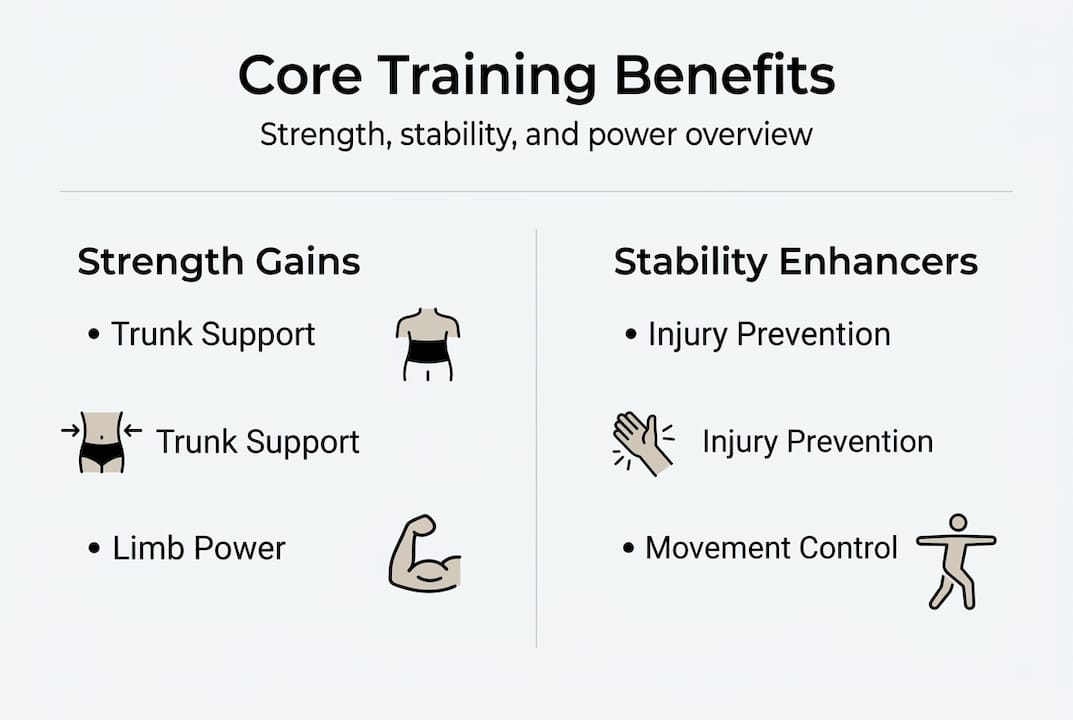
One important caveat: core training alone will not make you jump higher or run faster overnight. The biggest gains come when core work is integrated into a complete, well-structured program.
Core training methods: Techniques, progressions, and programming
Now that you understand the why, here is the how. Effective core training follows a clear progression from basic activation to complex, loaded movement.
The four-stage progression:
- Activation drills: Abdominal hollowing, abdominal bracing, diaphragmatic breathing. These teach your nervous system to recruit the right muscles.
- Stability isometrics: Planks, side planks, dead bugs, bird dogs. These build endurance and control under static load.
- Dynamic anti-movement: Pallof press, ab wheel rollouts, cable chops. These train your core to resist rotation and lateral forces.
- Compound integration: Squats, deadlifts, loaded carries, overhead pressing. These are where evidence-based core protocols show the greatest real-world transfer.
The McGill “Big 3” (curl-up, side plank, bird dog) are the gold standard starting point, especially if you have any history of low back discomfort. They build endurance and stability without loading the spine into repeated flexion.
Key programming guidelines:
- Train core 2 to 3 times per week, 10 to 15 minutes per session
- Use progressive overload by increasing hold time, adding resistance, or reducing stability
- Target 45 to 60 second holds for isometric exercises as a baseline benchmark
- Pair core work with your main training session, not as a standalone workout
- Rotate between anti-flexion, anti-extension, and anti-rotation exercises each week
Pro Tip: If you want to accelerate your results, explore ab machine benefits and dedicated core equipment solutions that add variety and resistance to your training without requiring a full gym setup.
Common mistakes and expert insights: What most people miss
Even experienced athletes make predictable errors with core training. Knowing them in advance saves you months of wasted effort.
The most common core training mistakes:
- Over-relying on crunches and sit-ups: Repeated spinal flexion increases compressive stress on the lumbar discs without delivering meaningful functional strength. The risk-to-reward ratio is poor.
- Treating core like a burnout finisher: Doing 200 reps of anything at the end of a session is not training. It is fatigue. Your core responds to quality load and progressive challenge, not volume for its own sake.
- Ignoring anti-movement patterns: Most real-world core demands involve resisting movement, not creating it. If your program has no Pallof presses, no carries, and no anti-rotation work, you are missing the most functional half of core training.
- Skipping breathing mechanics: Athletes who brace without breathing correctly are leaving performance on the table. Breath and brace work together.
- Chasing visible abs over functional strength: A visible six-pack is a body composition outcome. A strong, stable core is a performance outcome. Train for function and the aesthetics often follow.
For athletes dealing with low back pain, the research from core training effects consistently points to McGill’s Big 3 and anti-movement exercises as the safest and most effective approach. Avoid repetitive flexion until the pain resolves.
Advanced athletes should layer in anaerobic conditioning with core demands, such as sled pushes, battle rope work, and loaded carries at higher intensities. These challenge the core under fatigue, which is exactly the condition it faces in competition. You can also use ab strap tools to add hanging core work that builds both strength and grip endurance simultaneously.
Enhance your core workouts with the right gear
You now have the science, the strategy, and the programming framework to build a genuinely strong and functional core. The next step is making sure your training environment supports that effort.

The right equipment makes a real difference. A quality weightlifting belt teaches you to brace against resistance and protects your spine during heavy compound lifts. Stocking up on versatile fitness accessories like ab straps, resistance bands, and stability tools adds variety and progressive challenge to your core sessions. At Armageddon Sports, you will find athlete-approved lifting gear built for every training level, from beginners learning to brace correctly to advanced athletes pushing their limits with loaded carries and anti-movement drills. Gear up and put your new knowledge to work.
Frequently asked questions
What is the difference between core and abs?
The core includes far more than just the abs. It also includes the obliques, lower back muscles, glutes, diaphragm, and pelvic floor, while the abs are simply one component of that larger system.
How often should I do core training?
For most athletes and fitness enthusiasts, 2 to 3 focused sessions per week lasting 10 to 15 minutes each is the optimal frequency for building core strength and endurance without overtraining.
Are crunches bad for your back?
Repeated crunches and sit-ups increase spinal compressive stress and carry a higher injury risk than anti-movement exercises, so prioritizing bracing and stability work is the smarter approach for most people.
Does core training improve sports performance?
Core training reliably improves balance and trunk endurance across most sports, though direct improvements in sport-specific skills like jumping or agility depend heavily on how core work is integrated into the overall program.
Can you train your core every day?
The core responds best when trained like any other muscle group. Following similar frequency guidelines to other muscle groups, meaning 2 to 3 sessions per week with rest days in between, produces better long-term results than daily training.