
Most gym routines isolate muscles with machines and single joint exercises, building strength that rarely translates to picking up groceries or climbing stairs. Functional fitness emphasizes movements mimicking real-life activities to enhance strength, mobility, balance, and coordination. This approach trains your body for the movements you perform every day, from lifting objects overhead to rotating your torso while carrying bags. This guide breaks down what functional fitness is, the science behind it, the movements that define it, its proven benefits, and how to apply it safely whether you’re a beginner or experienced athlete.
Table of Contents
- Understanding Functional Fitness: What It Is And How It Works
- Core Movements And Methodologies In Functional Fitness Training
- Benefits And Expert Perspectives On Functional Fitness In Everyday Life
- Applying Functional Fitness Safely: Tips For Beginners And Enthusiasts
- Upgrade Your Functional Fitness With Gear From Armageddon Sports
- Frequently Asked Questions
Key takeaways
| Point | Details |
|---|---|
| Movement focused training | Functional fitness trains multi-joint patterns like squatting, pushing, pulling, and rotating that mirror daily activities rather than isolating single muscles. |
| Practical strength gains | This approach builds coordination, balance, and power that directly improve your ability to perform everyday tasks with less effort and injury risk. |
| Scalable for all levels | Programs adjust intensity through bodyweight, bands, or weights, making functional fitness accessible for beginners, seniors, and advanced athletes. |
| Injury prevention emphasis | Training movement patterns with proper form reduces compensation patterns and strengthens stabilizer muscles that protect joints during daily activities. |
| Complementary approach | Combining functional training with traditional strength work delivers the best results for both real-world performance and muscle development. |
Understanding functional fitness: what it is and how it works
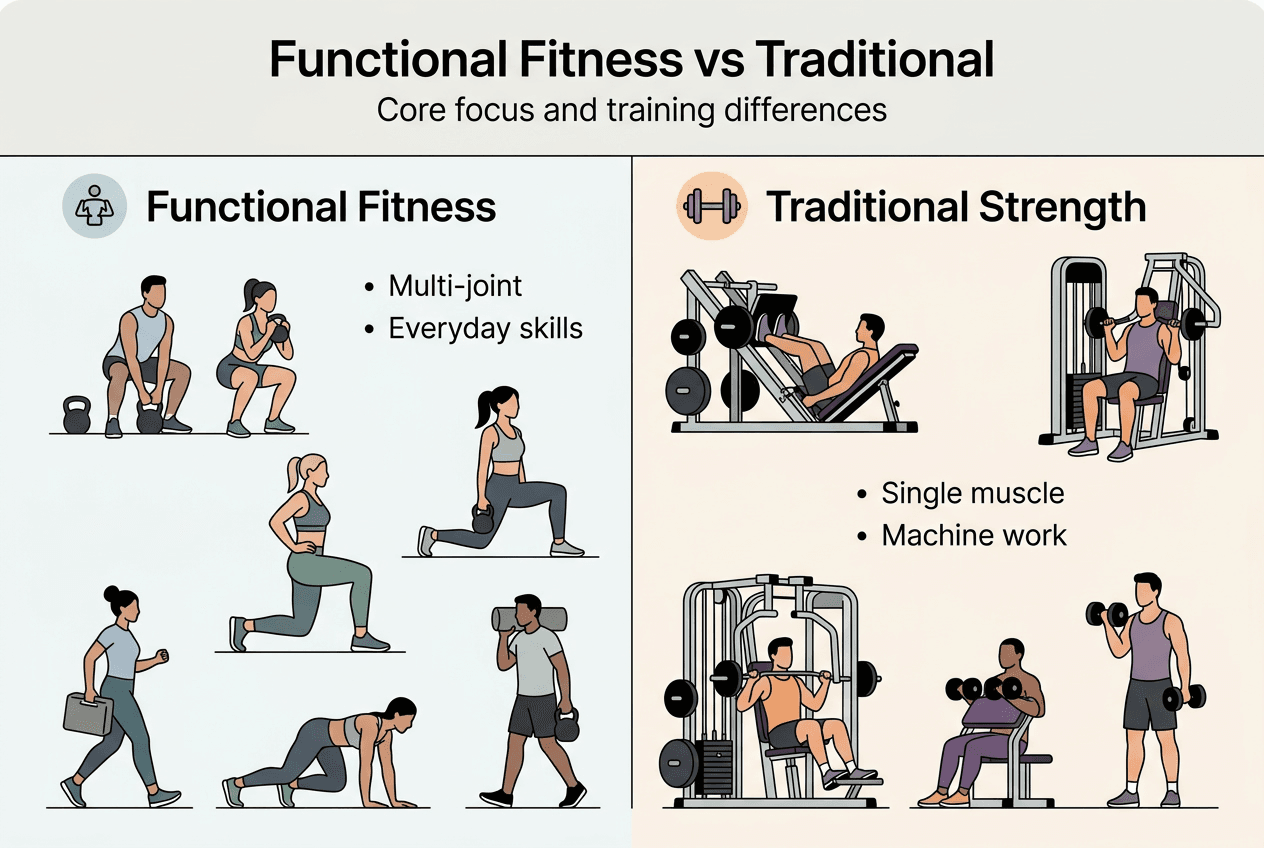
Functional fitness trains natural movement patterns your body uses daily rather than isolating muscles on machines. ACSM defines functional fitness as neuromotor training originating in rehab and sports medicine emphasizing purposeful training. The approach focuses on multi-joint, multi-plane compound movements that engage several muscle groups simultaneously, unlike bicep curls or leg extensions that work single muscles in one direction.
This training method emerged from physical therapy and athletic performance programs where practitioners noticed isolated strength didn’t always translate to functional ability. A patient might build strong quadriceps on a leg extension machine but still struggle to stand from a chair safely. Functional fitness addresses this gap by training the integrated muscle chains and neuromotor skills your body actually uses.
The core characteristics that define functional fitness include:
- Training movements across multiple planes of motion (forward/back, side to side, rotational)
- Engaging core stabilizers throughout exercises rather than using back support
- Incorporating balance and coordination challenges that mimic real-world instability
- Emphasizing movement quality and control over maximum weight lifted
- Building strength that transfers directly to activities of daily living
Traditional bodybuilding splits muscles into isolated groups trained on different days, often using machines that lock you into fixed paths. Functional training instead views your body as an integrated system where muscles work together to produce movement. When you lift a box from the ground, your legs drive upward, your core stabilizes your spine, your back maintains position, and your arms hold the load. Functional strength training replicates this coordination.
The neuromotor component involves training your nervous system to coordinate muscle activation patterns efficiently. Balance, agility, and proprioception (body awareness in space) improve through functional exercises that challenge stability. This neural adaptation often produces strength gains even without significant muscle growth, explaining why functional athletes can move heavy objects despite less visible muscle mass than bodybuilders.
Core movements and methodologies in functional fitness training
Functional fitness builds around seven fundamental movement patterns your body performs daily. Multi-planar compound movements engage multiple muscle groups including squats, lunges, deadlifts, pushes, pulls, hinges, carries, and rotations. Mastering these patterns before adding complexity or load creates a foundation for safe, effective training.
The seven core patterns include:
- Squat: Lowering your hips while maintaining upright posture, used when sitting or picking up low objects
- Hinge: Bending at hips with minimal knee bend, the foundation for deadlifts and lifting from ground level
- Lunge: Single leg movements forward, backward, or laterally that build unilateral strength and balance
- Push: Pressing movements away from your body horizontally or vertically, from pushups to overhead presses
- Pull: Drawing resistance toward your body, training back and grip strength for carrying and climbing
- Carry: Loaded walking or holding positions that build core stability and real-world strength endurance
- Rotate/Anti-rotate: Twisting movements and resisting rotation that protect your spine during daily activities
Training equipment emphasizes free weights, kettlebells, resistance bands, and bodyweight rather than machines. Dumbbells and kettlebells require stabilization that engages core and supporting muscles throughout movements. Resistance bands provide variable tension that challenges muscles differently than gravity-based weights. Bodyweight exercises remain the most accessible and scalable option for beginners.
Recommended training frequency ranges between 2-5 sessions per week using formats like EMOMs, AMRAPs, and circuits with progressive overload principles. EMOM (every minute on the minute) structures work periods with built-in rest, while AMRAP (as many rounds as possible) tests work capacity over set timeframes. Circuit training rotates through multiple exercises with minimal rest, building both strength and cardiovascular fitness.
Progressive overload in functional training adjusts multiple variables:
| Variable | Progression Method | Example |
|---|---|---|
| Volume | Increase sets or reps | 3 sets of 8 squats to 4 sets of 10 |
| Load | Add weight or resistance | Bodyweight lunges to goblet lunges |
| Tempo | Slow eccentric or add pauses | 3-second descent on pushups |
| Complexity | Advance movement pattern | Split squat to Bulgarian split squat |
| Range | Increase movement distance | Partial to full depth squats |
Strength training at home can incorporate these progressions with minimal equipment. Many functional patterns scale effectively from bodyweight to loaded variations as you build capacity. A beginner might start with wall pushes, progress to incline pushups, then floor pushups, and eventually weighted vest pushups, all training the same horizontal push pattern.
Pro Tip: Master bodyweight versions of each fundamental pattern with perfect form before adding any external resistance, as movement quality determines both safety and effectiveness in functional training.
Core workout techniques particularly benefit from functional approaches that train anti-rotation and anti-extension rather than just flexion movements like crunches. Planks, pallof presses, and dead bugs build the core stability that protects your spine during daily activities and compound lifts.
Benefits and expert perspectives on functional fitness in everyday life
Functional fitness delivers scientifically validated improvements in movement skills critical for daily activities. Functional fitness improves balance and coordination, boosts speed/strength/power/agility, reduces injury risk, and increases confidence in daily activities. These adaptations translate directly to real-world tasks from carrying children to navigating uneven terrain.

Research demonstrates measurable confidence gains from consistent functional training. CrossFit participants report a 58% increase in daily activity confidence after six months of functional fitness training. This psychological benefit stems from knowing your body can handle physical demands without hesitation or fear of injury.
Key benefits across populations include:
- Enhanced proprioception and body awareness reducing fall risk in older adults
- Improved joint stability through strengthened stabilizer muscles around major joints
- Greater movement efficiency requiring less energy for daily tasks
- Reduced chronic pain from better movement patterns and muscular balance
- Increased metabolic demand from compound movements engaging more muscle mass
- Sport-specific performance gains through movement pattern transfer
Functional training proves particularly valuable for populations with specific needs. Seniors maintain independence longer through improved balance and strength for activities of daily living. Rehabilitation patients rebuild movement capacity after injury using scaled functional patterns. Athletes enhance sport performance by training movements that mirror competitive demands.
Comparing functional and traditional approaches highlights distinct advantages:
| Aspect | Functional Training | Traditional Strength Training |
|---|---|---|
| Movement focus | Multi-joint, multi-plane patterns | Single-joint, isolated muscles |
| Equipment | Free weights, bodyweight, bands | Machines, fixed paths |
| Stability demand | High (requires core engagement) | Low (machine support) |
| Daily life transfer | Direct application to ADLs | Limited practical carryover |
| Injury prevention | Emphasizes movement quality | Focuses on load progression |
| Muscle development | Functional strength and coordination | Hypertrophy and maximum strength |
Experts note important nuances about functional fitness applications. Poor technique or inadequate coaching can increase injury risk despite the approach’s preventive benefits. Gym accessories for strength training support proper form and joint protection during loaded movements.
Some strength coaches caution against abandoning traditional training entirely. Functional fitness excels at building practical strength and movement quality, but isolated exercises remain valuable for addressing specific weaknesses or pursuing hypertrophy goals. A hybrid approach combining both methodologies often delivers optimal results.
“Functional training prepares your body for life’s physical demands, but traditional strength work still has a place for building maximum force production and targeting lagging muscle groups. The best programs blend both approaches strategically.”
Pro Tip: Prioritize core anti-rotation exercises like pallof presses and unilateral movements like single-leg deadlifts to address muscular imbalances and build the stability that prevents compensatory movement patterns causing injury.
Improving grip strength naturally through functional carries and pulling movements enhances your ability to hold objects during daily activities while building forearm and hand strength that supports other lifts.
Applying functional fitness safely: tips for beginners and enthusiasts
Starting functional fitness requires attention to movement quality and progressive difficulty to build capacity safely. Begin with bodyweight versions of fundamental patterns, focusing on proper form before adding external load. A bodyweight squat performed with good depth, upright torso, and stable knees provides more benefit than a loaded squat with compensation patterns.
Gradual intensity progression prevents overload injuries while building work capacity. Add resistance through bands or light weights only after mastering bodyweight patterns for multiple sets with consistent form. Improper form in functional training can increase injury risk; coaching and gradual progression are essential for safety.
Seeking qualified instruction accelerates learning and prevents ingrained movement faults. A certified functional fitness coach can assess your movement patterns, identify limitations, and program appropriate progressions. Video analysis helps you see your own form and compare it to proper technique demonstrations. Many online resources provide reliable instruction, though in-person coaching offers immediate feedback.
Proper equipment supports safe training across functional movements:
- Weightlifting belts provide core support during heavy compound lifts like squats and deadlifts
- Lifting gloves protect hands during high-volume training and improve grip on bars and kettlebells
- Wrist wraps stabilize joints during pressing movements and handstand work
- Knee sleeves offer compression and warmth that supports joint health during squatting patterns
- Resistance bands enable scalable loading and variable resistance for movement practice
Choosing safe weightlifting gear matched to your training style and body proportions enhances both performance and injury prevention. Properly fitted belts support intra-abdominal pressure without restricting breathing or movement range.
Common risks in functional training stem from predictable mistakes. Attempting complex movements before building foundational strength creates injury vulnerability. Lifting loads that exceed your control capacity compromises form and stresses joints. Neglecting recovery between intense sessions prevents adaptation and increases overuse injury risk. Training through pain rather than working around limitations often worsens underlying issues.
Functional training programs should be individualized with focus on goals, progressive overload, and scaled complexity. Your program should address your specific movement limitations, fitness level, and practical objectives. A desk worker rebuilding movement capacity needs different programming than an athlete enhancing performance.
Pro Tip: Incorporate single-leg exercises like Bulgarian split squats and single-arm carries into every training week to expose and correct strength imbalances between sides that often cause compensation injuries.
Workout accessories for recovery including foam rollers and massage tools help maintain tissue quality and movement range between training sessions. Recovery practices prove as important as training intensity for long-term progress and injury prevention.
Upgrade your functional fitness with gear from Armageddon Sports
Quality equipment enhances both safety and effectiveness when training functional movement patterns. The right gear supports proper form during compound lifts, protects joints under load, and enables progressive training without unnecessary injury risk.
Explore our lifting equipment collection designed for functional training demands. From kettlebells to resistance bands, we stock tools that support multi-planar movements and compound exercises. Weight lifting belts provide core stability during heavy squats, deadlifts, and overhead presses, allowing you to train these fundamental patterns safely as you build strength. Our fitness accessories include grip support, joint protection, and recovery tools that keep you training consistently. Whether you’re starting your functional fitness journey or advancing your practice, Armageddon Sports equips you with reliable gear for every movement pattern.
Frequently asked questions
How is functional fitness different from traditional strength training?
Functional fitness trains multi-joint movement patterns used in daily life like squatting, pushing, pulling, and rotating, while traditional training often isolates single muscles using machines. The functional approach emphasizes coordination, balance, and movement quality that transfers directly to real-world activities, whereas traditional methods prioritize muscle size and maximum strength in controlled environments.
What are the main movements involved in functional fitness?
The seven fundamental patterns include squats, hinges, lunges, pushes, pulls, carries, and rotational movements. These patterns cover nearly all human movement and can be scaled from bodyweight to heavily loaded variations. Training these movements builds strength and coordination that applies directly to lifting objects, climbing stairs, carrying groceries, and other daily physical tasks.
Is functional fitness safe for beginners and seniors?
Functional fitness scales effectively for all fitness levels when programmed appropriately with proper coaching. Beginners start with bodyweight patterns focusing on movement quality before adding load, while seniors benefit from improved balance and strength that maintains independence. The key is individualizing intensity, complexity, and volume to match current capacity while progressively building strength and coordination.
How often should I train functional fitness effectively?
Most people see excellent results training functional fitness 2-5 times weekly depending on intensity and recovery capacity. Beginners might start with 2-3 sessions focusing on movement quality, while experienced athletes can handle 4-5 sessions mixing strength and conditioning work. Allow at least one full rest day weekly and listen to your body’s recovery signals to prevent overtraining.
Can functional fitness help reduce injury risks in daily life?
Functional training significantly reduces injury risk by strengthening movement patterns and stabilizer muscles used during daily activities. Training proper squat mechanics protects your back when lifting objects, while core anti-rotation work prevents spine injuries during twisting movements. The improved balance, coordination, and body awareness from functional training also reduces fall risk, particularly valuable for older adults maintaining independence.
Recommended
- What is functional strength? Guide to effective training – Armageddon Sports
- Understanding body composition: a 2026 fitness guide – Armageddon Sports
- Strength Training: Transforming Fitness at Home – Armageddon Sports
- What is progressive overload? A 2026 guide for strength gains – Armageddon Sports
- Complete Guide to Functional Foods for Fitness – MyGymSupplements