
Many athletes and fitness enthusiasts believe flexibility is the key to performance, but they’re missing a critical piece. Mobility training goes beyond passive stretching to develop active joint control, combining strength, stability, and coordination in ways that directly enhance athletic output and reduce injury risk. This guide breaks down what mobility training actually is, the specific techniques that deliver results, and why prioritizing active range of motion over static flexibility can transform your training outcomes. You’ll learn evidence-backed methods to improve movement quality, boost performance metrics, and build resilient joints that support long-term athletic success.
Table of Contents
- Key takeaways
- Understanding mobility training: more than flexibility
- Key mobility training methodologies and exercises
- Mobility training benefits: performance, injury prevention, and recovery
- Nuances, special cases, and expert perspectives in mobility training
- Explore quality gear to enhance your mobility training
- FAQ
Key Takeaways
| Point | Details |
|---|---|
| Mobility versus flexibility | Mobility training combines flexibility with strength and neuromuscular control to enable active joint control through full ranges. |
| Active range of motion | Training emphasizes actively moving joints through full capacity with control, not merely passively stretching. |
| End range strength | Developing strength at extreme joint angles differentiates mobility from passive flexibility and supports safe, powerful movement. |
| Performance and injury benefits | Mobility work improves movement quality, enhances performance metrics, and lowers injury risk by promoting stable mechanics under load. |
| Hypermobility and asymmetries | Special considerations include focusing on control and stability for hypermobile athletes and addressing asymmetries to prevent compensations. |
Understanding mobility training: more than flexibility
Mobility training represents a comprehensive approach to movement quality that extends far beyond what most people associate with stretching. While flexibility refers to the passive lengthening capacity of muscles and connective tissues, mobility training improves active joint control combining elements of flexibility, strength, stability, and coordination. This distinction matters because athletic performance depends on your ability to control movement through full ranges of motion, not just achieve those ranges passively.
Active range of motion forms the foundation of mobility work. You’re not simply relaxing into a stretch position but actively moving your joints through their full capacity while maintaining muscular tension and control. This requires neuromuscular coordination, joint stability, and sufficient strength at end ranges where most injuries occur. The mobility vs flexibility explanation clarifies that mobility encompasses the functional application of flexibility within movement patterns your body actually uses during sports and daily activities.
Strength at extreme joint angles separates mobility from passive flexibility. When you can actively control your hip through its full rotation or maintain shoulder stability in overhead positions, you’re demonstrating true mobility. This active control protects joints during dynamic movements, reduces compensation patterns that lead to overuse injuries, and allows you to generate force efficiently throughout your entire range of motion. Without this strength component, increased flexibility can actually increase injury risk by creating unstable joint positions.
Mobility training directly supports functional movement patterns essential for athletic performance. Whether you’re squatting, sprinting, throwing, or jumping, your body needs joints that move freely while maintaining stability under load. Incorporating dynamic stretching boost performance techniques prepares your neuromuscular system for the specific demands of your training session or competition.
Pro Tip: Test your mobility versus flexibility by comparing passive and active ranges. If you can passively stretch your hamstring to 90 degrees but only actively lift your leg to 60 degrees, you have a 30-degree mobility deficit that training should address.
“Mobility is flexibility plus strength. You need both the range of motion and the ability to control that range under load to move efficiently and safely.”
The neuromuscular control aspect of mobility training teaches your nervous system to coordinate muscle activation patterns that stabilize joints throughout movement. This coordination prevents compensation patterns where other joints or muscle groups take over when primary movers lack sufficient range or strength. Better joint mechanics reduce wear on cartilage, tendons, and ligaments while improving movement efficiency and power transfer.
Key mobility training methodologies and exercises
Effective mobility programs incorporate multiple training methodologies that address different aspects of joint function and movement control. Dynamic stretches form the cornerstone of most mobility warm-ups, moving joints through progressively larger ranges while activating surrounding musculature. The World’s Greatest Stretch exemplifies this approach, combining hip flexor lengthening, thoracic rotation, and hamstring activation in one fluid movement pattern that prepares multiple joints simultaneously.

Controlled Articular Rotations (CARs) represent a fundamental mobility training technique that systematically explores and expands active joint ranges. You slowly rotate a joint through its full capacity while maintaining tension in surrounding muscles, which maps your current active range and gradually expands it through consistent practice. Hip CARs particularly benefit athletes by improving internal and external rotation capacity that supports squatting, cutting, and rotational power movements.
Functional range conditioning builds on CARs by adding progressive angular isometric loading (PAILs) and progressive angular isometric stretching (RAILs) at end ranges. This methodology strengthens joints at their most vulnerable positions, creating usable range rather than passive flexibility. The 90/90 hip switch drill demonstrates this principle, requiring active control as you transition between internal and external hip rotation positions while seated.
Structured mobility programs follow a logical progression:
- Increase available range of motion through CARs and dynamic stretches
- Build strength at newly accessed end ranges using isometric holds and eccentric loading
- Integrate expanded ranges into functional movement patterns
- Maintain gains through consistent practice and progressive overload
R.A.M.P dynamic warm-ups provide a systematic framework for mobility-focused preparation. Raise body temperature through light aerobic activity, Activate key muscle groups with targeted exercises, Mobilize joints through dynamic stretches and CARs, then Potentiate the nervous system with movement-specific drills. This sequence prepares your body physiologically and neurologically for high-intensity training.
Plyometric exercises enhance mobility by requiring rapid force production through full ranges of motion. Box jumps, depth drops, and bounding movements train your nervous system to control joints during high-velocity eccentric loading, which improves reactive strength and movement efficiency. The plyometric exercise benefits extend beyond power development to include enhanced joint stability and proprioception.
Pro Tip: Schedule mobility work when your nervous system is fresh, typically early in training sessions or as standalone sessions. Fatigue compromises motor control and reduces the neuromuscular benefits of mobility training.
Core stability exercises integrate with mobility work by providing a stable platform from which limbs can move freely. Exercises like dead bugs, bird dogs, and pallof presses teach your trunk to resist unwanted movement while your hips and shoulders explore their full ranges. This stability-mobility relationship ensures efficient force transfer and reduces compensatory movement patterns.
| Exercise Type | Primary Benefit | Frequency |
|---|---|---|
| Dynamic Stretches | Prepare joints for movement | Daily, pre-training |
| CARs | Map and expand active ROM | 4-6 times weekly |
| PAILs/RAILs | Strengthen end ranges | 2-3 times weekly |
| Plyometrics | Develop reactive control | 2-3 times weekly |
The mobility training exercises guide offers detailed progressions for implementing these methodologies across different training levels and goals.
Mobility training benefits: performance, injury prevention, and recovery
Research demonstrates substantial performance improvements from structured mobility programs across multiple athletic populations. Basketball players who completed 12 weeks of mobility training showed 22% increase in layup success, improved sprint speeds, and enhanced jump heights compared to control groups. These gains stemmed from better joint mechanics allowing more efficient force production and transfer through kinetic chains.
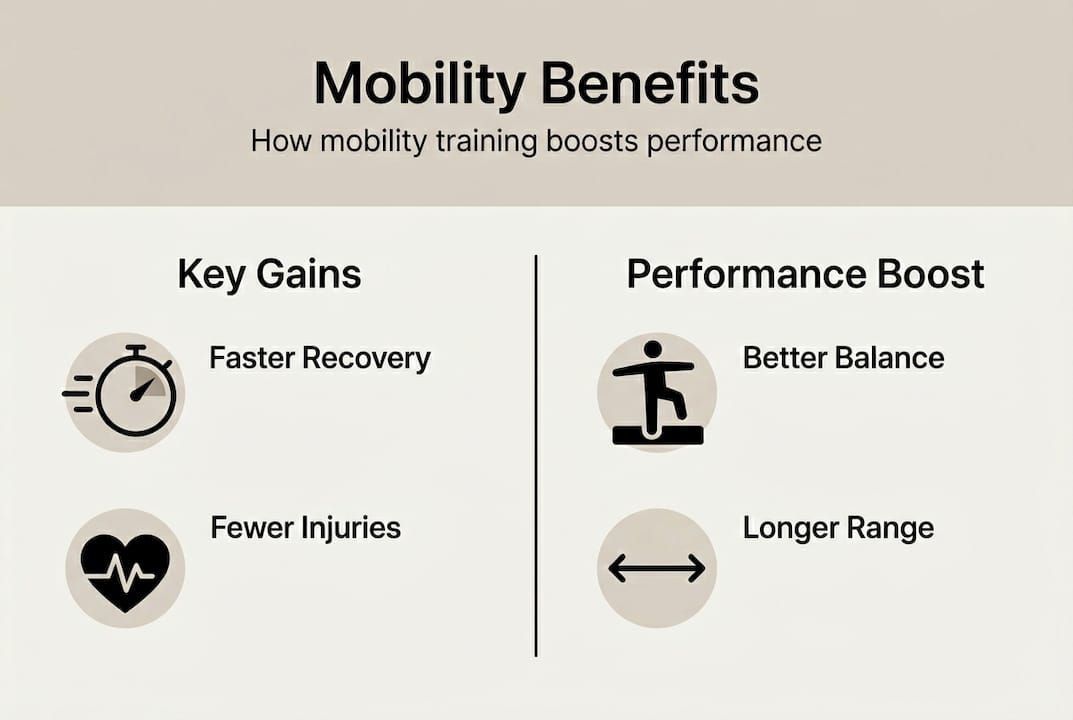
Functional Movement Screen (FMS) scores improve significantly with consistent mobility work, indicating better overall movement quality and reduced injury risk. Athletes who scored below 14 on the FMS face substantially higher injury rates, but targeted mobility interventions raise scores while simultaneously improving sport-specific performance metrics. The correlation between movement quality and injury prevention makes mobility training a dual-purpose investment for athletes.
Injury rates decrease by approximately 10% when athletes incorporate regular mobility training into their programs. This reduction comes from improved joint stability, better neuromuscular control, and reduced compensation patterns that overload certain tissues. Ankle, knee, and shoulder injuries particularly benefit from mobility-focused prevention strategies that address common range of motion and stability deficits.
| Performance Metric | Improvement | Study Duration |
|---|---|---|
| Layup Success Rate | +22% | 12 weeks |
| Match Sprint Speed | Significant increase | 12 weeks |
| Injury Incidence | -10% | Season-long |
| FMS Score | Above 14 threshold | 8-12 weeks |
Core stability shows strong correlations with mobility improvements, as better trunk control allows limbs to move through larger ranges safely. Athletes with superior core stability demonstrate higher quality movement patterns and can better utilize their available joint ranges during complex athletic tasks. This relationship explains why comprehensive mobility programs include dedicated core training components.
Explosive power gains accompany mobility improvements when training includes strength work at end ranges. Athletes who can squat deeper with proper mechanics access longer muscle lengths and greater stretch-shortening cycle benefits, translating to higher jumps and faster acceleration. The functional training performance gains research confirms that mobility-strength combinations outperform either quality trained in isolation.
Recovery benefits extend beyond injury prevention to include faster return-to-play timelines following injuries. Mobility training supports ACL rehabilitation by restoring normal joint mechanics and neuromuscular control patterns disrupted by injury and surgery. Early integration of functional movements through appropriate ranges accelerates tissue adaptation and reduces re-injury risk compared to traditional static rehabilitation protocols.
“The athletes who prioritize mobility training consistently demonstrate superior movement quality, reduced injury rates, and better long-term performance trajectories than those who focus solely on strength or conditioning.”
Post-exercise recovery improves when mobility work helps clear metabolic waste products and reduces muscle tension that accumulates during intense training. Light mobility sessions on recovery days maintain joint health without adding significant training stress. Understanding active recovery benefits helps athletes structure effective between-session protocols that support adaptation rather than impeding it.
Balance and proprioception improvements from mobility training enhance athletic performance across all movement planes. Better awareness of joint position and movement quality allows faster reaction times and more precise motor control during competition. These neuromuscular adaptations complement the physical range and strength gains to create well-rounded movement capacity.
Nuances, special cases, and expert perspectives in mobility training
Hypermobility presents unique challenges that require modified mobility training approaches. Individuals who already possess excessive passive range of motion need stability-focused programming rather than additional stretching. Hypermobility requires stability focus through strength training at end ranges and neuromuscular control exercises that teach the nervous system to protect vulnerable joint positions. For hypermobile athletes, traditional flexibility work can increase injury risk by creating even more unstable ranges.
Unilateral asymmetries between left and right sides demand specific assessment and correction strategies. Research on asymmetry correction shows that differences exceeding 10-15% in strength or range of motion correlate with increased injury risk and reduced performance. Mobility programs should identify these imbalances through bilateral comparisons and address limitations on the restricted side while maintaining gains on the more mobile side.
Post-injury training adaptations require careful progression from passive to active range restoration. Early-phase rehabilitation traditionally emphasized static stretching and passive range of motion, but contemporary approaches incorporate functional movements and controlled loading much earlier in recovery timelines. Inertial training devices and carefully progressed plyometrics restore neuromuscular control patterns while tissues heal, leading to faster and more complete recovery outcomes.
Expert perspectives increasingly emphasize strength-based mobility over passive flexibility for both performance and injury prevention. Functional training methodologies demonstrate superior neuromechanical benefits compared to isometric holds or static stretching alone. The ability to control and produce force through full ranges matters more for athletic success than simply achieving those ranges passively.
Key considerations for specialized populations:
- Youth athletes benefit from mobility training that supports natural movement development without overemphasizing flexibility
- Masters athletes require mobility work to counteract age-related range of motion losses and maintain functional independence
- Contact sport athletes need mobility programs that balance range expansion with joint protection strategies
- Endurance athletes must address repetitive movement pattern restrictions without compromising training volume
Pro Tip: Film your movement patterns from multiple angles to identify asymmetries and compensation strategies that standard assessments might miss. Video analysis reveals subtle quality differences that feel normal but limit performance.
The relationship between mobility and tissue tolerance deserves attention when designing training programs. Rapidly expanding range of motion without allowing connective tissues time to adapt increases injury risk. Progressive overload principles apply to mobility training just as they do to strength work, requiring gradual increases in range, load, and complexity over weeks and months.
| Training Focus | Best For | Avoid For |
|---|---|---|
| Range Expansion | Restricted joints | Hypermobile individuals |
| Stability Work | Hypermobility | Severely restricted ROM |
| Passive Stretching | General flexibility | Performance preparation |
| Active Control | All athletes | Acute injury phases |
Integrating functional fitness guide principles with mobility training creates comprehensive programs that address real-world movement demands. This integration ensures that expanded ranges translate to improved performance in sport-specific contexts rather than existing only in isolated positions.
Timing considerations affect mobility training outcomes. Morning sessions when core temperature is lower may require extended warm-ups but can establish movement patterns that persist throughout the day. Evening sessions benefit from accumulated daily movement but may face fatigue limitations. Experiment with timing to identify when your body responds best to mobility work.
Explore quality gear to enhance your mobility training
Optimizing your mobility training requires the right equipment to support proper form and maximize results. Quality resistance bands, foam rollers, and mobility tools help you explore full ranges of motion safely while building the strength and control that separate true mobility from passive flexibility. The right gear protects your joints during end-range loading and provides feedback that improves movement awareness.

Our fitness accessories for training collection includes everything you need to build comprehensive mobility routines. From resistance bands for PAILs and RAILs work to foam rollers for tissue preparation, these tools support the progressive overload necessary for meaningful mobility gains. Proper fitness and workout gloves protect your hands during floor-based mobility exercises while maintaining grip during dynamic movements. Explore our lifting equipment collection to find supportive gear that helps you strengthen newly accessed ranges safely and effectively.
FAQ
What is the difference between mobility and flexibility?
Flexibility refers to the passive range of motion in your muscles and connective tissues, achieved through relaxation and external forces like gravity or partner-assisted stretching. Mobility combines this passive range with active strength, stability, and neuromuscular control, allowing you to move joints through full ranges while maintaining tension and producing force. For athletic performance and injury prevention, mobility proves more valuable because it represents usable range of motion under the dynamic conditions your body faces during training and competition.
How often should I practice mobility training for best results?
Daily micro-sessions of 5-10 minutes targeting specific joints or movement patterns yield consistent improvements in active range of motion and movement quality. For more substantial performance gains, structured programs lasting 4-12 weeks with 3-4 dedicated mobility sessions weekly show measurable improvements in athletic metrics like sprint speed, jump height, and sport-specific skills. Consistency matters more than session length, so brief daily practice outperforms occasional longer sessions for building lasting mobility adaptations.
Can mobility training help prevent injuries and aid recovery?
Mobility training reduces injury rates by approximately 10% through improved joint stability, neuromuscular control, and elimination of compensation patterns that overload vulnerable tissues. The combination of expanded active range and strength at end ranges protects joints during dynamic movements where most injuries occur. Post-injury, mobility work accelerates recovery by restoring normal movement patterns and tissue tolerance, with early functional training supporting faster return-to-play timelines than traditional passive rehabilitation. Understanding active recovery benefits helps structure effective protocols that support healing while maintaining movement quality.
What are the best mobility exercises to include in warm-ups?
Dynamic stretches like the World’s Greatest Stretch combine hip flexor lengthening, thoracic rotation, and hamstring activation to prepare multiple joints simultaneously for training demands. Controlled Articular Rotations (CARs) for hips, shoulders, and thoracic spine systematically explore and activate full joint ranges while building neuromuscular control. These exercises raise core temperature, activate key muscle groups, and mobilize joints more effectively than static stretching for performance preparation. Incorporating dynamic stretching boost performance techniques creates warm-ups that directly enhance subsequent training quality and reduce injury risk.