
Building a powerful core does not require bulky machines or expensive equipment. Resistance bands bring dynamic tension and adaptable challenges to every abdominal workout, making them a favorite tool for fitness enthusiasts and personal trainers. With options ranging from loop bands to tube bands with handles, these versatile accessories suit every training level and goal. Discover how to harness the strength and flexibility of resistance bands to help yourself and your clients achieve lasting core results.
Table of Contents
- Step 1: Choose The Right Resistance Bands For Core Training
- Step 2: Set Up A Safe Workout Area With Essential Gear
- Step 3: Learn And Perform Core Activation Techniques
- Step 4: Execute Targeted Resistance Band Abdominal Exercises
- Step 5: Monitor Form And Adjust Resistance For Optimal Results
- Step 6: Evaluate Progress And Plan Future Core Workouts
Quick Summary
| Key Point | Explanation |
|---|---|
| 1. Choose the Right Band Type | Select bands that suit your exercises for optimal performance and muscle engagement during core workouts. |
| 2. Create a Safe Workout Space | Ensure a clutter-free environment with proper lighting and equipment for effective and safe training. |
| 3. Master Core Activation Techniques | Focus on proper muscle engagement to enhance workout effectiveness and prevent injuries during exercises. |
| 4. Monitor Your Form | Regularly check your alignment and execution to avoid injuries and ensure maximum benefit from each movement. |
| 5. Track Your Progress | Document your workouts and adjust resistance levels to continuously challenge your muscles and avoid adaptation. |
Step 1: Choose the right resistance bands for core training
Selecting the perfect resistance band can transform your core training from ordinary to exceptional. Resistance bands offer variable resistance that adapts dynamically to your workout intensity, making them an incredibly versatile tool for strengthening your core muscles.
When choosing resistance bands for core training, you’ll want to consider several critical factors:
- Band Type: Different bands serve different purposes
- Resistance Level: Match the band to your current fitness level
- Material Quality: Durability matters for consistent performance
- Comfort and Grip: Ensure the band feels good during exercise
Not all resistance bands are created equal - choose wisely to maximize your core workout potential.
Resistance bands typically come in several variations:
Here’s a comparative overview of common resistance band types for core training:
| Band Type | Best Use | Primary Benefit | Considerations |
|---|---|---|---|
| Loop Bands | Bodyweight moves | Enhances stability | Limited handle options |
| Tube Bands/Handles | Targeted exercises | Versatile resistance | Handles may wear out |
| Flat Resistance | Broad training styles | Easy to adjust grip | May fold or roll |
| Figure-8 Bands | Advanced stabilization | Unique tension angles | Less beginner-friendly |
- Loop bands: Ideal for bodyweight exercises
- Tube bands with handles: Great for targeted core movements
- Flat resistance bands: Versatile for multiple training styles
- Figure-8 bands: Perfect for advanced core stabilization work
Beginners should start with lighter resistance bands and gradually progress to more challenging levels as strength improves. Professional fitness guides recommend selecting bands based on individual fitness goals and personal comfort.
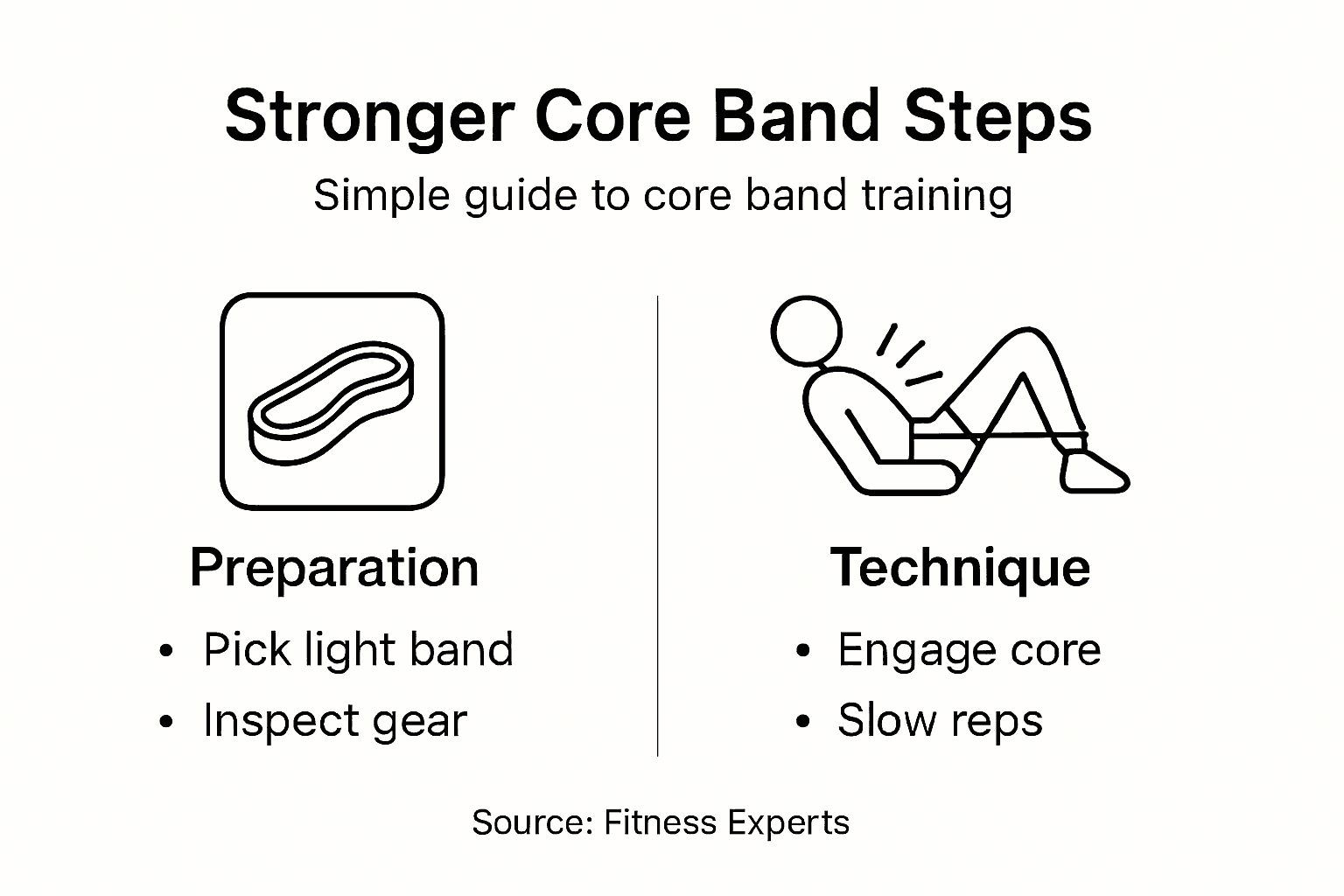
Pro tip: Always inspect your resistance bands for wear and tear before each workout to prevent unexpected snapping during core exercises.
Step 2: Set up a safe workout area with essential gear
Creating a dedicated and safe workout space is crucial for effective resistance band core training. Home workout equipment plays a vital role in establishing an environment that supports your fitness goals and minimizes injury risks.
To set up an optimal workout area for resistance band core exercises, consider these essential elements:
- Clear Space: Ensure at least 6-8 feet of unobstructed floor area
- Smooth Surface: Use exercise mat or clean, non-slip flooring
- Proper Lighting: Bright, well-lit area for visibility and safety
- Temperature Control: Comfortable room temperature for effective workouts
A well-prepared workout space is the foundation of consistent and safe training.
Your essential gear checklist should include:
- Thick exercise mat
- Resistance bands with various tension levels
- Water bottle
- Towel
- Optional: Mirror for form checking
Anchor Points Matter. When using resistance bands, ensure you have sturdy anchor points like a door frame, heavy furniture, or professional wall mounts. Avoid weak or unstable surfaces that could cause equipment failure during your workout.
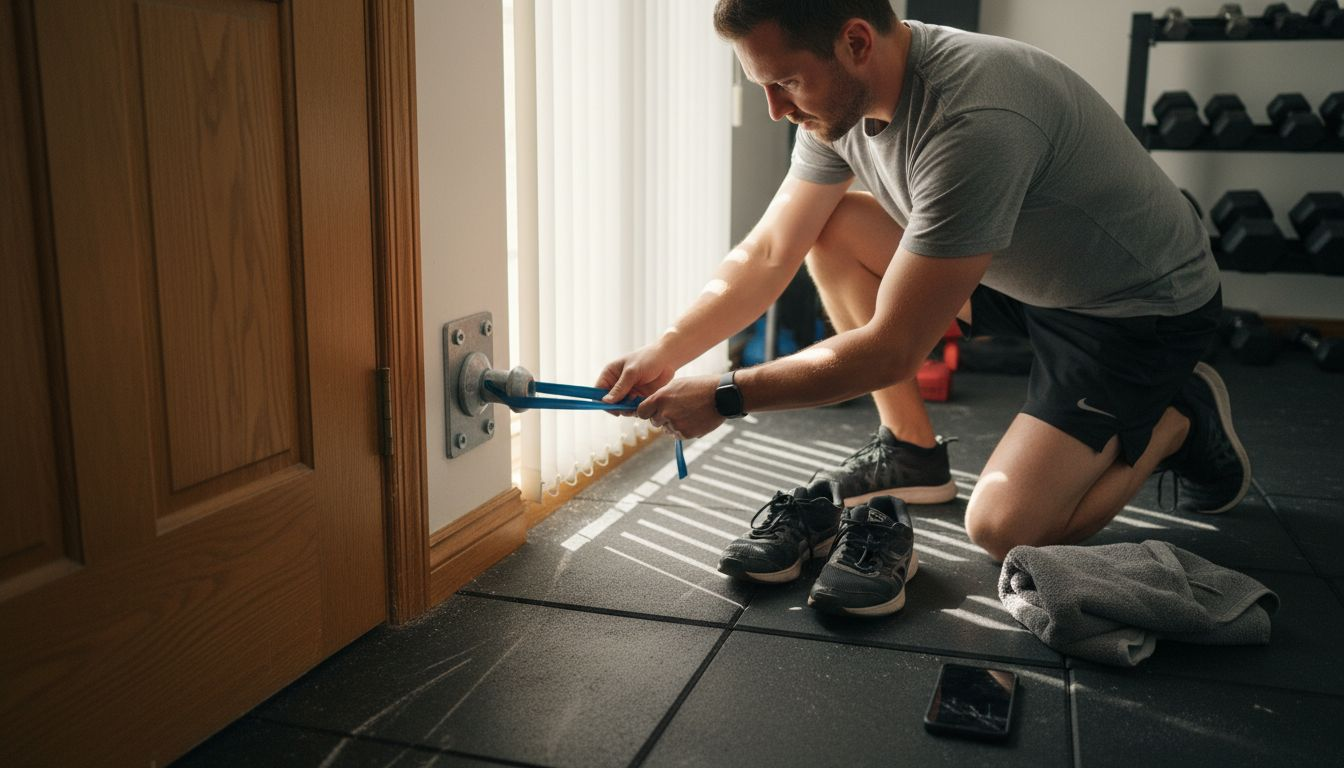
Pro tip: Always perform a quick equipment inspection before each workout to check for any signs of wear or potential safety hazards.
Step 3: Learn and perform core activation techniques
Mastering core activation techniques is fundamental to getting the most out of your resistance band abdominal workout. Core muscle engagement involves precise stabilization that goes far beyond simply contracting your abs.
To effectively activate your core muscles, focus on these critical elements:
- Neutral Spine: Maintain natural lower back curvature
- Breath Control: Use controlled, steady breathing
- Muscle Engagement: Contract muscles gently (about 30% effort)
- Posture Awareness: Keep pelvis and spine aligned
Core activation is a subtle art of muscle control, not brute force.
Core activation step by step:
- Stand or lie in a comfortable position
- Take a deep breath and relax your body
- Gently draw your belly button toward your spine
- Maintain a slight contraction without tensing completely
- Breathe normally while maintaining the engagement
Muscle Engagement Techniques require understanding the difference between forced tension and gentle activation. For men, imagine stopping urine flow midstream. For women, perform a gentle pelvic floor contraction. Avoid clenching or overexerting your muscles.
Pro tip: Practice core activation in front of a mirror to visually confirm your technique and muscle engagement.
Step 4: Execute targeted resistance band abdominal exercises
Resistance band core exercises provide dynamic muscle engagement that transforms your traditional abdominal workout. By incorporating bands, you’ll create constant tension that challenges your muscles in entirely new ways.
Target different core muscle groups with these essential resistance band exercises:
- Pallof Press: Builds anti-rotational core strength
- Standing Oblique Crunches: Targets side abdominal muscles
- Russian Twists: Engages entire core and improves rotational stability
- Side Planks with Band Resistance: Intensifies lateral core muscles
Resistance creates progress - your core muscles grow stronger with every controlled movement.
Execute these exercises with precision:
- Maintain proper core activation techniques
- Select appropriate band resistance
- Move slowly and with control
- Focus on muscle engagement, not momentum
- Breathe consistently throughout each movement
Technique Matters More Than Repetitions. Start with fewer, more controlled repetitions rather than rushing through multiple uncontrolled movements. Adjust band tension to match your current strength level, ensuring continuous muscle challenge without compromising form.
Pro tip: Rotate between different band resistance levels to prevent muscle adaptation and maintain consistent core strength progression.
Step 5: Monitor form and adjust resistance for optimal results
Proper form monitoring prevents injury during core workouts, transforming your resistance band training from potentially risky to highly effective. Understanding how to assess and adjust your technique ensures maximum muscle engagement and minimal strain.
Critical form monitoring techniques include:
- Visual Feedback: Use mirrors or video recording
- Body Alignment: Maintain neutral spine position
- Muscle Engagement: Focus on core activation
- Movement Control: Execute slow, deliberate motions
Small adjustments create significant improvements in workout effectiveness.
Resistance band form monitoring steps:
- Check your body alignment before starting
- Perform movements slowly and controlled
- Watch for compensatory muscle movements
- Adjust band tension if form breaks down
- Reset and restart if technique falters
Resistance Progression Requires Precision. Start with lighter bands and incrementally increase difficulty as your technique becomes more consistent. This approach prevents injury while steadily building core strength.
Pro tip: Record your workouts periodically to objectively analyze your form and track technique improvements over time.
Step 6: Evaluate progress and plan future core workouts
Tracking your resistance band core workout progression is crucial for continuous improvement and maintaining motivation. Understanding how to systematically assess your performance helps you design more effective training strategies.
Key metrics for tracking core workout progress include:
For optimal progress, track these resistance band core workout metrics over time:
| Metric | What It Shows | How To Use |
|---|---|---|
| Repetition Count | Endurance level | Spot fatigue trends |
| Resistance Level | Strength progression | Gauge muscle growth |
| Exercise Variety | Functional coverage | Prevent adaptation |
| Recovery Time | Rest effectiveness | Fine-tune intensity |
- Repetition Count: Number of reps per set
- Resistance Level: Band tension and difficulty
- Exercise Variety: Range of movements performed
- Recovery Time: Rest periods between workouts
Progress is not linear - embrace small improvements and consistent effort.
Progress evaluation steps:
- Record initial baseline measurements
- Document each workout’s details
- Compare performance every 2-4 weeks
- Adjust resistance and complexity accordingly
- Modify workout plan based on results
Progressive Overload Matters. Gradually increase band resistance or complexity to continuously challenge your core muscles. Avoid stagnation by introducing new exercise variations that target different muscle groups and movement patterns.
Pro tip: Create a digital or physical workout journal to objectively track your resistance band core training progress and identify long-term trends.
Unlock Your Stronger Core with the Right Resistance Bands Today
If you are looking to maximize your core workouts and overcome challenges like maintaining proper form and gradual strength progression, the right equipment can make all the difference. This article highlights the importance of core activation techniques and using varied resistance levels to avoid plateaus. Armageddon Sports offers a wide selection of Resistance Training Bands designed to meet your specific fitness goals and accommodate all strength levels.

Don’t settle for ordinary core workouts that fail to produce lasting results. Take control of your fitness journey by shopping quality resistance bands that support safe and effective training. Explore our full range of fitness gear and wellness equipment at Armageddon Sports and discover how the right tools can accelerate your progress. Start building a stronger core now with expert-approved resistance bands and workout essentials that keep you motivated and injury-free.
Visit Buy Resistance Training Bands- Armageddon Sports to browse premium options tailored for core strength improvement and explore Shop Women’s Health & Workout Equipment- Armageddon Sports for complementary training aids. Begin your transformation today and experience a core workout that truly delivers.
Frequently Asked Questions
What are the best resistance band exercises for abdominal strength?
Resistance band exercises like the Pallof Press, Standing Oblique Crunches, and Russian Twists are effective for building abdominal strength. Choose a few exercises that target different areas of your core and incorporate them into your routine at least twice a week.
How do I properly activate my core before doing resistance band workouts?
To properly activate your core, maintain a neutral spine, control your breathing, and gently contract your muscles. Start by drawing your belly button toward your spine and hold that engagement throughout your workout to maximize effectiveness.
How can I measure my progress in resistance band abdominal workouts?
You can measure your progress by tracking metrics such as repetition count, resistance level, and exercise variety. Document these details after each workout and review them every 2-4 weeks to identify improvements and adjust your training plan accordingly.
What should I look for when selecting resistance bands for core training?
Choose resistance bands based on type, resistance level, material quality, and comfort. Aim for bands that suit your current fitness level and feel comfortable during exercise to enhance your core training experience.
How often should I change my resistance band workouts to see better results?
To see better results, consider changing your resistance band workouts every 4-6 weeks. This can include varying your exercises, increasing resistance, or adjusting the number of repetitions to prevent plateaus and encourage continuous muscle growth.
Recommended
- How to Use Resistance Bands for Effective Toning Results – Armageddon Sports
- Ab Machine Benefits – Transforming Home Core Training – Armageddon Sports
- Abdominal Straps for Hanging: Boosting Core Workouts – Armageddon Sports
- Best Hanging Ab Straps—Pull-Up Bar Exercises To Train Your Abs [Guide] – Armageddon Sports