
Choosing the right gym equipment can feel overwhelming when hundreds of options promise similar results. The key is understanding a few critical evaluation criteria that separate genuinely effective gear from expensive clutter. This guide breaks down gym equipment types by muscle activation, safety features, space requirements, and budget considerations so you can confidently invest in tools that match your training goals and deliver measurable progress.
Table of Contents
- How To Choose Gym Equipment: Key Selection Criteria
- Free Weights: Description, Strengths, And Best Use Cases
- Weight Machines: Safety, Benefits, And Ideal Users
- Cardio Equipment Types And Functional Benefits
- Accessories And Specialty Equipment: Enhancements For Training And Recovery
- Comparing Equipment Types: Free Weights, Machines, And Cardio
- Situational Picks: Choosing The Right Equipment For Your Goals
- Boost Your Training With Top-Quality Gym Equipment And Accessories
Key takeaways
| Point | Details |
|---|---|
| Selection depends on five core factors | Muscle activation potential, safety features, space constraints, budget limits, and specific fitness goals determine the best equipment choices. |
| Free weights maximize muscle engagement | Dumbbells, barbells, and kettlebells offer the highest versatility and compound movement benefits but require proper technique. |
| Machines prioritize safety and control | Weight machines guide movements to reduce injury risk, making them ideal for beginners and rehabilitation contexts. |
| Cardio equipment varies in joint impact | Ellipticals produce 20-30% less joint stress than treadmills while bikes offer space-efficient cardiovascular training. |
| Accessories enhance performance and safety | Belts, straps, gloves, and resistance bands prevent injuries and add training variety without major space or cost investments. |
How to choose gym equipment: key selection criteria
Muscle activation potential determines how effectively equipment builds strength and size. Compound movements that engage multiple muscle groups simultaneously deliver superior hypertrophy results compared to isolated exercises. Research consistently shows that equipment allowing natural movement patterns produces better functional strength gains.
Safety considerations matter more than most buyers realize. Your skill level directly influences injury risk with certain equipment types. Beginners benefit from guided movement paths that enforce proper form, while experienced lifters can safely handle equipment requiring stabilizer muscle engagement and balance control.
Space and portability shape practical purchasing decisions. Home gyms demand compact, multi-functional equipment that maximizes training variety within limited square footage. Commercial facilities can accommodate larger machines, but even they must balance floor space against member usage patterns and traffic flow.
Budget impacts both initial investment and long-term value. Quality equipment lasts decades with proper maintenance, making upfront cost less important than durability and functionality. Adjustable options often provide better value than fixed-weight alternatives by consolidating multiple pieces into one versatile tool.
Fitness goals guide equipment selection more than any other factor. Strength-focused programs require progressive overload capabilities, hypertrophy training benefits from varied resistance angles, and cardiovascular conditioning demands sustained heart rate elevation with manageable joint stress. Matching equipment to your primary objective ensures your investment actually supports measurable progress.
Pro Tip: Write down your top three fitness goals before shopping. Reference this list when evaluating equipment to avoid impulse purchases that look impressive but don’t serve your actual training needs. For comprehensive guidance on essential gear, explore the home gym equipment essentials 2026 guide.
Free weights: description, strengths, and best use cases
Free weights include dumbbells, barbells, and kettlebells, each offering distinct training advantages. Dumbbells enable unilateral exercises that correct muscle imbalances and provide a natural range of motion. Barbells allow heavier loads for compound lifts like squats, deadlifts, and bench presses that form the foundation of strength programs. Kettlebells combine strength and cardiovascular training through dynamic movements like swings and snatches.
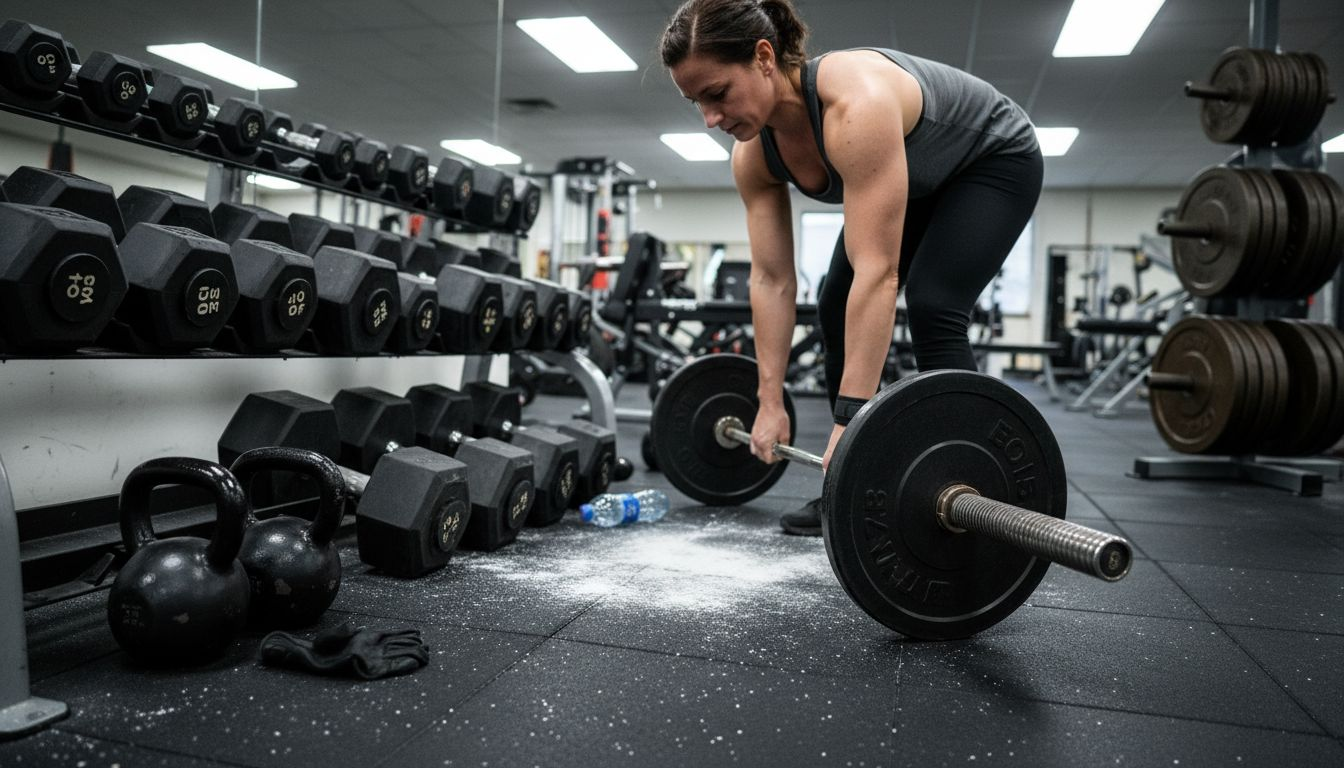
These tools enable compound exercises that simultaneously activate multiple muscle groups. A single barbell squat engages quadriceps, hamstrings, glutes, core stabilizers, and even upper back muscles. This comprehensive activation makes free weights more effective for muscle growth than machines targeting isolated muscles.
Progressive overload becomes straightforward with free weights. Adding small weight increments weekly drives continuous strength and size gains. Most commercial gyms stock dumbbells in 2.5 to 5 pound increments and barbells accept fractional plates as small as 0.5 pounds, enabling precise load progression that matches your recovery capacity.
Safety requires proper technique and awareness. Free weights demand balance and stabilization that machines provide automatically. New lifters should learn foundational movement patterns with lighter loads before attempting maximal lifts. Spotters become essential for heavy pressing and squatting exercises.
Cost and space efficiency favor free weights over machines. A quality adjustable dumbbell set replaces an entire rack of fixed weights, saving thousands in equipment costs and dozens of square feet. Barbells require minimal floor space when stored vertically on wall mounts. For space-saving strategies, review the home gym equipment essentials 2026 guide.
Pro Tip: Invest in fractional plates (0.5 to 1.25 pounds) early in your training journey. These small increments enable sustainable weekly progression on pressing and overhead movements where adding five pounds creates too large a jump for consistent success.
Weight machines: safety, benefits, and ideal users
Weight machines guide resistance along predetermined paths that enforce consistent movement patterns. This design reduces injury risk by eliminating the balance and coordination challenges inherent in free weight exercises. The controlled motion makes machines particularly valuable when fatigue compromises form during final sets.
Muscle activation levels run lower compared to free weights because machines eliminate stabilizer muscle recruitment. However, this isolation benefit allows targeted muscle development and helps beginners build foundational strength safely. Machines excel in rehabilitation contexts where injury recovery requires controlled loading without balance demands.
Beginners gain confidence using machines that remove technique barriers. The guided motion paths prevent common form errors that cause injuries in novice free weight users. Visual weight stack markings simplify load selection and progression tracking without requiring plate math or barbell loading knowledge.
Cost and space requirements generally exceed free weight options. Quality commercial machines range from several hundred to several thousand dollars per unit. Each machine occupies significant floor space while typically serving only one or two exercise variations. Home gym budgets often accommodate only a few select machines compared to comprehensive free weight setups.
Isolation exercises complement free weight programs effectively. After completing compound barbell movements, machines allow targeted volume on specific muscles without taxing stabilizers already fatigued from earlier work. This combination approach maximizes both functional strength and aesthetic muscle development. For safety-focused training tools, check out gym accessories for safety and performance.
Cardio equipment types and functional benefits
Treadmills deliver high calorie expenditure through natural walking and running mechanics. The belt-driven surface accommodates various speeds and incline angles that simulate outdoor terrain. However, repetitive impact forces create higher joint stress, particularly in knees and ankles. Runners with existing joint concerns should limit treadmill volume or choose lower-impact alternatives.
Elliptical trainers combine upper and lower body movement in a smooth, continuous motion. Studies demonstrate ellipticals produce 20-30% less joint stress compared to treadmills while maintaining similar cardiovascular benefits. The reduced impact makes ellipticals ideal for long-term cardio training without cumulative joint damage that sidelines treadmill-dependent athletes.
Stationary bikes offer space-efficient cardiovascular training suitable for all fitness levels. Recumbent models provide back support for users with lower back sensitivity, while upright bikes engage core muscles more actively. Cycling eliminates impact forces entirely, making bikes the lowest-risk cardio option for injury-prone individuals or those recovering from lower body injuries.
Equipment selection depends on your cardio objectives and injury history. Fat loss benefits from any modality performed consistently at appropriate intensities. Athletic conditioning often requires sport-specific equipment matching competition demands. Joint health concerns should prioritize low-impact options regardless of calorie burn differences.
Price ranges span from budget to commercial quality. Consumer-grade treadmills start around several hundred dollars but may lack durability for daily use. Commercial units costing several thousand dollars withstand heavy use and offer superior warranties. For balancing home and gym training, read home workout vs gym training.
Accessories and specialty equipment: enhancements for training and recovery
Weightlifting belts provide spinal support during heavy compound lifts. The rigid belt creates intra-abdominal pressure that stabilizes the spine under maximal loads. Research shows belts reduce spinal compression forces by 20-40% during squats and deadlifts. Proper belt use involves bracing against the belt, not simply wearing it passively.
Resistance bands deliver portable, versatile training options. Loop bands provide accommodating resistance that increases throughout movement ranges, challenging muscles differently than constant-load free weights. Bands work effectively for warm-ups, rehabilitation exercises, and travel workouts when access to traditional equipment becomes limited.
Gloves and straps improve grip security and reduce hand injuries. Lifting gloves prevent calluses and blisters during high-volume training sessions. Wrist straps allow continued training when grip strength fails before target muscles reach fatigue, extending productive training volume on pulling exercises.
Specialty gear prevents injuries and supports recovery. Knee sleeves provide warmth and mild compression that reduces joint stress during squatting movements. Wrist wraps stabilize wrist joints during heavy pressing exercises. Foam rollers facilitate myofascial release that accelerates recovery between training sessions.
Accessories complement main equipment for balanced performance. A well-equipped training space combines free weights or machines with targeted accessories addressing individual needs and weaknesses. Strategic accessory selection often delivers disproportionate value relative to cost. Learn more about performance-enhancing tools at maximize strength gains with gym accessories and safety-focused options at choosing weightlifting gear for safety.
Comparing equipment types: free weights, machines, and cardio
| Equipment Type | Muscle Activation | Safety Level | Space Needs | Cost Range | Ideal Users |
|---|---|---|---|---|---|
| Free Weights | Highest (compound movements engage multiple muscle groups) | Moderate (requires technique skill) | Moderate (adjustable options save space) | Low to moderate (dumbbells and barbells offer best value) | Intermediate to advanced lifters focused on strength and hypertrophy |
| Weight Machines | Moderate (isolation focus with reduced stabilizer engagement) | Highest (guided paths prevent form errors) | Large (each machine serves limited exercises) | High (commercial quality units cost thousands) | Beginners, rehabilitation clients, and isolation exercise needs |
| Cardio Equipment | Low muscle building, high cardiovascular benefit | Varies (ellipticals lowest impact, treadmills higher joint stress) | Varies (bikes compact, treadmills require dedicated space) | Moderate to high (quality units justify investment) | All levels seeking cardiovascular conditioning and calorie expenditure |
Muscle activation patterns differ substantially across equipment categories. Free weights require stabilizer muscle engagement that machines eliminate through guided movement paths. This distinction matters more for functional strength goals than pure aesthetic muscle development. Cardio equipment focuses entirely on cardiovascular adaptation rather than muscle building.
Safety considerations shift based on user experience and injury history. Machines minimize technique-related injury risk but may encourage poor movement patterns if users ignore proper setup. Free weights demand coaching investment upfront but develop body awareness that transfers across all physical activities.
Space planning determines home gym feasibility. Urban apartment dwellers benefit from compact free weight setups or fold-away cardio machines. Suburban garage gyms accommodate larger equipment arrays. Commercial facilities must balance member preferences against floor space economics and maintenance costs.
Cost analysis should consider cost per exercise variation and equipment lifespan. A single barbell and plate set enables dozens of exercises for decades. Individual machines cost more while serving fewer movement patterns. Cardio equipment requires periodic belt replacements and electronic maintenance. For comprehensive home gym planning, visit the home gym equipment essentials 2026 guide and home workout equipment ideas 2026.
Situational picks: choosing the right equipment for your goals
Home gyms with limited space maximize value through adjustable dumbbells and resistance bands. A quality adjustable dumbbell set replaces 15-20 pairs of fixed dumbbells while occupying minimal floor space. Bands provide hundreds of exercise variations in a storage bag smaller than a shoebox. Wall-mounted pull-up bars and suspension trainers add bodyweight training options without consuming floor space.
Beginners build safe strength foundations using machines that enforce proper movement patterns. The guided resistance paths prevent form breakdowns that cause injuries when technique knowledge remains incomplete. Start with fundamental machine exercises for 8-12 weeks before transitioning to free weights as movement competence develops.
Advanced bodybuilders prioritize free weights for maximal hypertrophy stimulus. The stabilizer muscle recruitment and natural movement arcs produce superior muscle activation compared to fixed machine paths. Competitive physique athletes supplement free weight programs with targeted machine isolation work during high-volume training phases.
Cardio-focused users should select low-impact equipment protecting joint health. Elliptical trainers and stationary bikes enable sustainable high-frequency cardio training without cumulative stress injuries. Treadmill users benefit from incorporating elliptical sessions to reduce weekly impact volume while maintaining cardiovascular conditioning.
Accessory selections support specific workout styles and recovery needs:
- Powerlifters require belts, wrist wraps, and knee sleeves for maximal lift support
- Bodybuilders benefit from straps extending pulling exercise volume and gloves protecting hands during high-volume training
- CrossFit athletes need jump ropes, resistance bands, and gymnastics grips for varied functional fitness work
- General fitness enthusiasts gain value from foam rollers, resistance bands, and basic lifting gloves
For balancing training environments, explore home workout vs gym training. Essential home equipment guidance appears at home workout equipment essentials. Safety and performance gear details live at types of weightlifting gear essentials.
Boost your training with top-quality gym equipment and accessories
Armageddon Sports provides comprehensive gym equipment selections matching the evaluation framework you just learned. Whether you need versatile free weights, safety-focused machines, or performance-enhancing accessories, the curated collections help you find gear supporting your specific training goals.
Explore fitness accessories that maximize workout safety and performance. Find weightlifting belts providing essential spinal support during heavy compound lifts. Browse complete lifting gear collections featuring straps, gloves, and specialty items that prevent injuries while extending productive training volume. Quality equipment investments made in 2026 deliver decades of reliable performance supporting your fitness journey.
FAQ
What is the safest gym equipment for beginners?
Weight machines offer the highest safety level for new lifters because guided movement paths reduce injury risk from technique errors. The predetermined resistance paths enforce consistent form even when fatigue sets in during final repetitions. Beginners can also safely use cardio equipment like elliptical trainers that provide low-impact cardiovascular training without complex movement patterns requiring extensive coaching.
How much space do I need for a home gym setup?
Space requirements vary dramatically based on equipment choices. Adjustable dumbbells and resistance bands create effective training environments in spaces as small as 6x6 feet. Weight machines typically require dedicated rooms of 10x10 feet or larger. Careful planning around multi-functional equipment like adjustable benches and wall-mounted storage maximizes training variety within limited square footage.
Can I build muscle effectively using only machines?
Machines enable safe, controlled muscle training that produces results, especially for beginners establishing strength foundations. However, free weights generally deliver superior muscle activation and hypertrophy potential through compound movements engaging multiple muscle groups simultaneously. Combining both equipment types optimizes results by leveraging machine safety for isolation work while using free weights for foundational strength development.
What gym accessories should I prioritize?
Prioritize weightlifting belts first if you perform heavy squats or deadlifts, as they provide critical spinal support during maximal lifts. Lifting straps and gloves follow as secondary investments that improve grip security and protect hands during high-volume training. Resistance bands deserve early consideration for their exceptional versatility in warm-ups, rehabilitation exercises, and travel workouts when primary equipment becomes unavailable.