
Setting up a home gym shouldn’t mean sacrificing your living room or draining your savings. The right equipment can transform a cramped apartment into an effective strength training space. This guide walks you through versatile, affordable gear that maximizes results while minimizing footprint, helping you build strength without the gym membership or equipment clutter.
Table of Contents
- Selection Criteria: Choosing Home Workout Equipment Wisely
- Versatile Equipment: Adjustable Dumbbells
- Budget-Friendly Options: Resistance Bands
- Specialized Equipment: Kettlebells
- Summary Table And Situational Recommendations
- Discover Top Home Gym Gear To Transform Your Workouts
- Frequently Asked Questions
Key takeaways
| Point | Details |
|---|---|
| Prioritize versatility and space efficiency | Equipment that supports multiple exercises saves money and room while delivering comprehensive strength training. |
| Adjustable dumbbells maximize value | Replace entire racks, save up to 85% space, and enable progressive overload for all fitness levels. |
| Resistance bands offer budget flexibility | Cost 70% less than free weights while providing effective muscle activation and portability. |
| Kettlebells boost explosive power | Improve power and endurance by 20% through ballistic exercises that complement traditional lifting. |
| Match equipment to your specific goals | Consider your space, budget, and training focus before investing in home strength gear. |
Selection criteria: choosing home workout equipment wisely
Before clicking “buy,” assess your unique situation. Your equipment choices should align with your space constraints, budget reality, and fitness objectives.
Start by measuring your actual workout area. A 6x6 foot corner can accommodate adjustable dumbbells and bands, while a full spare room opens possibilities for benches and compact stations. Experts rank versatility and return on investment as top criteria for home strength training equipment.
Consider these priorities:
- Versatility: Choose gear supporting 10+ exercises to maximize workout variety
- Budget alignment: Quality basics beat cheap all-in-one systems every time
- Space footprint: Measure twice, buy once to avoid cluttered regret
- Goal specificity: Match equipment to whether you’re building mass, power, or endurance
- Durability focus: Well-built gear lasts years and maintains resale value
Pro Tip: Start with one versatile piece like adjustable dumbbells rather than buying multiple specialized items. You can always expand as your routine evolves.
Your strength training selection criteria should balance these factors. A $300 set of quality adjustables beats a $500 machine gathering dust because it doesn’t fit your actual training style.
Versatile equipment: adjustable dumbbells
Adjustable dumbbells solve the home gym’s biggest challenge: providing progressive resistance without hoarding dozens of fixed-weight pairs. Adjustable dumbbells save up to 85% space compared to traditional racks and are top-ranked for versatility.
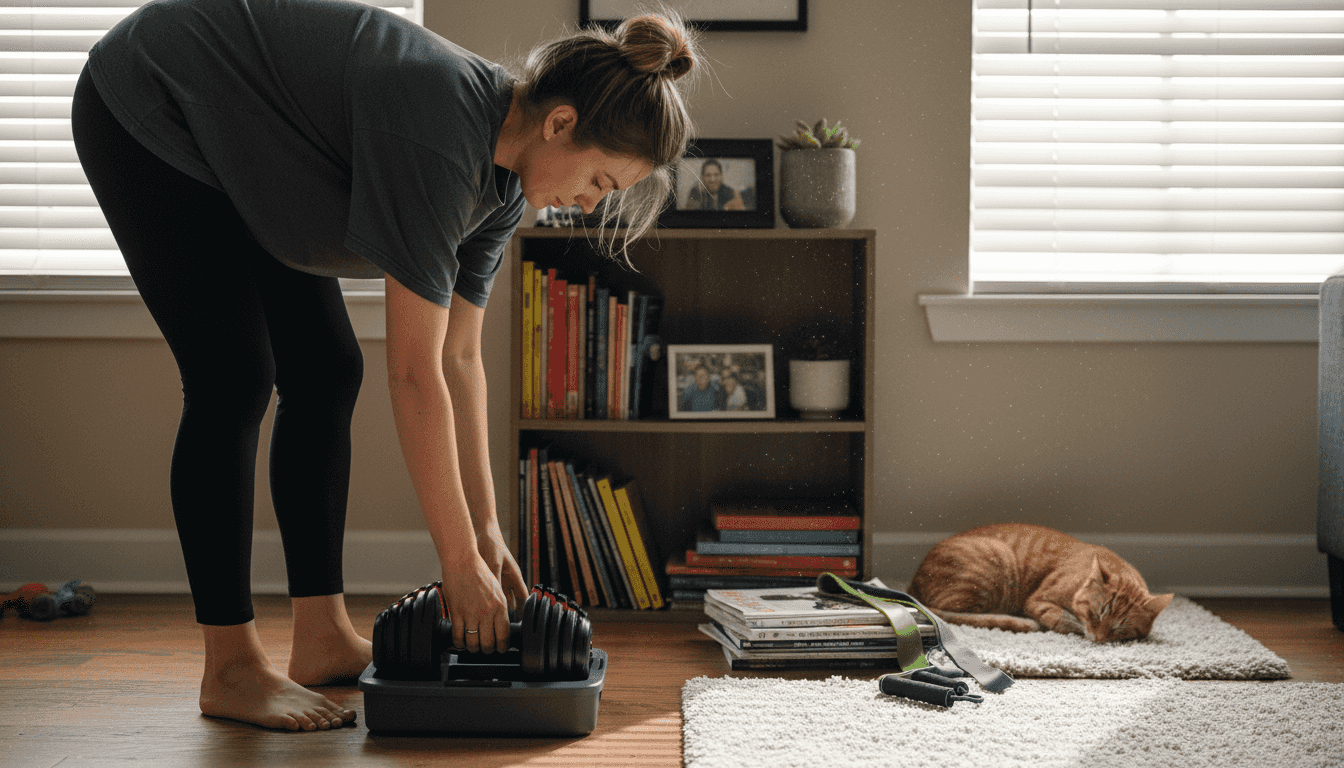
These compact powerhouses replace an entire wall of weights with a single set. Modern dial systems let you switch from 5 to 50 pounds in seconds, supporting everything from bicep curls to goblet squats.
Key advantages include:
- Space efficiency: Two adjustable sets occupy less than 3 square feet
- Progressive overload: Increment by 2.5 to 5 pounds as you strengthen
- Exercise variety: Press, curl, row, lunge, and fly with the same equipment
- Mid-range investment: Quality sets run $200 to $400, less than buying individual pairs
- Long-term durability: Metal construction withstands years of daily use
“Adjustable dumbbells are the single best investment for home strength training. They adapt to your progress and never become obsolete.” — Fitness equipment experts
Pro Tip: Look for models with a secure locking mechanism and comfortable grip texture. Cheaper sets with loose plates create safety risks during dynamic movements.
The adjustable dumbbell essentials and space-saving tips highlight how these tools anchor effective home routines. They’re equally valuable for beginners learning form and advanced lifters chasing muscle gains.
Budget-friendly options: resistance bands
When your budget is tight but your fitness goals aren’t negotiable, resistance bands deliver remarkable value. Resistance bands cost about 70% less than free weights while enabling effective strength training.
A complete band set with varying resistance levels typically costs $30 to $80. Compare that to $200+ for a basic dumbbell collection, and the savings become clear.
Bands excel in several areas:
- Portability: Pack them for travel or outdoor workouts without bulk
- Storage simplicity: Hang on a hook or toss in a drawer when not in use
- Joint-friendly resistance: Variable tension reduces injury risk for beginners
- Versatility: Anchor to doors, wrap around poles, or loop under feet for hundreds of exercises
- Scalability: Stack multiple bands to increase resistance as you progress
They’re particularly effective for muscle activation work, rehabilitation exercises, and endurance-focused training. Many athletes use bands to warm up before heavy lifting or add accommodating resistance to barbell movements.
Pro Tip: Invest in a set with fabric bands rather than latex tubes. Fabric versions last longer, feel more comfortable, and won’t snap unexpectedly during use.
The affordable resistance band options guide shows how to build full-body strength with minimal investment. Bands complement rather than replace free weights, giving you training flexibility without financial strain.
Specialized equipment: kettlebells
Kettlebells bring a unique training stimulus that dumbbells can’t replicate. Their offset center of gravity makes them ideal for ballistic exercises like swings, snatches, and cleans.
Kettlebells enhance power and endurance more effectively than dumbbells for ballistic exercises, improving performance by 20%. This advantage comes from the momentum-based movements that kettlebell training emphasizes.
Consider kettlebells if you want:
- Explosive power development: Swings and snatches build hip drive and athleticism
- Cardiovascular conditioning: High-rep kettlebell circuits elevate heart rate while building strength
- Core integration: The offset load forces constant stabilization during movements
- Functional strength: Kettlebell patterns mirror real-world lifting and carrying
- Compact footprint: One or two bells serve multiple training purposes
A 16kg (35lb) kettlebell works for most beginners, while intermediate lifters often use 20-24kg. Unlike adjustable dumbbells, you’ll likely buy 2-3 fixed weights over time to support different exercises.
“Kettlebell training bridges the gap between pure strength work and athletic conditioning. The ballistic movements develop a type of power that static dumbbell exercises can’t match.” — Strength coaches
Prices range from $40 to $100 per bell depending on weight and quality. The kettlebells for power training resource explains proper technique and programming to maximize results while avoiding injury.
Summary table and situational recommendations
Different equipment serves different needs. This comparison helps you match gear to your specific constraints and goals.
| Equipment Type | Price Range | Space Required | Exercise Variety | Best For |
|---|---|---|---|---|
| Adjustable Dumbbells | $200-$400 | 3-4 sq ft | 50+ exercises | General strength, progressive overload |
| Resistance Bands | $30-$80 | 1 sq ft | 75+ exercises | Budget training, travel, rehab |
| Kettlebells | $40-$100 each | 2-3 sq ft per bell | 30+ exercises | Power, conditioning, athleticism |
| Compact Home Gym | $500-$1500 | 25-50 sq ft | 40+ exercises | Comprehensive routines, cable work |
| Pull-Up Bar | $30-$150 | Doorway or wall | 10+ exercises | Upper body, core strength |
Experts rank adjustable dumbbells, resistance bands, and compact home gyms as the top three for versatility and ROI.
Here’s how to choose based on your situation:
- Tight budget (under $150): Start with resistance bands and a pull-up bar for comprehensive upper body and accessory work
- Limited space (under 100 sq ft): Adjustable dumbbells plus bands cover nearly every strength movement without clutter
- Power focus: Invest in 2-3 kettlebells at different weights to build explosive strength and conditioning
- Comprehensive training: Add an adjustable bench to your dumbbells for chest pressing and incline work
- Advanced lifters: Consider a compact home gym or power rack if you have the space and budget for barbell training
The equipment comparison and picks guide dives deeper into building a complete home setup progressively. Start small, master what you have, then expand strategically as your training demands grow.
Discover top home gym gear to transform your workouts
You’ve learned what makes home equipment effective. Now it’s time to equip your space with gear that matches your goals.
Armageddon Sports carries the adjustable dumbbells, resistance bands, and kettlebells that transform cramped spaces into strength-building stations. Our fitness accessories collection includes everything from weight belts to grip enhancers, while the lifting equipment section features specialized gear for serious training. Whether you’re setting up your first home gym or upgrading existing equipment, our home gym essentials guide helps you make informed decisions. Stop paying for gym memberships you barely use. Build strength on your schedule with equipment that fits your space and budget.
Frequently asked questions
What is the most space-efficient strength training equipment for small homes?
Adjustable dumbbells top the list, replacing entire racks while occupying just 3-4 square feet. Resistance bands run a close second since you can store them in a drawer. Both options support 50+ exercises without dominating your living area.
Can resistance bands replace free weights for strength gains?
Bands build muscle effectively, especially for beginners and intermediate lifters. However, they lack the progressive overload precision that heavy free weights provide. The best approach combines both: use bands for warm-ups, accessories, and travel, while relying on dumbbells or kettlebells for primary strength movements.
Are kettlebells suitable for beginners wanting to improve power?
Yes, but start with proper coaching on technique. Kettlebell swings are simple but not easy, and poor form leads to back strain. Begin with a lighter weight (12-16kg) and focus on hip hinge mechanics. Once you master the basics, kettlebells become one of the most effective tools for building explosive strength.
How much budget should I allocate for versatile home workout gear?
A solid starter setup costs $250 to $400. That gets you adjustable dumbbells ($200-$300), resistance bands ($40-$60), and a pull-up bar ($30-$50). This combination supports full-body training for years. Add equipment gradually as your routine demands more variety.
Do compact home gyms justify the higher cost for home use?
It depends on your training style and available space. If you need cable exercises and prefer machine-based training, a $800-$1200 compact gym makes sense. However, most people get better value from adjustable dumbbells, bands, and a bench. Machines shine for isolation work but can’t match free weights for building functional strength and athleticism.