
TL;DR:
- Proper planning and organization are essential for a safe, effective, and motivating home gym.
- Versatile equipment supporting progressive overload maximizes results within limited space and budget.
- Consistency, smart programming, and discipline are more important than complex gear for building muscle at home.
Most home gyms fail not because the person gives up, but because the setup itself works against them. Cluttered corners, mismatched gear, and zero plan for progression turn a promising space into an expensive storage room. The good news? A few deliberate decisions about space, equipment, and layout can flip that completely. This guide walks you through every step: assessing your real-world constraints, selecting gear that grows with you, arranging your space safely, building a routine that delivers actual muscle and strength gains, and keeping the whole thing running long-term.
Table of Contents
- Assessing your space, goals, and budget
- Choosing versatile equipment for muscle and strength gains
- Arranging and organizing your space for safety and efficiency
- Programming effective home routines for real results
- Maximizing return on investment and troubleshooting common pitfalls
- Expert perspective: Why simplicity and consistency beat complexity in home training
- Take the next step: Equip your home gym for success
- Frequently asked questions
Key Takeaways
| Point | Details |
|---|---|
| Plan before buying | Measure your space, set goals, and budget to avoid wasted purchases and ensure your setup fits your needs. |
| Start simple, upgrade later | Effective setups often begin with just dumbbells and bands; expand only as you outgrow them. |
| Organize for safety | Arrange equipment for safe movement, adding flooring and clearance zones to prevent injury. |
| Prioritize consistency | Regular, intelligently programmed workouts matter more than the amount or cost of your equipment. |
| Use progressive overload | Increase challenge over time through more reps, sets, or resistance to keep building muscle at home. |
Assessing your space, goals, and budget
Before you buy a single piece of equipment, measure everything. Ceiling height matters as much as floor space. You need at least 7 to 8 feet of clearance overhead for overhead pressing or pull-up bars, and a minimum of 2 to 3 feet of open space around each piece of equipment for safe movement. The home gym setup process starts with exactly this kind of honest audit before anything else.
Here are the three space tiers most home gym builders fall into:
| Setup level | Floor space | Best for |
|---|---|---|
| Minimal | 50 sq ft (3x6 to 6x6 ft) | Bands, dumbbells, bodyweight |
| Medium | 80 sq ft (8x10 ft) | Bench, rack, free weights |
| Full | 100+ sq ft (10x10 ft+) | Multi-station setups |
According to space benchmarks for home gyms, rubber flooring runs $1 to $3 per square foot, which is one of the smartest early investments you can make. It protects your floor, reduces noise, and gives you a stable surface for lifting.
Now match your space to your actual goals. Someone focused on general health and muscle toning needs very different gear than someone chasing a 300-pound deadlift. Be specific. “Get stronger” is not a goal. “Add 20 pounds to my squat in 12 weeks” is.
On budget, here is a realistic breakdown:
- Minimal setup: $200 to $500 (adjustable dumbbells, bands, mat)
- Medium setup: $800 to $1,500 (add a bench and basic barbell set)
- Advanced setup: $2,000 to $5,000+ (power rack, full plate collection, accessories)
The ROI math works strongly in your favor. A commercial gym membership runs $480 to $960 per year. A solid home setup pays for itself in 3 to 5 years, and you keep the equipment indefinitely. Before you spend anything, read through our home gym essentials guide and get clear on what home gym equipment actually covers.
Choosing versatile equipment for muscle and strength gains
Once you know your space and budget, equipment selection becomes straightforward. The goal is maximum training variety per dollar spent, not maximum gear per square foot.
| Level | Key equipment | Approx. cost |
|---|---|---|
| Starter | Adjustable dumbbells, resistance bands, flat bench | $150 to $400 |
| Intermediate | Power rack, barbell, weight plates | Add $600 to $1,200 |
| Advanced | Kettlebells, pull-up bar, cable attachment | Add $300 to $700 |
Core equipment for strength and toning follows this exact progression, with adjustable dumbbells serving as the most versatile starting point for most people.
For small spaces and apartments, adjustable dumbbells and resistance bands are hard to beat. They cover hundreds of exercises, take up almost no floor space, and allow consistent progression. A minimalist setup under $500 actually excels for beginners and those focused on toning because consistency and simplicity beat complexity every time at that stage.
The single most important principle in equipment selection is whether it supports progressive overload, meaning your ability to gradually increase resistance over time. Without that, you plateau fast. Bands come in multiple resistance levels. Adjustable dumbbells let you add weight in small increments. Barbells allow near-unlimited load progression.
Pro Tip: Skip specialty machines in your first year. A cable crossover or leg press machine costs hundreds of dollars and trains a narrow range of movements. That same money buys you an adjustable dumbbell set and a pull-up bar that together cover your entire body.
Check out our equipment essentials list and our breakdown of 20 essential workout pieces to build your shopping list with confidence.
Arranging and organizing your space for safety and efficiency
Equipment selection is only half the work. How you arrange it determines whether your workouts are safe, efficient, and actually enjoyable. A poorly laid-out space creates hazards and kills motivation.
Follow these steps to map your layout:
- Sketch your floor plan on paper first. Mark doors, windows, and any fixed obstacles.
- Place your heaviest, least-moved items first (rack, bench) against walls or in corners.
- Leave open floor zones for stretching, bodyweight work, and kettlebell swings.
- Position mirrors on at least one wall to check form during lifts.
- Plan your storage with wall-mounted racks or a vertical dumbbell stand to keep the floor clear.
Safety warning: An unstable or overcrowded setup is a real injury risk. Tripping over loose plates or lifting near low ceilings causes serious accidents. Always prioritize clearance over fitting in more gear.
Ventilation is often ignored but matters a lot. A stuffy, overheated space tanks your performance and makes every session feel harder than it should. A fan or cracked window goes a long way. Mirrors and ventilation are consistently flagged as essentials by fitness experts, not luxuries.
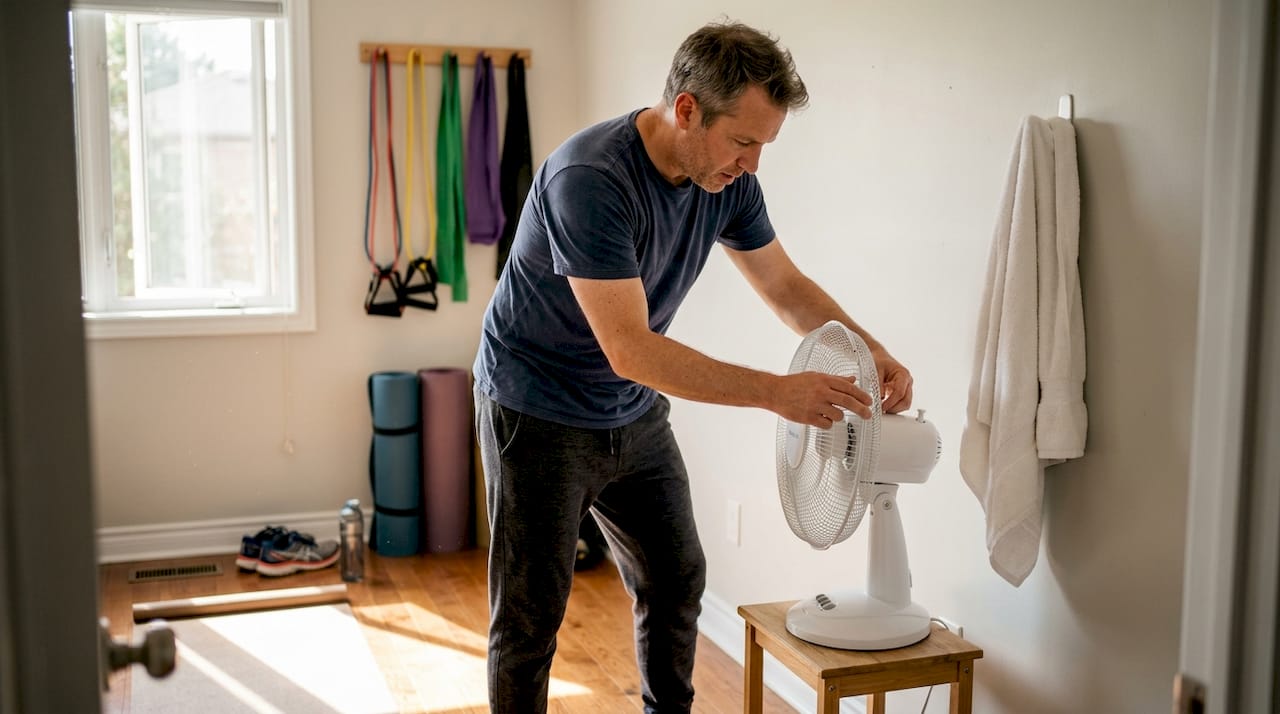
For small apartments, wall-mounted and foldable gear is a game changer. Foldable benches, wall-mount pull-up bars, and resistance bands stored on a single hook can turn a 6x8 ft corner into a fully functional training zone.
Pro Tip: Use colored zones or tape lines on your rubber flooring to separate your lifting area from your stretching area. It sounds simple, but having a defined space for each activity speeds up transitions and keeps your workout focused.
For more layout ideas, browse our space-saving ideas for home workout setups.
Programming effective home routines for real results
A well-arranged space with great gear still does nothing without a solid training program. Here is how to structure one that actually builds muscle and strength.
- Train 2 to 3 times per week using full-body sessions. This frequency optimizes recovery and muscle protein synthesis for most people.
- Lead with compound movements like squats, hinges, presses, and rows. These recruit the most muscle per exercise.
- Apply progressive overload every session by adding one rep, one set, or a small weight increase.
- Track your workouts. A simple notebook works. You cannot progress what you do not measure.
- Deload every 4 to 6 weeks by reducing volume by 40 to 50 percent to allow full recovery.
Full-body routines 2 to 3 times per week with consistent progressive overload is the most evidence-backed approach for home muscle building. Free weights enable near-unlimited progression for hypertrophy (muscle growth) when used this way.
For equipment progression, think in stages. Start with bands and bodyweight. Add dumbbells when bands feel too easy. Introduce a barbell when dumbbell loads become impractical. Bands and dumbbells are fully sufficient for complete full-body circuits and real toning results in apartment setups.
Avoid these common programming mistakes:
- Training the same muscles every day without rest
- Skipping lower body work because it is harder
- Ignoring rest and sleep as part of your program
- Jumping to advanced exercises before mastering basics
- Neglecting progressive overload entirely and doing the same workout for months
For a deeper look at structuring your sessions, our strength training at home resource covers this in detail.
Maximizing return on investment and troubleshooting common pitfalls
The average gym membership costs $480 to $960 per year. A minimal home setup builds muscle equivalently when used consistently, and your break-even point typically arrives within 3 to 5 years. After that, every workout is essentially free.
But the ROI only materializes if you actually use the space. Here are the most common reasons home gyms go unused and how to prevent each one:
- No clear routine: Fix this by scheduling workouts like appointments, not options.
- Cluttered, uninviting space: Spend 10 minutes after every session resetting the space.
- Boredom: Rotate exercise variations every 4 to 6 weeks to stay engaged.
- Plateau: Revisit your progressive overload strategy. Are you actually adding load or reps?
- Injury from poor form: Record yourself occasionally to catch technique issues early.
The key to long-term success is using what you have consistently before upgrading. Master your current setup for 6 to 12 months before adding new equipment. This builds the discipline and technical skill that actually drives results.
If progress stalls, the solution is rarely more gear. It is usually better programming, more sleep, or improved nutrition. Equipment upgrades make sense only after you have genuinely outgrown your current tools. For a full comparison of training environments, see our breakdown of home vs gym training.
Expert perspective: Why simplicity and consistency beat complexity in home training
Here is something the fitness industry rarely says out loud: most people do not need more gear. They need more reps with the gear they already have.
We see it constantly. Someone buys a full rack, a cable machine, and a set of specialty bars, uses the setup twice a week for a month, and then watches it collect dust. Meanwhile, someone else with a $200 adjustable dumbbell set and a pull-up bar trains four times a week for two years and looks completely transformed.
The trap is buying equipment as a substitute for discipline. A new purchase feels like progress. It is not. Progress is the workout you did on Tuesday when you did not feel like it.
Upgrade your gear when you have genuinely outgrown it, not when you are bored or stuck. Boredom and plateaus are programming problems, not equipment problems. Master a handful of movements with perfect form before adding complexity. That is what transforming your fitness at home actually looks like in practice.
Take the next step: Equip your home gym for success
You now have a clear framework: assess your space, choose versatile gear, arrange it safely, program with intention, and stay consistent. The next move is putting the right tools in your hands.
At Armageddon Sports, we stock everything from foundational lifting gear like belts, straps, and gloves to a full range of home gym accessories designed for real training environments. Whether you are building your first setup or upgrading after outgrowing your current gear, our catalog makes it easy to find exactly what you need. Our team is here to help you choose smart, spend well, and train harder.
Frequently asked questions
How much space do I need for an effective home workout setup?
A minimal setup needs around 50 sq ft, roughly a 3x6 to 6x6 foot area, but having 80 to 100 square feet opens up far more equipment and exercise options.
What is the most versatile single piece of equipment for home strength training?
Adjustable dumbbells cover the widest range of exercises in the smallest footprint, and they support both strength and hypertrophy progression through incremental weight increases.
How do I keep progressing with limited gear like bands or dumbbells?
Add reps, sets, and time under tension before moving to heavier resistance, and advance via overload by progressing to more challenging exercise variations as your strength improves.
What do I do if my home gym motivation drops off after a few months?
Rotate your exercise selection and rearrange your space slightly. If that does not help, a targeted upgrade after 6 to 12 months of consistent use is often the right move.
Is home training as effective as the gym for muscle building?
Yes. Minimal setups build muscle equivalently to commercial gyms when programming and effort are consistent, making your home setup a fully capable training environment.