
TL;DR:
- Choose equipment based on your goals, space, and budget for effective home workouts.
- Core items include adjustable dumbbells, resistance bands, a yoga mat, and an adjustable bench.
- Minimal, consistent equipment use beats complex setups; start simple and upgrade as needed.
Walk into any fitness retailer or scroll through any equipment site and you’ll face hundreds of options, each promising to transform your body. The sheer volume of choices makes it genuinely hard to know what you actually need versus what’s just clever marketing. This guide cuts through that noise with a criteria-driven approach, covering the core equipment categories, a side-by-side comparison of essentials versus extras, and expert-backed picks for every budget and space. Whether you’re starting from scratch or upgrading an existing setup, you’ll leave with a clear, actionable equipment list built around your goals.
Table of Contents
- How to choose your home workout essentials
- Core equipment for a versatile home workout
- Advanced options: Full-body trainers and specialty picks
- Comparing essentials: What you really need versus nice-to-have gear
- Why the perfect home gym doesn’t exist—and what matters most
- Equip your home gym for real results
- Frequently asked questions
Key Takeaways
| Point | Details |
|---|---|
| Space and goal driven choices | Select home workout equipment based on your fitness goals and available space for optimal results. |
| Essential gear for all levels | Dumbbells, resistance bands, and mats form the foundation for versatile strength and flexibility workouts. |
| Smart buying beats splurging | Prioritize usability and routine-alignment over purchasing bulky equipment you won’t use. |
| Budget-friendly setups work | Effective home gyms can be built for under $500 using multi-purpose, space-efficient items. |
| Consistency trumps equipment | Maintaining steady workout routines matters more than having perfect gear. |
How to choose your home workout essentials
Before you spend a single dollar, you need a framework. Buying equipment without a plan is how you end up with a treadmill that becomes a very expensive clothes rack. The smartest move is to start with three questions: What are your goals? How much space do you have? What’s your realistic budget?
Goals drive everything. If you want to build strength, you’ll prioritize resistance tools like dumbbells and barbells. If cardio and fat loss are the focus, you might lean toward jump ropes, resistance bands, or a compact cardio machine. Flexibility and recovery work calls for a quality mat and foam roller. Most people want a mix, which is why versatile, multi-use equipment almost always wins over single-purpose machines.
Space is the second filter. A spare bedroom gives you real options. A studio apartment corner means you need compact, storable gear. When choosing home gym essentials, experts recommend that beginners and small-space setups start with bodyweight training, bands, and a mat, then add dumbbells and a bench as the routine solidifies. Strength-focused lifters can layer in a rack and barbell once they’ve confirmed the space works. Space-saving equipment ideas are worth exploring before committing to anything bulky.
Here’s a simple tiered approach based on experience level:
- Beginner/small space: Yoga mat, resistance bands, a single pair of adjustable dumbbells
- Intermediate/strength-focused: Add an adjustable bench and a heavier dumbbell set
- Advanced/serious lifter: Power rack, barbell, weight plates, kettlebells
One thing the resistance training guidelines from the American College of Sports Medicine make clear is that equipment type does not consistently impact outcomes when effort and consistency are maintained. Bands, bodyweight, free weights, and machines all deliver results when you show up and work hard. That’s not a reason to buy cheap junk, but it is a reason to stop obsessing over having the “perfect” setup before you start.
“The best home gym is the one you actually use. Align your gear with your real habits, not your aspirational ones.”
Pro Tip: Start with two or three pieces you’ll use every single session. Add equipment only when your current tools genuinely limit your progress, not because something new looks appealing.
Core equipment for a versatile home workout
Now that you know how to select your essentials, let’s break down the most versatile core equipment. These four items form the foundation of almost every effective home setup, regardless of goal or experience level.
According to expert recommendations for 2026, the core workout items every home gym should include are adjustable dumbbells, resistance bands, a yoga or exercise mat, and an adjustable bench. Each one earns its place because of versatility, not just popularity.
Adjustable dumbbells
- Replace an entire rack of fixed weights in one compact unit
- Support progressive overload as you get stronger
- Work for upper body, lower body, and core exercises
- Drawback: Higher upfront cost than fixed dumbbells
Resistance bands
- Portable, lightweight, and incredibly versatile for strength training at home
- Add accommodating resistance, meaning the load increases as you reach peak strength in a movement
- Great for warm-ups, mobility work, and standalone strength sessions
- Drawback: Bands wear out over time and need periodic replacement
Yoga mat
- Essential for floor-based core work, stretching, and bodyweight training
- Provides cushioning and grip that protects joints and prevents slipping
- Doubles as a defined workout zone, which helps mentally separate training from relaxation
- Drawback: Thin mats offer little protection for heavy floor work
Adjustable bench
- Unlocks incline, flat, and decline positions for chest, shoulder, and back exercises
- Pairs with dumbbells to dramatically expand your exercise library
- Drawback: Takes up more floor space than the other three items combined
For anyone building a budget capsule gym under $100 per item, these four pieces cover strength training, calisthenics, and mobility without requiring a dedicated room. That’s a remarkable amount of training potential for a modest investment.
Pro Tip: Pair resistance bands with dumbbells on the same exercise. For example, anchor a band and hold a dumbbell simultaneously during a bicep curl. The combination challenges your muscles through a fuller range and boosts activation without adding any extra equipment.
Check out the best resistance bands if you’re unsure which style or resistance level fits your training.
Advanced options: Full-body trainers and specialty picks
Once you’ve built your core, consider adding advanced options for expanded routines and intensity. These picks are for people who’ve outgrown the basics or who want to train at a higher level from day one.
Suspension trainers (like TRX-style systems) are one of the most underrated tools in home fitness. They anchor to a door or ceiling mount and use your bodyweight at shifting angles to challenge every major muscle group. Suspension trainers work well in tight spaces because they pack into a bag when not in use. The learning curve is real, but the payoff in functional strength and core stability is significant.
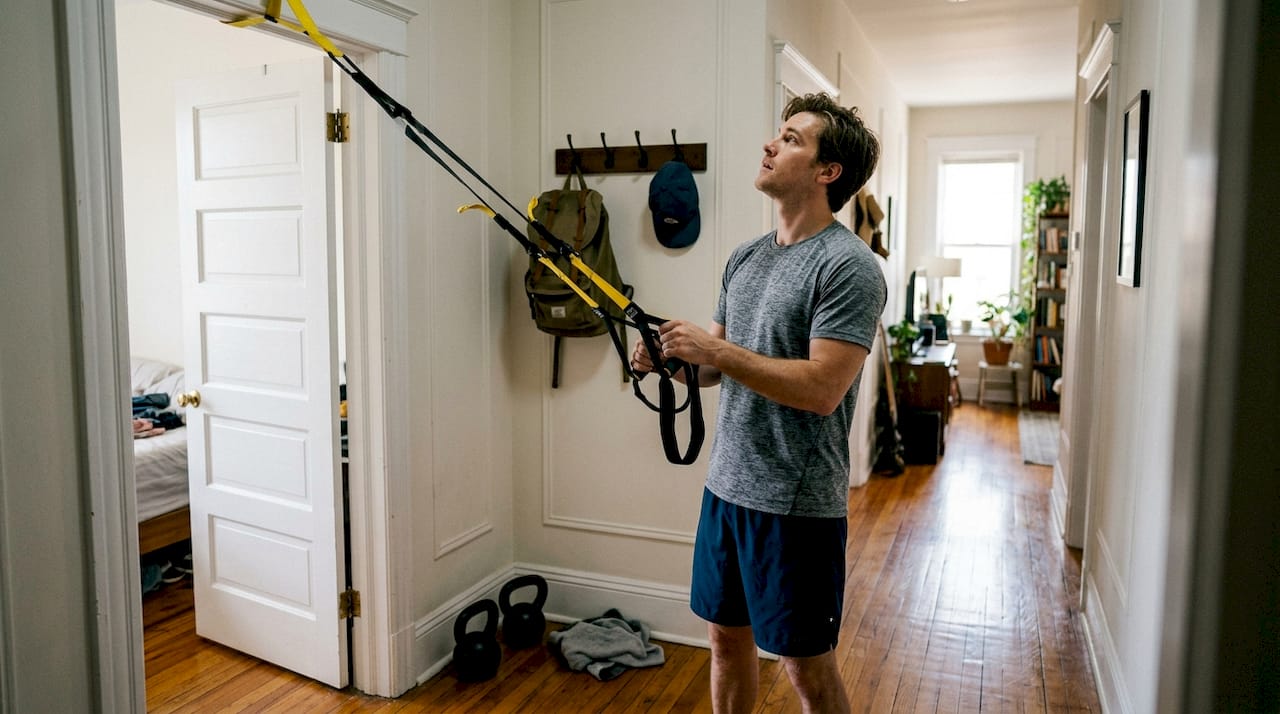
Kettlebells add dynamic, functional movement patterns that dumbbells simply can’t replicate as naturally. Swings, Turkish get-ups, and cleans build power, grip strength, and cardiovascular conditioning simultaneously. They’re compact, durable, and last decades.
Power racks and barbells are the gold standard for advanced strength training. If your goal is serious progressive overload in squats, deadlifts, and bench press, a rack is eventually necessary. Expert equipment picks include the REP PR-5000 power rack and Bowflex adjustable dumbbells for serious lifters, alongside kettlebells for functional work.
Smart digital gyms like Tonal use digital resistance and AI coaching to deliver a full strength workout in a wall-mounted unit. The footprint is minimal, but the price is steep. These make sense for people with very limited space and a generous budget.
“Usability beats prestige every time. The fanciest rack in the world won’t help if your ceiling is too low or your schedule too packed to use it.”
Here’s a quick breakdown of advanced options by priority:
- Best for tight spaces: Suspension trainer, kettlebell set, adjustable dumbbells
- Best for serious strength: Power rack, barbell, weight plates
- Best for tech-forward training: Smart gym systems with digital resistance
- Best for functional fitness: Kettlebells, suspension trainer, pull-up bar
If you’re curious about recovery and supplemental tools, ab stimulator comparisons can help round out your routine beyond traditional lifting.
Comparing essentials: What you really need versus nice-to-have gear
With advanced gear covered, here’s how the essentials stack up against luxury extras and how to prioritize for your space and goals.
| Equipment | Cost range | Space needed | Versatility | Best for |
|---|---|---|---|---|
| Resistance bands | $15-$50 | Minimal | Very high | All levels, small spaces |
| Adjustable dumbbells | $150-$400 | Low | Very high | Strength, muscle gain |
| Yoga mat | $20-$80 | Minimal | High | Core, mobility, recovery |
| Adjustable bench | $100-$300 | Medium | High | Strength, chest, shoulders |
| Kettlebells | $30-$150 each | Low-Medium | High | Functional, fat loss |
| Suspension trainer | $50-$200 | Minimal | High | Full body, small spaces |
| Power rack + barbell | $500-$2,000+ | Large | Medium | Advanced strength |
| Smart gym (Tonal etc.) | $3,000+ | Low | Medium | Tech-forward, space-limited |
The ACSM findings from a study of over 30,000 participants confirm that consistency outperforms equipment every time. Bands and bodyweight training produce comparable muscle and strength gains to free weights when volume and effort are matched, roughly 10 sets per muscle group per week. That’s a powerful argument for starting simple.
Here’s how to prioritize based on your specific situation:
- Beginner: Bands, mat, adjustable dumbbells. Skip everything else for now.
- Fat loss focus: Add a jump rope or suspension trainer. Cardio machines are nice-to-have, not essential.
- Muscle gain: Prioritize dumbbells and bench. A rack becomes essential once you’re lifting heavy.
- Small space: Space-saving essentials like bands and suspension trainers are your best friends.
The capsule gym budget advice is clear: a budget under $500 is entirely viable with dumbbells, bands, and a mat. Avoid impulse-buying bulky machines you’ll use twice. Volume and consistency are the real variables that drive results, not the price tag on your equipment.
Why the perfect home gym doesn’t exist—and what matters most
Here’s the uncomfortable truth nobody in the fitness equipment industry wants to say out loud: there is no universal gear list that works for every person. Every “must-have” list you read is written by someone with a specific body, specific goals, specific space, and specific habits. Yours are different.
We’ve seen people build impressive physiques with nothing but a pull-up bar, a set of bands, and a mat. We’ve also seen people spend $10,000 on equipment that collects dust within six months. The difference is never the gear. It’s whether the tools match the person’s actual routine and lifestyle.
The real insight from the data is this: a minimal setup used consistently beats an elaborate one used occasionally. Every time. Your job is to match your tools to your habits, not to build the gym you think you should have. Start with what you’ll actually use, then evolve your setup as your strength training mindset and routine mature. Equipment should follow commitment, not precede it.
Equip your home gym for real results
You now have a clear picture of what to buy, what to skip, and how to build a setup that matches your goals and space. The next step is finding gear that actually delivers on quality without overcomplicating your space.
At Armageddon Sports, we stock a curated range of fitness accessories built for real home workouts, including gloves, belts, straps, and recovery tools that complement any equipment list. If you’re ready to upgrade your lifting setup, our lifting gear collection covers everything from wrist wraps to weight belts designed for strength-focused training. Whether you’re building your first home gym or refining an existing one, we’ve got the accessories that make every session more effective.
Frequently asked questions
What is the minimum equipment needed for a home workout?
Adjustable dumbbells, resistance bands, and a yoga mat cover core strength and mobility with minimal space and a modest budget. These three items alone support hundreds of effective exercises.
Do resistance bands and bodyweight exercises build muscle as effectively as free weights?
Yes. Matched volume and effort produce comparable hypertrophy and strength gains whether you use bands, bodyweight, or free weights, according to ACSM data from over 30,000 participants.
How can I build a home gym for less than $500?
Focus on adjustable dumbbells, resistance bands, and a yoga mat, each available under $100 per item. Adding a suspension trainer keeps you well under budget while covering full-body training.
What equipment is best for small spaces?
Suspension trainers, resistance bands, and adjustable dumbbells maximize functionality with the smallest possible footprint, making them ideal for apartments or shared living spaces.
Recommended
- 20 Pieces of Home Workout Equipment You Need in Your Home Gym – Armageddon Sports
- Get the Most from Your Workout: Fitness Gear Essentials – Armageddon Sports
- Top 5 Workout Accessories for Personal Trainers 2026 – Armageddon Sports
- Home workout equipment ideas 2026: save 85% space – Armageddon Sports