
TL;DR:
- Proper fitting and bracing technique are essential for maximum safety and performance.
- Leather belts offer more support for heavy lifts, while nylon belts are more comfortable for dynamic training.
- Use the belt mainly for heavy, maximal lifts to enhance core stability and reduce injury risk.
Picking a weightlifting belt sounds simple until you’re standing in front of a rack of options with no idea whether you need leather or nylon, 4 inches or 6, prong or lever. The wrong choice doesn’t just waste money. It can leave you bracing wrong, lifting less, or worse, getting hurt. Research confirms that belts increase intra-abdominal pressure by up to 40%, which directly stabilizes your spine under load. This guide walks you through exactly how to choose, fit, and use a weightlifting belt so you can lift heavier, stay safer, and stop guessing at the gym.
Table of Contents
- Why use a weightlifting belt?
- Types of weightlifting belts: Which style fits your training?
- Finding the right fit: Sizing and features that matter
- How to use your belt correctly: Placement and techniques
- Biggest mistakes and troubleshooting
- Our take: What most lifters overlook with weightlifting belts
- Find your perfect weightlifting belt at Armageddon Sports
- Frequently asked questions
Key Takeaways
| Point | Details |
|---|---|
| Choose the right type | Match your belt style to your lifting discipline and main exercises. |
| Get the correct fit | Measure your waist and pick the right width and thickness for optimal support. |
| Use your belt wisely | Only wear the belt for heavy lifts and follow proper placement and bracing. |
| Avoid common mistakes | Steer clear of wrong sizing, overuse, and misplacement to maximize safety and results. |
Why use a weightlifting belt?
A weightlifting belt isn’t just a piece of leather you strap on to look serious. It has a real physiological job. When you brace your core against a rigid belt, you dramatically increase intra-abdominal pressure, which acts like an internal air bag around your spine. That pressure reduces shear force on your vertebrae and keeps your torso stable under heavy load.
The numbers back this up. Research shows that belts boost intra-abdominal pressure by 25 to 45%, improving both lift capacity and spinal stability. That’s not a marginal gain. For a lifter squatting 300 pounds, even a small improvement in spinal stability can mean the difference between a clean rep and a tweaked lower back.
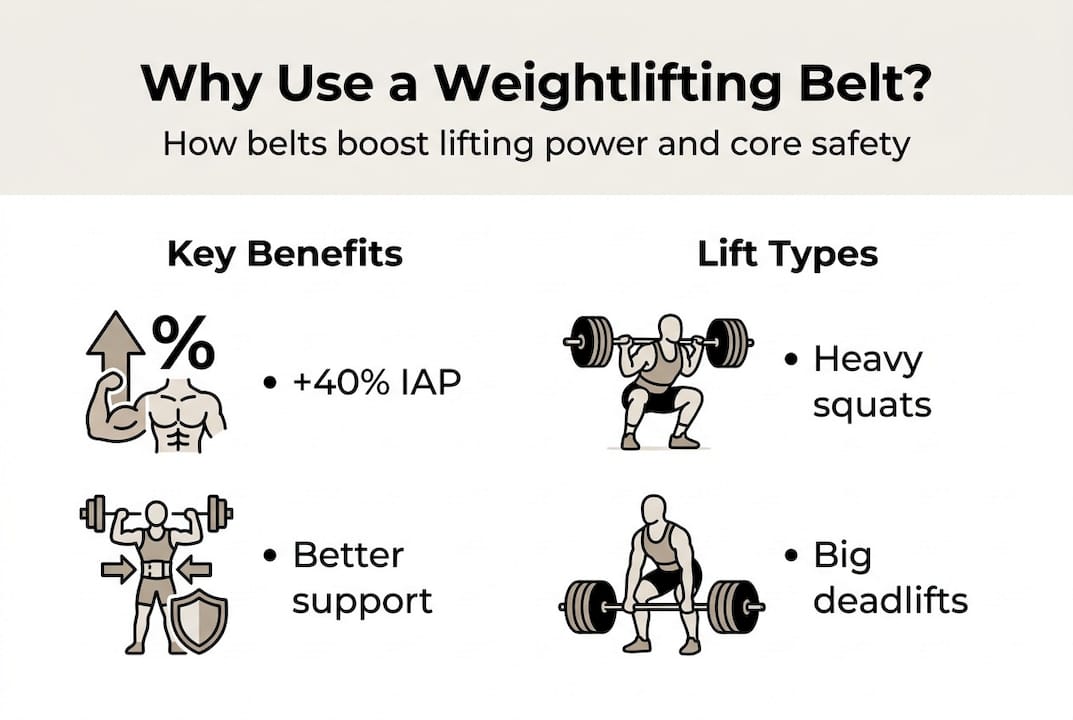
Beyond safety, belts have a direct performance effect. Studies have recorded faster bar speed and greater force output when lifters use a belt during heavy compound movements. You’re not just protecting yourself. You’re actually lifting more weight.
When is a belt most useful?
- Heavy back squats and front squats above 80% of your one-rep max
- Conventional and sumo deadlifts at near-maximal loads
- Romanian deadlifts and good mornings where the lower back is under sustained tension
- Max attempts and competition lifts
- Any set where spinal fatigue is a real concern
Understanding the belt benefits goes a long way toward using one correctly. The belt isn’t doing the work for you. It’s giving your core something to push against, which amplifies the bracing you’re already doing.
“A belt works because you create the pressure. The belt just gives your muscles a wall to push against. Without active bracing, you’re just wearing a fashion accessory.”
If you want a proven starting point, the 6 inch leather belt is a reliable option for most strength athletes. Now that you know why belts matter, let’s break down your options for gear.
Types of weightlifting belts: Which style fits your training?
Not all belts are built the same, and the differences matter more than most people think. Knowing the role of belts, you’ll want to choose the right type for your training.
The three main categories:
- Powerlifting belts: Uniform width all the way around (usually 4 inches), thick leather, stiff as a board. Built for maximum support in squats and deadlifts.
- Olympic weightlifting belts: Wider in the back, tapered in the front. Allows more hip flexion and torso movement for snatches and clean and jerks.
- General fitness belts: Often nylon or neoprene, lighter, more flexible. Good for moderate loads and dynamic movements.
| Belt type | Shape | Rigidity | Closure | Best for |
|---|---|---|---|---|
| Powerlifting | Uniform width | Very stiff | Prong or lever | Squats, deadlifts, max lifts |
| Olympic | Tapered front | Moderate | Prong | Snatches, clean and jerks |
| General fitness | Contoured | Flexible | Velcro or prong | Moderate training, variety |
Research confirms that powerlifting vs Olympic belts differ significantly in rigidity and mobility, and that stiffer belts can shift load toward lower back muscles if used without proper bracing technique.
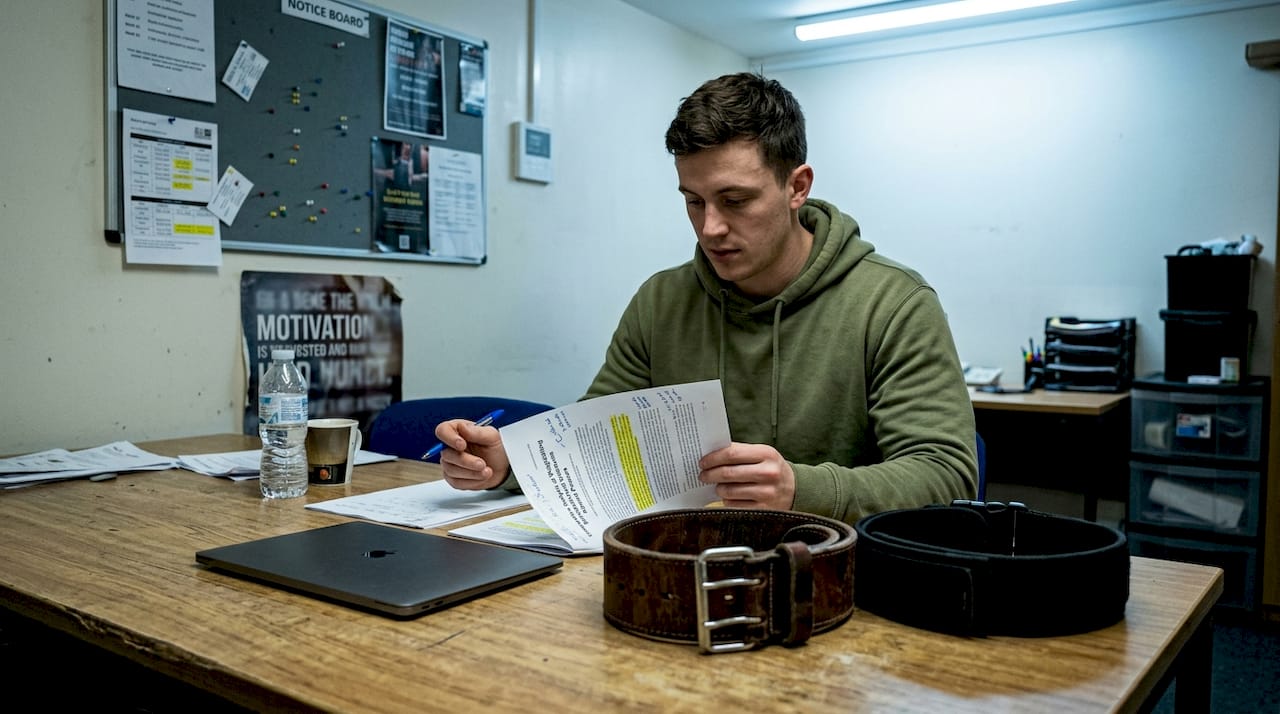
Leather belts outlast nylon by years and provide superior rigidity for heavy lifting. Nylon and neoprene options are more comfortable for all-day wear and better suited to circuit training or lighter sessions. For closures, prong belts are the most common and adjustable. Lever belts lock in fast but require a tool to adjust tightness between sets. Velcro is quick and convenient but wears out faster under serious loads.
Explore your leather belt options if you’re focused on strength sports. For a broader look at what belongs in your gym bag, check out gear essentials for a complete breakdown.
Pro Tip: If your training is mostly squats and deadlifts at heavy weights, go with a stiff leather powerlifting belt. If you do a mix of Olympic lifts and strength work, a tapered belt gives you the flexibility you need without sacrificing support.
Finding the right fit: Sizing and features that matter
Once you understand your belt options, the next step is getting the fit right. A belt that’s too big slides around. A belt that’s too small won’t let you brace properly. Neither one protects you.
How to measure for your belt:
- Wear your typical training clothes (not jeans or thick layers).
- Measure your waist at the level where you’ll actually wear the belt, usually just above your hip bones.
- Compare that measurement to the manufacturer’s sizing chart, not a general clothing size guide.
- If you’re between sizes, go larger for nylon and smaller for leather (leather breaks in over time).
- Test the fit: you should be able to slide two fingers under the belt when it’s buckled but not braced.
Belt width and thickness quick reference:
| Width | Thickness | Best use case |
|---|---|---|
| 3 to 4 inches | 10mm | Olympic lifting, dynamic movements |
| 4 inches | 13mm | Powerlifting, max strength work |
| 6 inches | 10mm | General strength training, back support |
| 6 inches | 13mm | Advanced powerlifters, competition use |
Research shows that the right fit reduces lumbar lordosis and maximizes core engagement during heavy lifts. A poorly fitted belt, regardless of how good the brand is, simply won’t deliver those benefits.
For guidance on how fit affects your safety across all your gear, read through gear fit and safety. If you prefer a contoured design for comfort during longer sessions, the neoprene belt is worth a look.
Pro Tip: Go wider (6 inches) if you have a longer torso or frequently experience lower back fatigue. A contoured belt helps most for lifters with a shorter torso or those who find flat belts dig into their ribs during squats.
How to use your belt correctly: Placement and techniques
Selecting and fitting your belt is just the start. Using it correctly is critical.
Step-by-step belt placement:
- Position the belt so it covers your lower back and sits just above your hip bones.
- Buckle or fasten the closure snugly, but not so tight you can’t take a full breath.
- Take a deep breath into your belly (not your chest), expanding your abdomen outward against the belt.
- Hold that breath and brace your core hard before you initiate the lift.
- Exhale at the top of the movement or between reps, never at the bottom of a heavy squat or pull.
Studies confirm that proper belt placement maintains bar path and reduces lumbar stress during heavy squats. Position matters as much as the belt itself.
Common mistakes to avoid:
- Wearing the belt too high (over the navel) or too low (on the hip bones)
- Cinching it so tight you can’t expand your belly to brace
- Using the belt for warm-up sets and light work where your core should be doing the job alone
- Forgetting to brace at all and just relying on the belt to hold you together
“Overusing your belt on every set, even light ones, trains your body to rely on external support instead of building the core strength that protects you when the belt comes off.”
If you use wrist wraps alongside your belt, the same principle applies: use supportive gear strategically, not habitually.
Pro Tip: Before your first max attempt with a new belt, spend two or three sessions practicing the Valsalva maneuver (big breath, brace, hold) with the belt on during moderate sets. That muscle memory pays off when the weight gets heavy.
Biggest mistakes and troubleshooting
Even the best belts can fall short if misused. Here’s how to avoid frustration.
Research confirms that incorrect belt use can negate performance benefits and actually increase injury risk. That’s a sobering fact worth taking seriously.
Top mistakes lifters make:
- Buying the wrong size because they used their pants size instead of measuring
- Choosing a belt based on looks or price alone, not on training style and load
- Placing the belt incorrectly and wondering why their back still hurts
- Wearing the belt for every single exercise, including bicep curls and cable rows
- Never breaking in a leather belt and then complaining it’s uncomfortable
If you’re experiencing discomfort, start with placement. Move the belt slightly up or down and see if that changes how it feels during the brace. If the belt digs into your ribs, you may need a contoured style. If it slides around, it’s too big. If you can’t breathe properly when braced, it’s too tight.
For performance issues, ask yourself whether you’re actually bracing against the belt or just wearing it. A belt that feels like it’s doing nothing usually means your bracing technique needs work, not that the belt is bad.
For more on how posture and alignment affect your lifting performance, the shoulder posture tips article offers useful context.
Pro Tip: Log your PRs with and without the belt for the same lifts over a 6-week block. If the gap between belted and unbelted numbers is growing, that’s a sign you’re relying on the belt too much and need to build more raw core strength.
Our take: What most lifters overlook with weightlifting belts
Here’s something most belt guides won’t tell you: the belt is the last 5% of the equation, not the first. We see lifters spend serious money on a premium lever belt before they’ve even learned how to brace correctly. The belt amplifies what you bring to it. If your core bracing is weak or your positioning is off, the belt just locks in your bad habits.
The real secret isn’t finding the fanciest belt. It’s learning to create tension without one first, then adding the belt to enhance what’s already there. Fit and education beat flashy features every time.
We also think too many lifters skip the break-in period for leather belts and give up on them too fast. A stiff leather belt feels brutal for the first few weeks. Stick with it. That rigidity is exactly what makes it so effective once it molds to your body.
Check out essential gear choices if you want to build a complete setup around the same philosophy: smart selection, proper use, real results.
Find your perfect weightlifting belt at Armageddon Sports
You’ve done the work of understanding what makes a great belt. Now it’s time to find the one that fits your training, your body, and your goals.
At Armageddon Sports, we carry a curated range of weightlifting belts built for real lifters, from neoprene contoured options for general training to thick leather powerlifting belts for serious strength work. Every product in our lineup is selected with performance and durability in mind. If you’re just starting out or upgrading your setup, our team is here to help you pick the right fit. Browse the full lifting gear selection to find belts, wraps, straps, and everything else you need to train with confidence.
Frequently asked questions
What size weightlifting belt should I get?
Measure your waist at the level you’ll wear the belt and cross-reference that number with the manufacturer’s sizing chart. A proper fit reduces lumbar lordosis and maximizes support, so don’t guess based on your clothing size.
Is a leather or nylon belt better for lifting?
Leather is stiffer and delivers more support for heavy compound lifts, while nylon offers comfort and flexibility for dynamic or varied training. Research highlights that rigidity vs mobility tradeoffs between belt types are real and should match your primary lifts.
Should I wear a belt for every exercise?
No. Reserve the belt for maximal or near-maximal lifts where spinal support is genuinely needed. Studies show that proper belt placement reduces lumbar stress during heavy squats, but overuse limits the core development you need for unbelted lifting.
How tight should my weightlifting belt be?
Tighten it until it feels snug and you can still take a full belly breath and brace outward. Research confirms that the right tightness maximizes core engagement while allowing comfortable bracing. Too tight restricts breathing and kills the technique that makes the belt work.
Recommended
- How to choose weightlifting gear: fit boosts safety 20% – Armageddon Sports
- Types of Weightlifting Gear: 7 Essentials Boosting Performance 40% – Armageddon Sports
- Buy Best Weight Lifting Belts- Armageddon Sports
- Weight Lifting Gym Belt Leather 6 Inch Wide Padded Men and Women Workout Back Support – Armageddon Sports