
Most athletes still stretch the wrong way before workouts. You might think holding a hamstring stretch for 30 seconds prepares your muscles, but research shows this actually reduces power output by up to 5%. Dynamic stretching improves ROMmax without affecting strength, making it the superior choice for pre-workout preparation. Unlike static holds, dynamic stretching uses controlled movements that activate your nervous system, increase joint mobility, and prime your body for peak performance. This guide reveals how to implement dynamic stretching protocols that enhance your warm-up routine and athletic output.
Table of Contents
- Understanding Dynamic Stretching: Definition And Benefits
- Scientific Evidence: How Dynamic Stretching Boosts Performance
- Comparing Dynamic Stretching With Other Stretching Types
- Applying Dynamic Stretching: Protocols And Tips For Athletes
- Get The Best Gear For Your Dynamic Stretching And Workouts
- Frequently Asked Questions
Key takeaways
| Point | Details |
|---|---|
| Dynamic stretching enhances mobility | Controlled active movements increase range of motion without reducing strength or power output. |
| Nervous system activation | Dynamic protocols elevate heart rate and prepare neural pathways for explosive movements. |
| Static stretching reduces power | Pre-activity static holds can decrease neuromuscular control and explosive strength by up to 5%. |
| PNF offers targeted flexibility | Proprioceptive neuromuscular facilitation excels for flexibility gains but works best outside warm-ups. |
| Limited chronic injury prevention | Stretching alone shows minimal impact on long-term injury reduction without comprehensive training. |
Understanding dynamic stretching: definition and benefits
Dynamic stretching involves controlled, active movements that take your muscles and joints through their functional ranges of motion. Unlike static stretching where you hold a position, dynamic stretching keeps you moving. Think leg swings, arm circles, or walking lunges. These movements prepare your body by mimicking the actions you’ll perform during your workout or sport.
The key difference lies in how each method affects your neuromuscular system. Static stretching involves holding a stretched position for 15 to 60 seconds, which can temporarily reduce muscle activation and power. PNF stretching combines passive stretching with isometric contractions, offering excellent flexibility gains but requiring more time and often a partner. Dynamic stretching activates muscles while stretching them, preparing the nervous system for the demands ahead.
Research demonstrates clear advantages for pre-workout preparation. Dynamic stretching improves ROMmax without affecting strength, meaning you gain mobility without sacrificing the explosive power needed for athletic performance. Your nervous system becomes primed, muscle temperature rises, and joint fluid increases, all contributing to better movement quality.
The benefits extend beyond simple flexibility:
- Increased usable range of motion during activity
- Enhanced coordination and movement patterns
- Elevated heart rate for cardiovascular readiness
- Improved muscle elasticity and responsiveness
- Better nervous system preparation for complex movements
Dynamic stretching avoids the performance decrements associated with static holds before activity. When you hold a static stretch, you temporarily reduce the stretch reflex sensitivity and decrease muscle stiffness, which sounds beneficial but actually impairs your ability to generate force quickly. This matters significantly for sports requiring explosive movements like sprinting, jumping, or lifting.
Pro Tip: Select dynamic stretches that closely mimic your sport’s movement patterns. Basketball players benefit from dynamic lunges with rotation, while swimmers should focus on arm swings and torso twists. This specificity maximizes neural preparation and movement readiness.
Scientific evidence: how dynamic stretching boosts performance
Recent research provides compelling data on dynamic stretching’s performance benefits. A 2026 study introduced a novel protocol targeting myofascial chains, revealing that dynamic stretching significantly improved joint mobility across multiple body regions. Participants showed measurable increases in shoulder, hip, and ankle mobility after just one session.

The same investigation found that jump height improved significantly following the dynamic stretching protocol. This matters because vertical jump performance indicates lower body power and explosive strength, both critical for athletic success. Unlike static stretching, which can reduce jump height by 2% to 5%, dynamic protocols enhance these capabilities.
Physiological markers confirm the warm-up effectiveness. Researchers observed that both dynamic and static protocols significantly increased heart rate, but dynamic stretching maintained this elevation while also improving power metrics. Heart rate elevation indicates cardiovascular system engagement, preparing your body for intense activity.
| Metric | Pre-Dynamic Stretching | Post-Dynamic Stretching | Change |
|---|---|---|---|
| Joint Mobility Score | Baseline | +12% to +18% | Significant increase |
| Vertical Jump Height | Baseline | +4% to +7% | Significant increase |
| Heart Rate (bpm) | Resting (~70) | Elevated (~95-105) | Warm-up ready |
| Power Output | Baseline | Maintained or improved | No decrease |
Performance benefits extend to sport-specific abilities. Studies demonstrate that dynamic stretching enhances power, speed, and agility when incorporated into warm-up routines. Athletes performing dynamic protocols before sprint tests showed faster times and better acceleration compared to those using static stretching or no stretching.
The mechanisms behind these improvements involve multiple physiological systems:
- Increased muscle temperature enhancing contraction speed
- Elevated neural drive to working muscles
- Improved muscle-tendon unit compliance
- Enhanced proprioceptive awareness and body control
- Greater recruitment of fast-twitch muscle fibers
These adaptations translate directly to better athletic performance. Whether you’re preparing for a competitive event or a challenging workout, dynamic stretching optimizes your body’s readiness. The combination of mobility gains and maintained power output creates an ideal pre-activity state.
Pro Tip: Combine dynamic stretching with light plyometric exercises during your warm-up. After completing dynamic stretches, add 2 to 3 sets of low-intensity jumps or hops. This progression maximizes neural activation and power development before your main workout.
Comparing dynamic stretching with other stretching types
Understanding when to use each stretching modality optimizes your training outcomes. Static stretching (SS) involves holding a stretched position without movement, typically for 15 to 60 seconds per muscle group. Proprioceptive neuromuscular facilitation (PNF) combines passive stretching with isometric muscle contractions, often requiring a partner or equipment.
| Stretching Type | Primary Benefit | Power Impact | Best Timing | Neuromuscular Effect |
|---|---|---|---|---|
| Dynamic | Mobility + activation | Maintained or improved | Pre-workout/competition | Enhanced control and readiness |
| Static | Flexibility gains | Reduced 2% to 5% | Post-workout/separate session | Temporary control decrease |
| PNF | Maximum flexibility | Variable, context dependent | Dedicated flexibility work | Improved stability and range |
Research reveals important distinctions in how each method affects performance. PNF stretching proves most effective for immediate flexibility enhancement, horizontal power in certain contexts, and postural stability. However, PNF requires more time and technical precision than dynamic stretching, making it less practical for standard warm-ups.
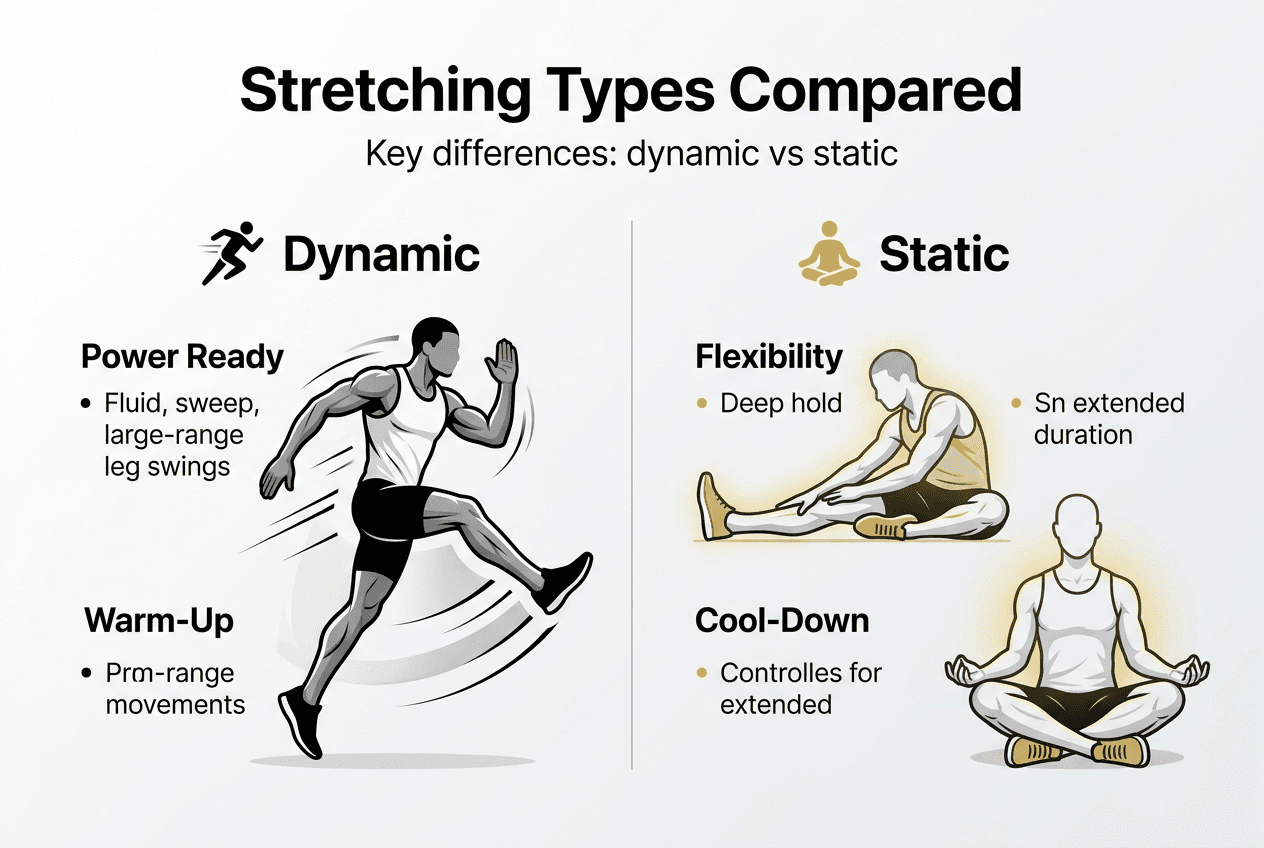
Static stretching presents a trade-off that many athletes overlook. While it effectively increases hamstring and overall flexibility, studies show static stretching may compromise neuromuscular control despite these gains. This reduction in muscle activation and coordination can impair performance in activities requiring quick, powerful movements.
The neuromuscular control issue stems from how static stretching affects the stretch reflex and muscle spindle sensitivity. When you hold a stretch for extended periods, you temporarily reduce the muscle’s protective mechanisms that enable rapid force production. This explains why sprinters and jumpers who perform static stretching before competition often show decreased performance.
Common misconceptions about stretching and injury prevention deserve clarification:
- Stretching alone provides minimal chronic injury prevention benefits
- Pre-activity static stretching does not reduce acute muscle strain risk
- Flexibility without strength creates joint instability
- More stretching does not always mean better performance
- Individual needs vary based on sport, mobility baseline, and training goals
Optimal stretching strategy depends on your immediate goals. Use dynamic stretching before workouts or competitions to maintain power while improving mobility. Reserve static stretching for post-workout cool-downs when flexibility gains won’t compromise performance. Implement PNF during dedicated mobility sessions when you have time for thorough, controlled work.
The performance impact varies significantly based on stretching type and timing. Dynamic protocols prepare your body for action, static methods promote recovery and long-term flexibility, and PNF offers targeted improvements for specific limitations. Understanding these distinctions allows you to structure your training intelligently.
Avoid static stretching immediately before activities requiring explosive power, speed, or maximal strength. Save these holds for after training when muscle relaxation and increased flexibility support recovery without performance penalties. This timing strategy maximizes benefits while minimizing drawbacks.
Applying dynamic stretching: protocols and tips for athletes
Designing an effective dynamic stretching routine requires attention to movement quality, progression, and sport-specific demands. Your protocol should systematically prepare the body regions and movement patterns you’ll use during your main activity. A well-structured routine takes 8 to 12 minutes and elevates your readiness without causing fatigue.
Follow these steps to perform an optimal dynamic stretching routine:
- Start with general mobility movements like arm circles and torso rotations to increase blood flow
- Progress to larger range movements such as leg swings and walking lunges
- Add sport-specific patterns that mimic your activity’s demands
- Gradually increase movement speed and range as your body warms
- Finish with a few explosive movements at submaximal intensity
- Transition directly into your workout or competition within 5 to 10 minutes
The novel protocol that significantly improved joint mobility targeted myofascial chains rather than isolated muscles. This approach recognizes that your body functions through connected tissue networks, not individual parts. Examples include combining hip flexion with thoracic rotation or pairing shoulder mobility with lateral trunk movement.
Effective dynamic stretches for common myofascial chains:
- Walking lunges with overhead reach (targets hip flexors, thoracic spine, shoulders)
- Leg swings forward/back and side to side (prepares hip mobility in multiple planes)
- Arm circles with gradual range increase (activates shoulder complex and upper back)
- Inchworms with push-up (engages posterior chain, shoulders, and core)
- Lateral lunges with torso rotation (mobilizes hips, spine, and improves coordination)
Movement control matters more than range or speed initially. Focus on smooth, controlled motions through your available range. Avoid bouncing or jerky movements, which can trigger protective muscle tension rather than relaxation. As your body temperature rises and joints feel more fluid, gradually increase both speed and range.
Pro Tip: Integrate resistance bands into your dynamic stretching for enhanced muscle activation. Light band tension during movements like lateral walks or arm pulls increases neural drive and stability. This combination improves both mobility and the strength to control new ranges.
Timing and repetition guidelines optimize effectiveness without causing fatigue. Perform each dynamic stretch for 8 to 12 repetitions or 20 to 30 seconds of continuous movement. Complete 1 to 2 sets of your full routine, depending on workout intensity and environmental conditions. Cold weather or early morning sessions may require additional warm-up time.
Common mistakes undermine dynamic stretching benefits. Avoid moving too quickly before your body is ready, which can cause muscle strains. Don’t skip movements for tight or weak areas, even if they feel uncomfortable initially. Resist the urge to hold positions statically during dynamic routines, as this defeats the purpose.
Listen to your body’s feedback and adjust accordingly. Some days you’ll feel mobile and ready quickly, while other times you need extra attention to specific areas. Factors like sleep quality, previous workout intensity, and stress levels all influence your warm-up needs. Flexibility in your approach, while maintaining core principles, yields best results.
Combining dynamic stretching with other warm-up elements creates comprehensive preparation. After your dynamic routine, include plyometric exercises at low to moderate intensity. This progression from mobility to power primes your nervous system for maximal performance during your main workout.
Get the best gear for your dynamic stretching and workouts
Optimizing your warm-up routine extends beyond technique to include the right equipment. Quality gear supports proper form during dynamic stretches and enhances your overall training effectiveness. Whether you’re an athlete preparing for competition or a fitness enthusiast committed to better workouts, having reliable accessories makes a measurable difference.

Armageddon Sports offers comprehensive fitness accessories designed to elevate your warm-up and training sessions. Resistance bands add progressive tension to dynamic movements, increasing muscle activation and control. Mobility tools help you target specific tight areas before transitioning to active stretches.
Protect your hands and improve grip during resistance exercises with premium workout gloves. Better grip means more controlled movements and reduced injury risk during dynamic warm-ups that incorporate equipment. When you progress to strength training, quality weightlifting belts provide essential core support for heavy lifts. Explore the complete collection to find equipment that matches your training goals and supports long-term performance gains.
Frequently asked questions
What exactly qualifies as dynamic stretching?
Dynamic stretching involves controlled, active movements that take muscles and joints through their functional ranges without holding positions. Examples include leg swings, arm circles, walking lunges, and torso rotations performed continuously for 8 to 12 repetitions.
How does dynamic stretching improve performance?
Dynamic protocols increase joint mobility, elevate muscle temperature, activate the nervous system, and enhance coordination without reducing power output. Research shows improvements in jump height, sprint speed, and agility when used during warm-ups.
Is dynamic stretching better than static stretching before sports?
Yes, for pre-activity preparation. Dynamic stretching maintains or improves power output while increasing mobility, whereas static stretching can reduce strength by 2% to 5%. Save static holds for post-workout when performance isn’t immediately required.
Can dynamic stretching help prevent injuries?
Dynamic stretching prepares your body for activity demands and may reduce acute injury risk during that session. However, research shows stretching alone has limited impact on chronic injury prevention without comprehensive strength training and proper technique.
How often should I include dynamic stretching in my workout routine?
Perform dynamic stretching before every workout or athletic activity. The routine takes 8 to 12 minutes and should be completed within 5 to 10 minutes of starting your main training. Consistency builds better movement patterns and readiness over time, complementing plyometric training for complete preparation.
Recommended
- Neck Stretcher Benefits: Relief and Performance Impact – Armageddon Sports
- What is plyometric exercise: improve power and agility – Armageddon Sports
- Speed Leg Bands Running Sprint Kinetic Agility Lateral Resistance Football Mobility – Armageddon Sports
- Muscle Stimulator Devices: Boosting Recovery Safely – Armageddon Sports
- 7 Essential Basketball Warmup Tips for Coaches Worldwide – Hoop Mentality