
Finding ways to make your biceps grow when progress stalls can feel frustrating for intermediate bodybuilders. Preacher curls create superior muscle activation by keeping your upper arms locked in place and forcing your biceps to do all the work. This exercise stands out because it eliminates momentum and lets you target both strength and thickness using specialized equipment found in gyms worldwide. Discover how this focused movement and different tools can help drive your next round of biceps gains while minimizing injury risks.
Table of Contents
- What Is A Preacher Curl Exercise?
- Top Variations And Equipment Options
- How Preacher Curls Promote Biceps Growth
- Common Mistakes And Injury Prevention Tips
- Alternatives To Preacher Curls For Biceps
Key Takeaways
| Point | Details |
|---|---|
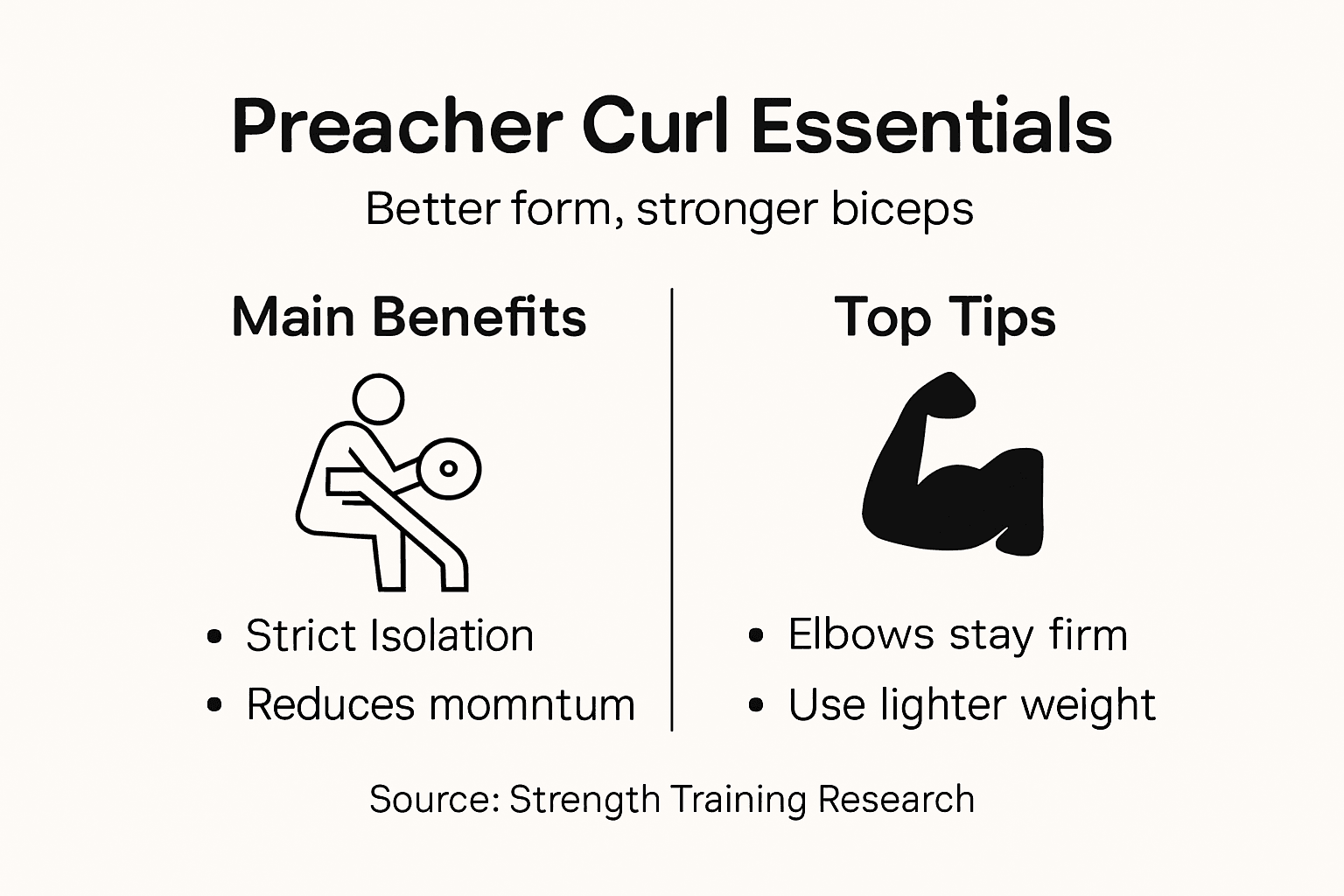
| Targeted Biceps Isolation | Preacher curls are designed to isolate the biceps by stabilizing the upper arms, eliminating momentum. |
| Proper Equipment Choice | Using an EZ curl bar is preferred for wrist comfort, with variations available for targeting specific biceps heads. |
| Emphasis on Controlled Movement | Focus on controlled reps to maximize tension and promote muscle growth while reducing injury risk. |
| Alternative Exercises | Incorporate variations like concentration curls and spider curls to prevent plateaus and enhance overall development. |
What Is a Preacher Curl Exercise?
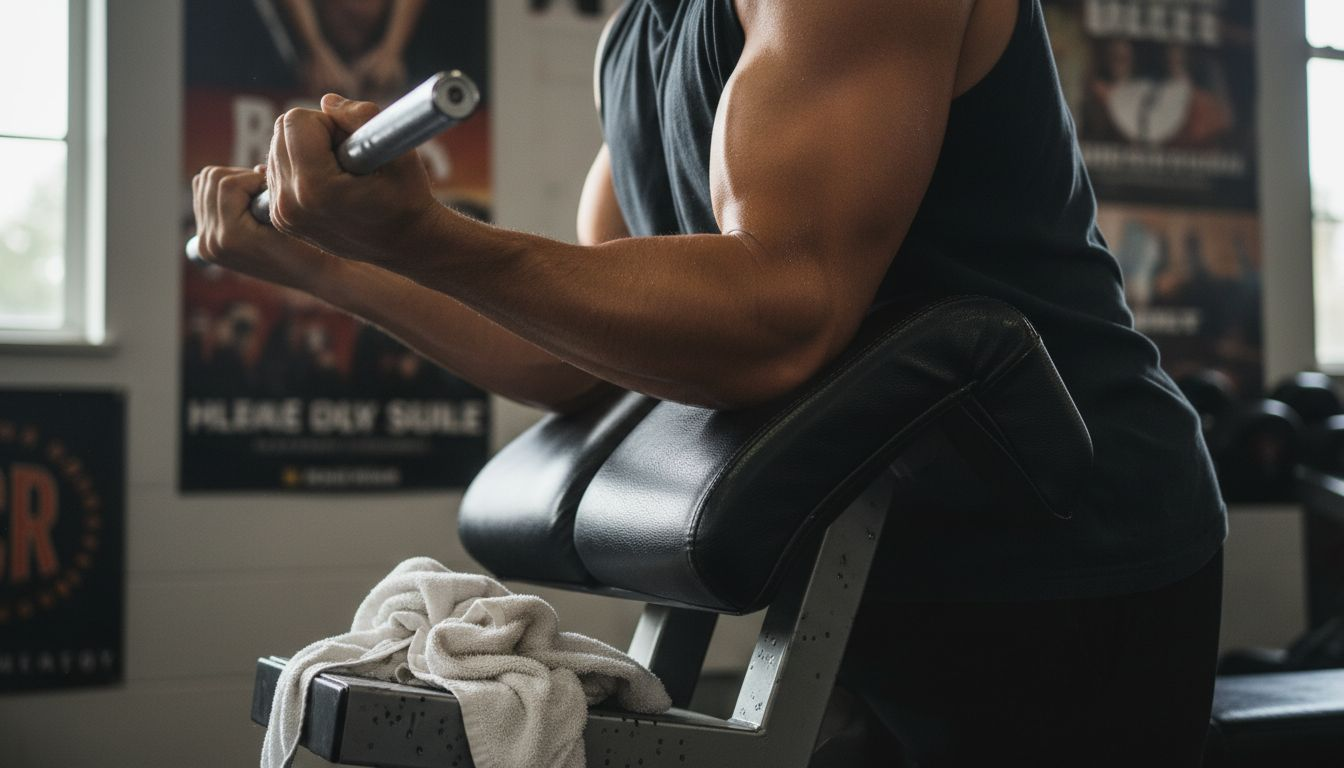
A preacher curl is a targeted biceps isolation exercise that locks your upper arms in place on a specially designed bench. This setup eliminates momentum and body swinging, forcing your biceps to do all the work. Unlike standing curls where your whole body can help, preacher curls demand strict control from start to finish.
The exercise works by fixing your upper arms on an angled bench, which prevents cheating movements. Your arms rest comfortably on the padded surface while you curl the weight upward. This constraint is the real magic—it keeps tension exactly where you want it: your biceps.
How the Preacher Curl Works
Your positioning determines everything in this exercise. Here’s what happens:
- Your upper arms remain stationary against the bench throughout the entire movement
- Your forearms extend downward from the elbow joint
- You curl the weight up by bending only at the elbows
- The range of motion spans from full extension to full contraction
The biceps brachii gets targeted specifically, with emphasis on the short head for added thickness. This is why many intermediate lifters use preacher curls when their biceps plateau with standard curls.
Equipment You’ll Need
The most common setup uses straightforward gear:
- A preacher bench (angled or adjustable)
- An EZ curl bar or straight barbell
- Adjustable dumbbells or fixed weights
- Optional: resistance bands for variations
The EZ curl bar is preferred because its angled grip reduces wrist strain. Your hands naturally rotate inward, protecting your joints while maximizing biceps engagement.
Why This Exercise Stands Out
Preacher curls eliminate variables. You cannot lean back. You cannot swing the weight. You cannot use your legs or back to generate momentum. Every ounce of effort comes from your biceps.
Removing body momentum forces your biceps to work harder, creating superior muscle activation compared to standing curls.
This controlled environment is exactly why intermediate bodybuilders trust preacher curls for breaking through strength plateaus. Your muscles cannot cheat, so they adapt faster and grow more consistently.
The exercise also reduces injury risk by maintaining a stable arm position. Your shoulders and lower back stay protected since they’re not involved in the movement. This makes preacher curls safer for longer training sessions.
Pro tip: Start with lighter weight than you’d use for standing curls—the added isolation means your biceps will fatigue faster, and proper form matters more than heavy loading.
Top Variations and Equipment Options
Preacher curls aren’t one-size-fits-all. Different equipment and bench angles let you target specific biceps heads and adapt to your training goals. Knowing your options helps you build a more complete arm development program.
Equipment Choices That Matter
Equipment options range from preacher benches to machines and free weights, each offering unique advantages. Your choice depends on your experience level, available resources, and training priorities.
- EZ curl bar: Angled grip reduces wrist strain and feels more natural
- Straight barbell: Allows heavier loads and builds maximum strength
- Dumbbells: Enable unilateral training to correct strength imbalances
- Machines: Provide guided motion and consistent resistance throughout
- Cables: Offer continuous tension and smooth resistance curves
The EZ curl bar remains the most popular choice for intermediate lifters. It balances comfort with heavy loading, making it ideal for sustained progress.
Here’s a quick comparison of preacher curl equipment variations and their main benefits:
| Equipment Type | Major Benefit | Typical User |
|---|---|---|
| EZ Curl Bar | Reduces wrist strain | Intermediate lifter |
| Straight Barbell | Enables heavy loading | Advanced lifter |
| Dumbbells | Corrects imbalances | All levels |
| Machine | Offers guided motion | Beginners |
| Cable | Provides constant tension | Intermediate/Advanced |
Bench Angle Adjustments
Your bench position changes which biceps head receives emphasis. This is crucial for complete development.
Higher incline angles target the short head of the biceps more intensely. Lower angles shift focus toward the long head. Many lifters rotate between angles during their training week to hit all muscle fibers.
Adjustable preacher benches let you modify the angle, meaning one piece of equipment works for multiple training goals.
Flat benches work differently than inclined ones. They change your leverage point and range of motion slightly. Experimenting with different angles prevents plateaus and keeps muscles responding.
Machine-Assisted vs. Free Weight Variations
Machine preacher curls offer consistent guidance and support. Your body follows a fixed path, which is helpful for building foundational strength. Machines also work well when you’re fatigued and need stability.
Free weights demand more stabilizer activation. Your core, shoulders, and smaller muscles engage to keep the weight controlled. This builds greater overall strength but requires more focus on form.
Beginners often start with machines. Advanced lifters mix both approaches. Intermediate lifters benefit from primarily using free weights while occasionally using machines for intensity variation.
Building Your Equipment Arsenal
You don’t need everything. Start with these essentials:
- One adjustable preacher bench
- An EZ curl bar
- Dumbbells in 3-5 weight increments
This trio covers nearly every preacher curl variation. Add machines or cables later as your gym access and budget allow.
Pro tip: Test different angles and equipment at your gym before buying—your preferences may differ from what videos suggest, and hands-on experience reveals what works best for your body.
How Preacher Curls Promote Biceps Growth
Preacher curls trigger biceps growth through a mechanism that standing curls simply cannot match. The fixed arm position creates an environment where your muscle fibers experience sustained tension with zero momentum assistance. This forces your biceps to work harder throughout every repetition.
When you curl on a preacher bench, your upper arms stay pinned against the pad. This eliminates body English and forces the biceps brachii to handle 100 percent of the load. Unlike barbell curls where your back and shoulders can help, preacher curls demand complete biceps responsibility.
The Science Behind Growth
Preacher curls increase thickness specifically in the distal part of the elbow flexors, including the biceps itself. This targeted growth happens because the exercise follows the principle of specificity.
Specificity means your muscles adapt exactly to the demands you place on them. Preacher curls demand isolated biceps work, so your biceps respond by growing thicker and stronger. Your body doesn’t waste resources strengthening stabilizer muscles because they aren’t being taxed.
This focused approach produces dramatic thickness gains compared to compound movements. Your biceps grow where they matter most for arm aesthetics.
How Tension Creates Growth
Muscle growth requires three things: mechanical tension, muscle damage, and metabolic stress. Preacher curls deliver all three efficiently.
- Mechanical tension: Heavy loads crush your muscle fibers under continuous stress
- Muscle damage: The controlled eccentric phase creates micro-tears that rebuild stronger
- Metabolic stress: Constant tension traps metabolites in your biceps, signaling growth
The locked-arm position maximizes tension throughout the entire range of motion. Your biceps cannot rest at the top of the movement like they can during standing curls. Every inch of the rep demands active contraction.
Fixed arm positioning ensures your biceps bear the entire load with zero compensation from other muscles.
This creates superior hypertrophy stimulus compared to exercises allowing body movement. Your biceps have nowhere to hide and nothing to lean on.
Strength Gains Drive Size
Strength and size follow each other closely. As you get stronger on preacher curls, your muscles grow to support that strength. Progressive overload on the preacher bench directly translates to visible arm development.
Intermediate lifters typically add 5 to 10 pounds to their preacher curl lift every 4 to 6 weeks when training consistently. That progressive tension increase triggers steady muscle growth. Your biceps adapt to handle heavier loads by adding tissue.
Pro tip: Track your preacher curl weight weekly and focus on adding even one extra repetition per session—this progressive tension increase is what separates lifters who grow from those who stall.
Common Mistakes and Injury Prevention Tips
Preacher curls are safer than many exercises, but mistakes happen. The most dangerous error is loading too much weight and sacrificing form to move it. This single habit causes more injuries than all other preacher curl mistakes combined.
When you use excessive weight, your body instinctively recruits help from shoulders and back muscles. Your elbows also shift position to gain leverage. These compensation patterns transform an isolation exercise into a partial-range movement that stresses your joints instead of building biceps.
The Most Common Form Breakdowns
Common preacher curl mistakes include improper elbow and wrist positioning, body swinging, and neglecting the eccentric phase. Each of these reduces biceps activation while increasing injury risk.
Specific errors to avoid:
- Allowing elbows to flare outward: Keeps them directly below shoulders at all times
- Bending wrists forward or backward: Maintain neutral wrist alignment throughout
- Rushing the lowering phase: Spend 2-3 seconds on the descent
- Moving your upper arms off the pad: Keep chest and arms locked in position
- Using momentum at the bottom: Control the weight, don’t bounce it
Your wrists deserve special attention. Bending them during curls transfers stress from biceps to small wrist tendons. These tendons don’t handle heavy loads well and develop tendinitis easily.
Bench Setup Matters for Injury Prevention
Proper bench height adjustment prevents shoulder strain. Your upper arms should rest completely on the pad with elbows roughly at a 90-degree angle at the bottom position. Too-high benches compress shoulders. Too-low benches force wrists to bend unnaturally.
Your chest should maintain light contact with the bench throughout every rep. This contact point signals that you’re maintaining proper positioning. If your torso pulls away, your form is breaking down.
Recovery and Joint Protection
Controlled tempo and proper warm-up are non-negotiable for preventing strains and tendon injuries.
Warm up with light weights before your working sets. Perform 15-20 repetitions with 40 percent of your working weight. This primes your joints and connective tissue without accumulating fatigue.
Perform reps at a steady 2-1-2 tempo: two seconds up, one second pause, two seconds down. This eliminates momentum and builds protective strength in your tendons. Slow, controlled reps feel harder but protect your long-term joint health.
Rest at least 48 hours between heavy preacher curl sessions. Your biceps recover quickly, but tendons adapt slowly. Overtraining them leads to chronic elbow and wrist problems that sideline lifters for months.
Pro tip: If your elbows or wrists hurt during preacher curls, reduce weight by 30 percent and focus on perfect form for two weeks—pain often signals compensation patterns rather than weakness.
Alternatives to Preacher Curls for Biceps
Preacher curls are outstanding for biceps growth, but they’re not your only option. Sometimes you lack access to a preacher bench, or your elbows need a break from that specific angle. Having reliable alternatives keeps your training consistent regardless of circumstances.
Effective alternatives include concentration curls, spider curls, incline dumbbell curls, hammer curls, and reverse curls, each providing similar isolation benefits through different movement patterns. These exercises prevent momentum and improve mind-muscle connection just like preacher curls do.
Top Alternatives for Maximum Isolation
Concentration curls demand zero equipment beyond a dumbbell. Sit on a bench with your elbow braced against your inner thigh, then curl the weight upward. Your leg provides the same support a preacher bench does, eliminating all body movement.
Spider curls use a bench set to an incline angle. You straddle the bench with your chest against the backrest, keeping your arms extended below you. This position eliminates momentum even more completely than standard preacher curls because gravity pulls straight downward.
Incline dumbbell curls position you on an inclined bench lying backward. Your arms hang naturally, and dumbbells provide an excellent range of motion. This variation hits the biceps from a different angle, promoting more complete muscle development.
Choosing Based on Your Situation
Your choice depends on available equipment and training goals:
- Home gym: Concentration curls require only one dumbbell
- Limited mobility: Hammer curls feel easier on wrists than straight-bar movements
- Building thickness: Spider curls create intense biceps pump
- Maximum range: Incline dumbbell curls extend the stretch phase
- Grip variety: Reverse curls shift emphasis to the brachialis muscle
Reverse curls deserve special attention. They target the brachialis muscle beneath your biceps. Building the brachialis pushes your biceps outward, creating bigger-looking arms overall.
Building a Complete Rotation
Rotating between different isolation exercises prevents adaptation plateaus while distributing joint stress across varied movement patterns.
Instead of doing preacher curls every biceps workout, rotate between three variations. Train preacher curls for 4 weeks, then switch to concentration curls for 4 weeks, then incline dumbbells. Your muscles respond to the novelty, and your joints stay healthier from varied loading angles.
This rotation approach works especially well for intermediate lifters. You avoid boredom while continuously challenging your muscles in new ways. Progress doesn’t stall because each variation recruits slightly different muscle fibers.
Combine any of these with compound pulling movements like barbell rows or pull-ups. The combination of compound and isolation work creates superior overall arm development compared to isolation exercises alone.
The following table summarizes biceps isolation curl alternatives and the muscle areas they emphasize:
| Exercise Variation | Main Emphasis | Equipment Needed |
|---|---|---|
| Preacher Curl | Distal biceps thickness | Bench and bar/dumbbell |
| Concentration Curl | Mind-muscle connection | Dumbbell only |
| Spider Curl | Intense biceps pump | Incline bench, weights |
| Incline Dumbbell Curl | Stretch and range | Incline bench, dumbbells |
| Hammer Curl | Brachialis strength | Dumbbell or band |
| Reverse Curl | Brachialis + forearms | Barbell or dumbbell |
Pro tip: Use concentration curls as your warm-up before heavier preacher curl sessions—the light dumbbell and focused contraction prepare your biceps without accumulating fatigue.
Elevate Your Preacher Curl Gains with Premium Fitness Gear
Struggling to break through biceps plateaus despite disciplined preacher curl routines The article highlights crucial challenges like maintaining perfect form, controlling wrist strain, and managing progressive overload to unlock superior muscle growth. These are the exact pain points every intermediate lifter faces when aiming for maximum biceps thickness and injury-free workouts. To conquer these obstacles your equipment must support precise positioning and consistent tension while protecting your joints.
Armageddon Sports offers a tailored selection of weightlifting gear and accessories designed to enhance your preacher curl performance and safeguard your wrists and elbows. From durable EZ curl bars that reduce joint strain to adjustable benches that allow perfect arm placement Armageddon Sports empowers you to train harder and smarter. Dont let improper equipment stall your progress or increase injury risk Shop now at Armageddon Sports and experience focused biceps training with confidence. Maximize your preacher curl results today with trusted fitness gear that drives strength, thickness, and lasting gains. Explore our range at https://armageddonsports.com and invest in your strongest arms yet.
Frequently Asked Questions
What is the primary benefit of doing preacher curls?
Preacher curls are designed to isolate the biceps, eliminating body momentum and forces your biceps to do all the work, promoting superior muscle activation and growth compared to standard curls.
Can preacher curls help me break through a biceps plateau?
Yes, preacher curls are often used by intermediate lifters to overcome strength plateaus because they demand strict form and isolate the biceps, stimulating muscle growth effectively.
What equipment do I need for preacher curls?
To perform preacher curls, you’ll need a preacher bench, an EZ curl bar or straight barbell, and optionally, dumbbells or resistance bands for variations.
How can I prevent injury while performing preacher curls?
To avoid injury, focus on maintaining proper form by keeping your elbows steady, avoiding excessive weight, and controlling the tempo of each rep. Additionally, warm up properly before starting your workout.
Recommended
- Arm Blaster Bicep: Boost Curl Strength Safely – Armageddon Sports
- Best Arm Blaster Biceps Curl Support Bicep Isolator Bar Bomber Arnold Machine – Armageddon Sports
- Forearm Workout Guide for Maximum Grip and Muscle Growth – Armageddon Sports
- What Is Hypertrophy and Why It Matters for Muscle Growth – Armageddon Sports